The Need for Business Finance (Cambridge International IGCSE Business)
Start-up capital
- All businesses need finance to get started, allow them to grow, to fund capital investments and their continuing activity
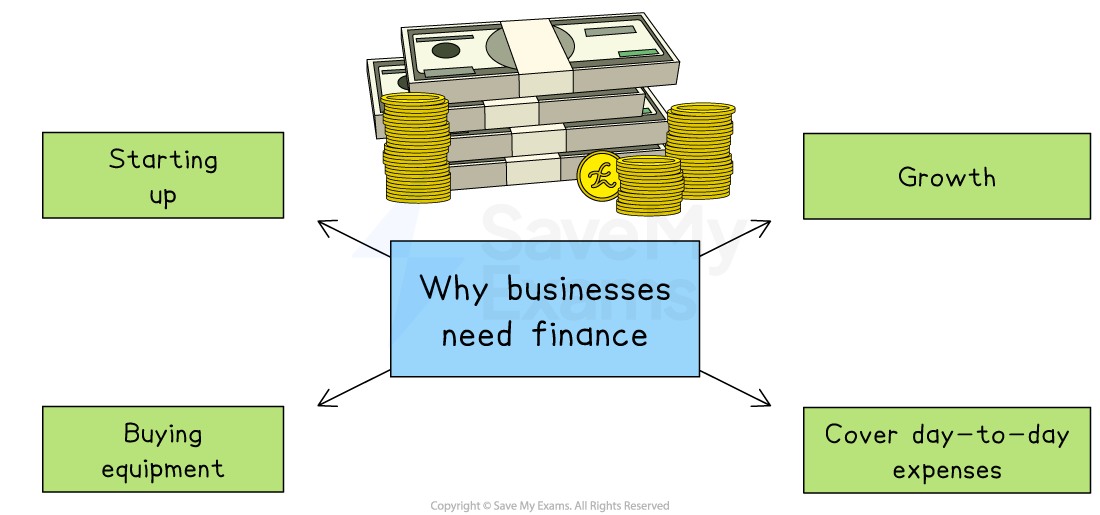
Diagram showing reasons why businesses need finance: starting up, buying equipment, growth, and covering day-to-day expenses.
- Start-up capital is the finance needed by a new business to pay for fixed assets and current assets before it can begin trading
- A business usually estimates the amount of start-up capital they need in the business plan
- Many small new businesses will get a start-up loan to cover these initial costs
Case Study Lily’s Local – Starting Up a Retail Clothing Shop
Lily plans to open a small clothing shop called Lily’s Local in a busy town centre. She will sell affordable fashion aimed at teenagers and young adults.
- Before she can open her doors to customers, Lily lists her start-up costs
Start-up costs for Lily’s Local
Type of cost Explanation Premises - Lily will need to pay a deposit and rent in advance for the shop unit Shop fittings - She must install shelves, rails, mirrors, a counter and changing rooms Stock - Initial clothing items must be bought in bulk from suppliers Insurance - Cover for **theft, fire, public liability and damage to stock or property Marketing and signage - Lily will pay for shop signs, flyers, social media adverts and a basic website Technology - A point-of-sale (POS) system, card reader and, possibly, a small computer Staff costs - If hiring part-time help, she will need to** pay wages and cover training Utilities connection - Setting up electricity, water, internet and phone lines Legal and professional fees - One-time payments for legal advice, setting up a business bank account or using an accountant
Lily’s start-up costs include both one-off payments (like fittings and licences) and pre-payments (like rent and stock)
- Planning these carefully is vital to avoid running out of cash before the shop opens
Once she begins trading, ongoing costs like rent, wages and restocking will become part of her regular operating expenses

Capital for growth
-
As a business grows more finance may be needed for capital expenditure
- It may require more equipment, buildings, IT equipment or vehicles, which will allow the business to increase output
-
If a business wants to grow by developing a new product, it will need to spend large amounts of capital on research and development (R&D)
-
For example. Apple's annual research and development expenses for 2023 were $29.915 billion
- This represented a 13.96% increase from 2022, with investments in artificial intelligence (AI) and innovation of new products
-
Finance to replace fixed assets and invest in new technology
-
Businesses need finance not just to buy new things, but also to keep their operations up-to-date
-
Fixed assets like machinery, vehicles, or equipment wear out or become outdated over time
-
If they are not replaced
- Production may slow down
- Maintenance costs may increase
- Products may become lower quality
-
Replacing old assets helps the business stay efficient and avoid delays
-
However, fixed assets are expensive, so businesses often need loans or use leasing to afford them.
-
-
Technology changes quickly, so businesses need to invest regularly in
- Modern software (e.g. for accounts or sales)
- Improved machines (e.g. faster or more accurate equipment)
- Digital tools (e.g. online payment systems or apps)
Working capital
Spec point — definition and calculation of working capital
-
Working capital is the money used in the day-to-day operations of a business
- Finance is required for working capital, which is spending on raw materials, wages or utilities
-
Having a steady flow of working capital is essential to keep the business operational
- Without working capital, the business would be unable to cover its day-to-day expenses
- It may suffer cash-flow problems* which could lead to business failure
Exam Hint Be specific when explaining why finance is needed – link it to clear purposes such as start-up capital, working capital, or expansion, rather than just saying “to run the business”
Short-term and long-term finance needs
-
Short-term finance needs last less than one year
-
Examples include
- Paying for stock or raw materials
- Paying wages and utility bills
- Covering temporary cash flow problems
- Paying suppliers or rent
- Unexpected repairs or inexpensive items of equipment
-
-
Long-term finance needs last for more than one year
-
Examples include
- Buying buildings, machinery or vehicles
- Starting a new business
- Expanding into new markets or countries
- Developing new products
- Replacing outdated equipment or technology
-
Was this revision note helpful?
Build on this topic