Why Communication is Important (Cambridge International IGCSE Business)
The importance of communication
- Communication is the successful transfer of messages between sender(s) and receiver(s)
The communication process
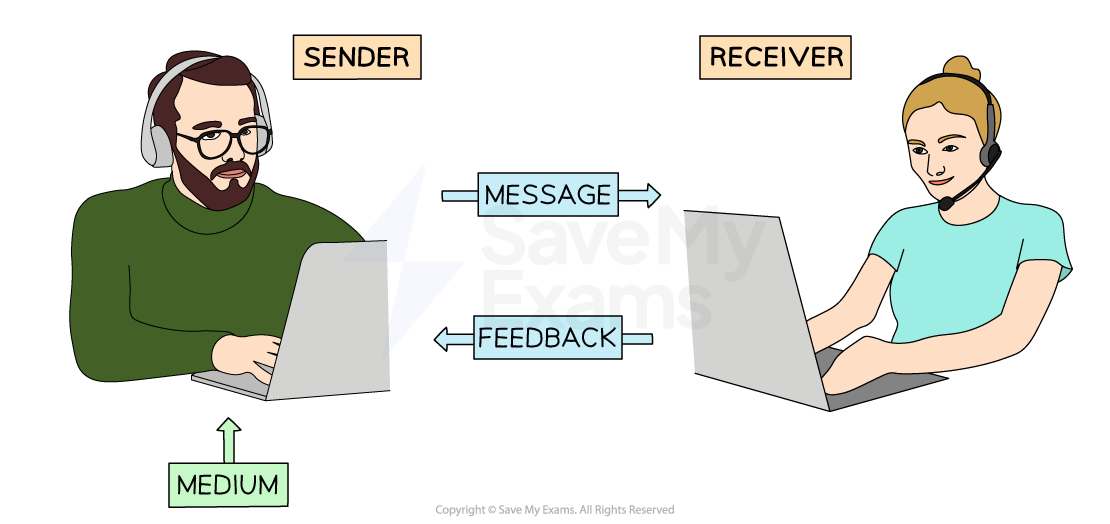
A sender passes the information to the receiver using a medium of communication such as email
-
Effective communication should be
- Clear and unambiguous
- Appropriate to the context and to the sender
- Sent to the correct receiver in an accessible format
- Timely and contain only the required amount of detail
-
Managers should make sure that communication is organised and controlled to ensure that a suitable level of communication exists between key stakeholders
- A 2021 survey of US workers found that more than one-third reported email overload that might lead them to resign from their jobs
Benefits of effective communication
- Helps managers and employees to minimise mistakes
- Supports everyone involved in a business to understand their role and know what is expected of them
- Ensures that the business's values and objectives are clear
- Provides customers with the information they need to understand goods and services
- Minimises business costs
- Helps businesses to effectively exploit new opportunities
Methods of communication
Spec point — "methods of communication, e.g. meetings (face-to-face or virtual), email, text messages, social media, phone calls (including mobile calls), letters, posters and noticeboards advantages and disadvantages of different methods of communication"
Methods of communication
- Businesses have a range of ways to organise communication, both within the organisation and with external stakeholders
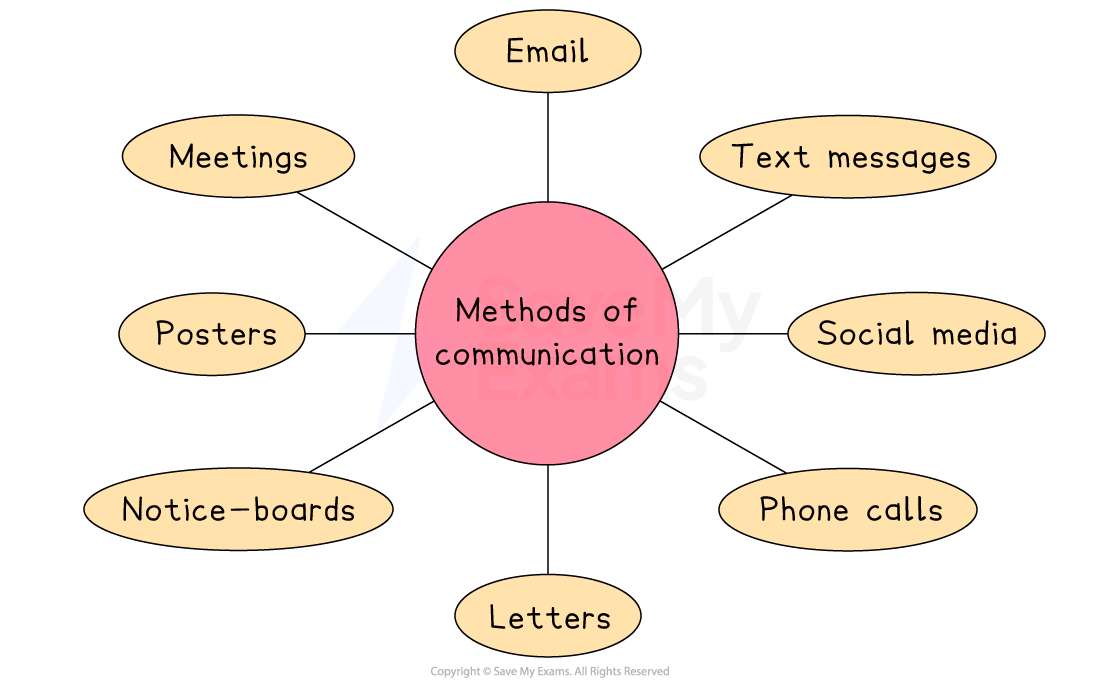
Methods of communication include meetings, text messages and phone calls
1. Meetings
-
Meetings are discussions that take place either in person or through video calls
-
They are useful when detailed conversations are needed or when team collaboration is important
- For example, a manager might hold a virtual meeting with department heads to plan for a product launch
Advantages and disadvantages of meetings
| Advantages | Disadvantages |
|---|---|
| - Meetings are effective for discussing complex issues where feedback is needed quickly | - Meetings can take a lot of time to organise and attend, reducing productivity |
| - Face-to-face or virtual meetings allow body language and tone to be observed for clearer communication | - Virtual meetings may be affected by poor internet connection or technical issues |
2. Email
-
Emails are written messages sent electronically over the internet to one or more people
-
They are useful for sharing documents, giving instructions or contacting external stakeholders like suppliers or customers
- For example, a sales manager may email a customer with an invoice and delivery confirmation
Advantages and disadvantages of email
| Advantages | Disadvantages |
|---|---|
| - Emails are fast and inexpensive to send to one or many recipients | - Some people may ignore emails or miss them if they go to a junk folder |
| - They provide a written record of communication that can be referred to later | - Messages can be misunderstood due to lack of tone or body language |
3. Text messages
-
Text messages are short, written communications sent by mobile phone
-
They are useful for urgent reminders or updates where a quick response is needed
- For example, a supervisor might text an employee to remind them about a last-minute shift change
Advantages and disadvantages of text messages
| Advantages | Disadvantages |
|---|---|
| - Text messages are quick to send and receive, especially for urgent communication | - Text messages are limited in length and not suitable for detailed or formal messages |
| - They are useful when internet access is not available | - Some people may view texts as unprofessional in a business setting |
4. Social media
-
Social media platforms like Facebook, Instagram, and X allow businesses to communicate with the public or with specific groups
-
They are useful for marketing, brand updates, and responding to customer questions and feedback
- For example, a clothing brand might post product updates and special offers on Instagram to attract customers
Advantages and disadvantages of social media
| Advantages | Disadvantages |
|---|---|
| - Social media allows businesses to reach a large audience quickly and interact with followers | - Negative comments or public complaints can damage the brand’s reputation |
| - It encourages two-way communication and can build strong customer relationships | - Not all stakeholders use social media or check it regularly |
5. Phone calls
-
Phone calls allow two or more people to speak directly using a landline or mobile phone
-
They are useful for quick decision-making or when immediate clarification is needed
- For example, a supplier may call the purchasing manager to confirm an urgent order
Advantages and disadvantages of phone calls
| Advantages | Disadvantages |
|---|---|
| - Phone calls allow fast, two-way communication that can clear up confusion quickly | - There is no written record unless the conversation is written down afterwards |
| - Speaking directly can help build stronger relationships and reduce misunderstandings | - Phone calls can interrupt the receiver and may not always be convenient |
6. Letters
-
Letters are written documents usually printed and delivered by post or hand
-
They are used for formal communication or when a permanent, signed record is needed
- For example, a company may send a job offer or contract to a new employee by letter
Advantages and disadvantages of letters
| Advantages | Disadvantages |
|---|---|
| - Letters are formal and professional, which helps when dealing with serious or legal matters | - Letters are slower to send and receive compared to electronic communication |
| - They provide a physical copy that can be kept as proof | - Printing and postage costs make letters more expensive than emails or texts |
7. Posters
-
Posters are printed signs or notices placed in visible areas such as staff rooms, canteens or shop floors
-
They are best for sharing key messages that need to be seen often, like health and safety reminders
- For example, a poster in a factory might remind workers to wear safety goggles
Advantages and disadvantages of posters
| Advantages | Disadvantages |
|---|---|
| - Posters are eye-catching and placed where many people can easily see them | - People may ignore posters if they see them every day or if the message is unclear |
| - They are useful for sharing basic or repeated messages like reminders | - Posters are not suitable for private or complex information |
8. Noticeboards
-
Noticeboards are boards found in workplaces where printed messages, rotas or announcements can be pinned up
-
They are useful for displaying long-term or regularly updated information such as shift timetables or company news
- For example, a restaurant might use a noticeboard to show the weekly staff schedule
Advantages and disadvantages of noticeboards
| Advantages | Disadvantages |
|---|---|
| - Noticeboards are a good way to display shared information in one central place | - Employees may forget to check them regularly, so messages can be missed |
| - They are useful for displaying updates that people can return to as needed | - Only workers who are physically at the location can view the information posted |
Internal and external communication
-
Internal communication is the exchange of message(s) between two or more members of the same organisation
- For example, telephone call between a sales manager and a finance team member
-
External communication is the exchange of message(s) between an organisation and external stakeholders such as customers, suppliers or investors
- For example, sending an online order form to a supplier
Recommending communication methods
Spec point — recommend and justify which method of communication to use in a given situation
-
Businesses are likely to develop their communication methods and style over time
- Smaller business may only be able to afford to communicate with customers through posters, leaflets and social media
- Larger businesses are likely to have greater budgets, which allow for the use of television and billboard promotional campaigns
Factors that influence the choice of communication method
| Factor | Explanation | Example |
|---|---|---|
| Cost | - Some methods are low-cost, while others are expensive but may reach more people | - A product recall could be shared through social media (cheap) or newspapers (expensive but wider reach) |
| Speed | - Urgent messages require fast delivery | - A cancelled meeting is best communicated by phone, not letter |
| Receiver | - Depends on the number and type of people receiving the message | - A group email can reach all 300 staff, unlike a noticeboard that may be ignored |
| Leadership style | - Communication style depends on how the leader involves staff | - A democratic leader may hold a meeting, while an autocratic one may send written notices |
| Message details | - Technical or detailed messages may need written formats | - Revenue figures can be emailed or added to a shared folder for staff to view |
| Need for a record | - Formal or important messages may need to be stored | - An order form creates a permanent record, unlike a phone call |
| Feedback | - Two-way communication is needed for quick decisions | - Verbal discussion helps colleagues act fast, unlike a delayed text message |
Case Study Communicating Effectively at Fresh Bite Foods
Fresh Bite Foods is a Canadian healthy snack manufacturer with around 100 employees. The business sells its products through retailers and its own online store.
Communication problems
- Fresh Bite used to rely on noticeboards to share updates like shift changes and health and safety rules
- However, many employees missed important messages
- Additionally, customer complaints and questions were handled only by email, which led to delays and frustration
Solutions
- The business introduced email and a staff messaging app to send updates directly to employees’ phones
- For urgent issues like machinery problems, managers use face-to-face conversations or phone calls
- This helped reduce lateness and confusion on the shop floor
- Fresh Bite also added a live chat feature on its website and trained customer service staff to respond quickly and clearly
- This made it easier for customers to ask questions and get fast support
- As a result, customer satisfaction and reviews improved
Exam Hint Don’t just say “communication is important” – show the consequences of poor communication, such as mistakes, delays, or demotivated employees. Examiners look for this cause-and-effect link
Was this revision note helpful?
Build on this topic