Methods of Motivation (Cambridge International IGCSE Business)
Financial methods of motivation
Spec point — "e.g. time-based, piece-rate, salary, bonus, commission, profit sharing, fringe benefits"
Financial methods of motivation
-
Financial incentives are rewards or payments given to employees in return for their labour or improved performance
-
The different theories of human motivation offer varying perspectives on the role of money in motivating staff
-
Herzberg's theory says that money is not generally a motivator, but the lack of it leads to dissatisfaction
-
Maslow's theory suggests people move through levels of needs that motivate them
- Lower-order needs are closely linked to financial rewards, whilst higher-order needs are rarely linked to pay
- Physiological and safety needs can be partially met by providing adequate pay
- Love and Belonging needs are often met by encouraging aspects such as teamwork
-
Financial methods of motivation
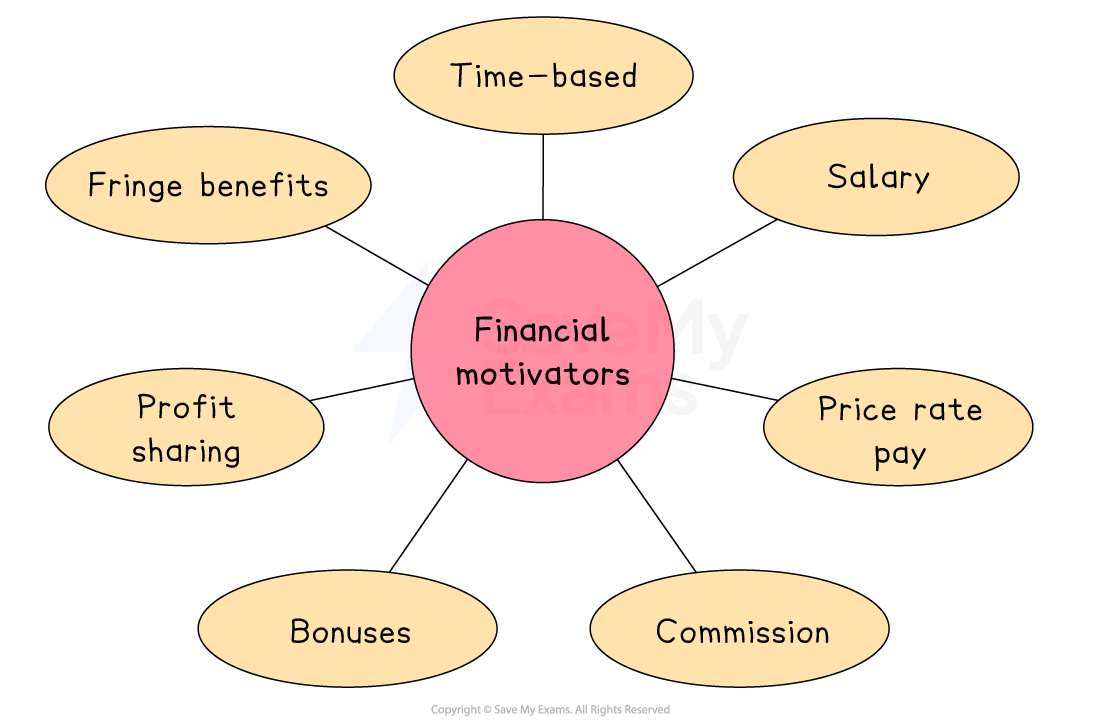
Financial incentives motivate some employees, depending upon the importance that they place on monetary items/money as a reward
| Incentive type | Explanation |
|---|---|
| Time based | - This refers to the **basic wage or salary *that a worker receives for their labour - Employees who work on an hourly rate are paid wages and *accrue *benefits such as annual leave according to the hours they work |
| Salary | - Salaries are paid to full-time staff and usually accompanied by benefits such as a fixed number of days of annual leave |
| Piece rate pay | - Some workers may be paid a** piece rate **according to how many items they produce or sell |
| Commission | - A percentage of** sales revenue is paid to workers who sell products or services - Commonly used in sales roles and motivates staff to sell more and upsell |
| Bonus | - An additional payment given to staff awarded for achieving specific goals, completing projects on time or exceeding performance targets - The opportunity to earn more money may motivate staff to work harder and achieve better results |
| Profit sharing | - A financial reward where employees receive a share of the business’s profits, often given as an annual payment in addition to their regular salary - Knowing they will benefit directly from the business’s success may encourage staff to work harder, improve performance and stay loyal to the firm |
| Fringe benefits | - These are additional benefits usually offered to salaried employees - Fringe benefits could include the use of a company car, private healthcare or gym membership - Employees can be motivated to work hard in order to keep their job and the associated fringe benefits |
Exam Hint Be careful not to confuse fringe benefits (like company cars or health insurance) with direct pay methods – they are still financial incentives, but given in non-cash form
Non-financial methods of motivation
Spec point — "e.g. job enrichment, job rotation, training, opportunities for promotion, praise, employee of the month"
Non-financial methods of motivation
- Non-financial incentives are rewards that are not directly related to money
- These incentives may be intangible and include methods that lead to recognition, praise, job satisfaction or improved work-life balance
Types of non-financial Incentives
- Praise/employee of the month
- Many workers respond well to praise or to recognition programs inside the workplace.
- Meaningful praise can increase productivity
- Job enrichment
- Involves adding more challenging or meaningful tasks to a job
- Staff feel more motivated and engaged, leading to improved productivity
- Job rotation
- Involves moving staff between broadly similar but varied roles in the business
- Exposes staff to new challenges and experiences, which can increase motivation, understanding and skill
- Teamworking
- Teamwork may involve workers completing tasks together
- Teamwork can increase motivation in the workplace, as each member of staff has a role and a shared goal
- Training
- Involves staff improving or learning new skills and abilities
- This can make employees feel valued, more productive and likely to remain with the business
- Promotion opportunities
- Employees offered promotion will feel recognised, have a higher status and will be given more challenging tasks/responsibilities to perform
- These benefits are closely linked to the views of both Maslow and Herzberg
Recommending motivation methods
Spec point — recommend and justify an appropriate method of motivation for a given situation
- When recommending a method of motivation for employees in a business, managers must recognise that individuals are motivated in different ways
Factors affecting the choice of motivation method
-
The context of the business
- What type of business is it? E.g. manufacturing or sales
- The budget available
- How many workers does the organisation have?
- Does the business currently use any methods of motivation?
- What is the nature of the work carried out by employees on a daily basis?
-
The balance of the compensation package
- Ideally it should include both financial and non-financial
- It should be adaptable and reflect the changing needs of staff
Recommending a method of motivation
Case Study Boosting Morale at ChocoBitz
ChocoBitz is a chocolate biscuit factory where employees worked long shifts on a fast-moving production line
Managers were concerned about poor motivation for several reasons
- The work was repetitive and routine, and employees felt they were not learning new skills or progressing
- Staff regularly complained about low rates of pay
- This made workers feel bored and less engaged in their jobs
- Staff turnover was high and increasing year on year
Solutions
To improve motivation, managers introduced job rotation
- This allowed workers to switch between different tasks on the production line
- This helped them build new skills, stay focused and feel valued
In addition, the business introduced a small performance-based bonus scheme
- Workers who met or exceeded daily production targets received a cash bonus
- This financial reward encouraged employees to stay productive and gave them an extra reason to remain with the company
Was this revision note helpful?
Build on this topic