Multinational Companies (MNCs) (Cambridge International IGCSE Business)
Definition of multinational companies
-
A multinational company (MNC) is a business that is registered in one country but has manufacturing, processing and/or service outlets in many different countries
- For example, Starbucks headquarters are in Washington, USA but they have 32,000 stores in 80 countries
Examples of multinational companies
Well-known multinational businesses include BP, General Electric (GE), McDonalds and FedEx
-
Factors such as globalisation and deregulation have contributed to the growth of MNC’s
-
MNC’s often choose locations based on factors such as cost advantages and access to markets
- Nike originates from the USA, but 50% of their manufacturing takes place in Mexico, China, Vietnam and Indonesia due to the lower production costs in these countries
Advantages of becoming a multinational company
- Multinational companies benefit in many ways by operating in different countries
- These advantages help increase profits, reduce costs and lower business risks
| Advantage | Explanation |
|---|---|
| Economies of scale | - By operating globally and increasing output, MNCs benefit from lower average costs, improving efficiency and competitiveness |
| Increased profit | - MNCs often make large profits, some of which are sent back to their home country - However, some use offshore bank accounts and do not return profits home |
| New markets | - MNCs can enter new markets in different countries, which increases sales and spreads risk across multiple regions |
| Transportation costs | - Setting up production facilities closer to customers reduces transportation costs and speeds up delivery times |
| Risk management | - Selling in many countries reduces the risk of overall business failure - For example, if Egypt enters a recession and sales fall there, rising sales in a strong German market may offset the losses |
| Tax incentives | - MNCs may increase profits by locating in countries with low corporation tax or where tax breaks are offered |
| Avoidance of protectionism | - MNCs can avoid import tariffs by setting up production in countries with protectionist policies - For example, a Chinese MNC might open a factory in the USA to avoid tariffs on Chinese exports |
Advantages to a country of hosting a multinational company
Spec point — "e.g. jobs, exports, increased choice, investment"
Advantages to a country of hosting a multinational company
- Many governments are in favour of MNCs establishing in their country, as there are benefits to the wider economy, but their presence can also have negative consequences
Positive impacts of MNCs on the national economy
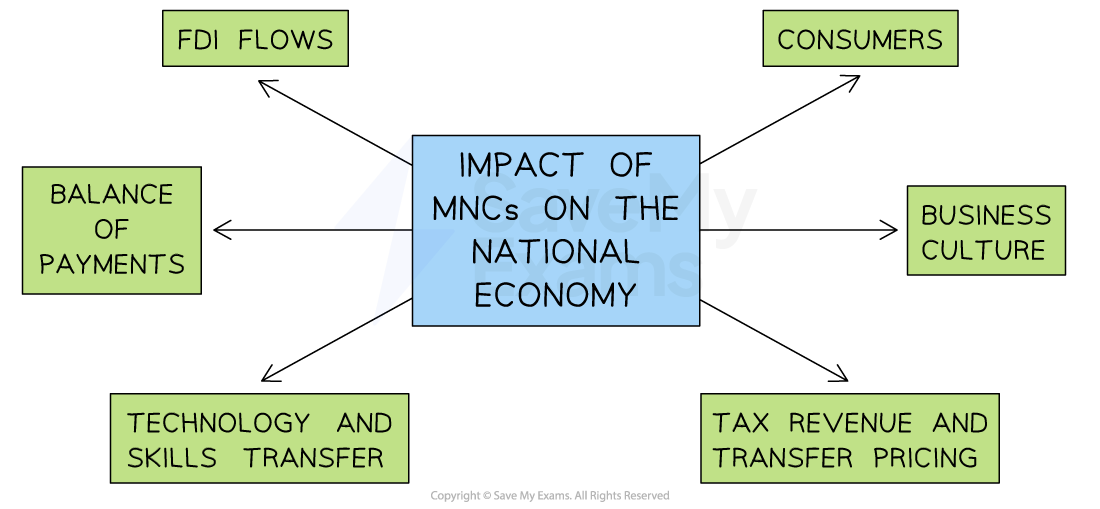
MNCs impact several business metrics in the national economy
Foreign direct investment (FDI)
-
There will be an inflow of money into a country if a MNC decides to invest into a country through foreign direct investment
- This money enriches local firms or citizens, who now have more money available to spend in the economy
- If this money is reinvested back into the local economy, it may help to generate new jobs and boost economic growth
Balance of payments
-
MNCs can help improve the balance of payments of a country as FDI flows into the country
- Any goods and services exported for sale by the MNC will generate further inflows to the country’s balance of payments
- This is especially beneficial to a country when the MNC is exporting a rare and valuable raw material, e.g cobalt
Technology and skill transfer
-
MNCs can bring new technologies and skills to local businesses
- This will help to improve efficiency and productivity, helping domestic businesses become more competitive in national and international markets
Consumers
-
Customers in countries which host MNCs often benefit from
- Better quality, a wider choice of goods and services and lower prices if MNCs pass their cost advantages on in the form of lower prices
- Improved living standards, as people may have higher incomes due to job creation and lower unemployment
Business culture
-
Domestic businesses may be influenced by the business culture of MNCs
- For example, in the 1990s, European businesses adopted the working practices of Japanese businesses such as Nissan
- Workplaces became more open and employers started to copy ideas such as Kaizen and continuous improvement
-
MNCs may also encourage a culture of entrepreneurship
- This can help boost overall economic growth
Tax revenue
- There is the potential for the host country to earn significant tax revenue from MNCs
- Governments can use this to invest in improving public services and infrastructure
Disadvantages to a country of hosting a multinational company
Spec point — "e.g. increased competition, environmental damage, exploitation of natural resources, repatriation of profits"
Disadvantages to a country of hosting a multinational company
- Multinational companies can also present some challenges, which governments sometimes struggle to mitigate
Loss of assets
- Business assets from the home country are now fully or partly owned by foreign businesses
- Local firms or individuals who have sold the asset may not reinvest the money into the local economy but may move it abroad or offshore
Balance of payments
-
MNCs can have a negative impact on the balance of payments
- If the MNC buys raw materials or equipment abroad (imports), there is a flow of money out of the country
- If the MNC send profits back to their home country, it will also represent a flow of money out of the country
Consumers
-
In the long run, MNCs can push domestic businesses out of the market, leaving customers with less choice
- This may lead to MNCs exploiting customers with higher prices and low-quality products, as they have limited choice
Business culture
-
MNCs may demonstrate unethical behaviour and have a company culture of exploitation
- For example, Bangladesh is used by many clothing brands to produce cheap clothes and many ignore poor working conditions
- This encourages local firms to also ignore the working conditions
Transfer pricing
-
MNCs often seek to maximise profits and try to reduce their tax liabilities
- Transfer pricing is a method used by MNCs to shift profits from where they are generated to countries with lower tax rates
- This is a method of tax avoidance and means that the businesses will deprive the host country of tax revenue
Exam Hint Many students only focus on the benefits of multinational companies. Examiners expect balance. Always consider both sides: while MNCs bring jobs and investment, they may also exploit resources or repatriate profits. A one-sided answer will limit your marks
Case Study Shell in Nigeria
Shell, one of the world’s largest oil multinationals, has operated in Nigeria for decades. While it created jobs and export income, it has also caused major problems for the host country.
Context
- Nigeria depends heavily on oil exports for government revenue.
- Shell and other MNCs dominate production and control much of the sector.
- Oil makes up around 90% of Nigeria’s foreign exchange earnings.
Disadvantages
Loss of assets
- Nigeria’s oil is largely controlled by foreign firms. Profits flow abroad rather than staying in the local economy
Balance of payments
- Shell imports machinery and repatriates profits to Europe, creating large outflows of money
Consumers
- Local energy firms struggle to compete, leaving customers dependent on one major supplier
Business culture
- Oil spills polluted land and rivers, setting a poor standard for environmental responsibility
Transfer pricing
- Shell has been accused of shifting profits abroad, reducing Nigeria’s potential tax revenue
Nigeria’s response
- The government formed the Nigerian National Petroleum Corporation (NNPC) to secure government ownership
- They introduced local laws to boost the use of Nigerian suppliers and the employment of Nigerian workers
- The government sued Shell for oil spills and demanded compensation
- They renegotiated contracts so more profit stays in Nigeria
- The government launched tax reforms to reduce profit shifting to other regions

Was this revision note helpful?
Build on this topic