The Need for Business Finance (Cambridge International IGCSE Business)
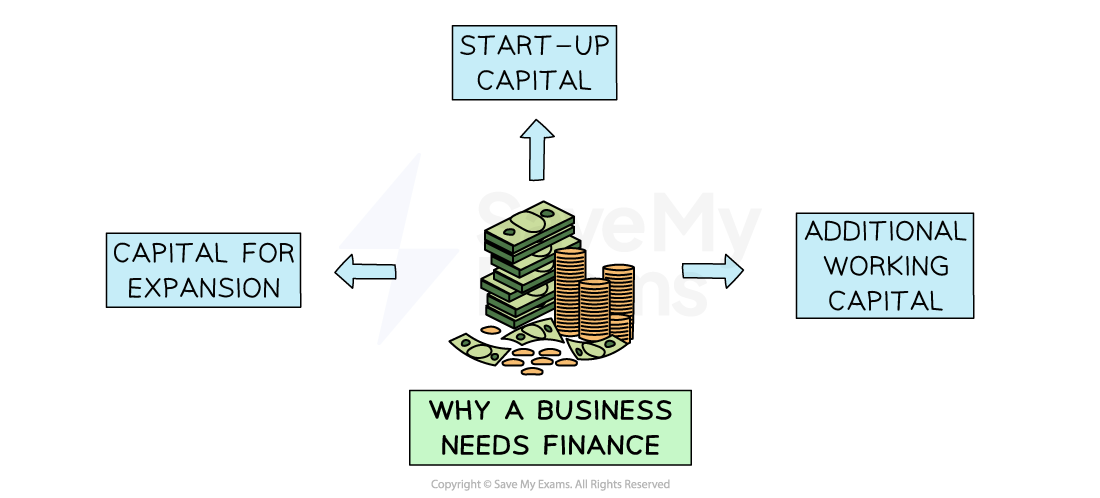
Why do businesses need finance?
Spec point — "• The main reasons why businesses need finance, e.g. start-up capital, capital for expansion and additional working capital • Understand the difference between short-term and long-term finance needs • Importance of alternative sources of capital, e.g. micro-finance, crowd-funding • Internal sources and external sources with examples • Short-term and long-term sources with examples, e.g. overdraft for short-term finance and debt or equity for long-term finance"
Why do businesses need finance?
- All businesses need finance to get started, allow them **to grow, **and fund their continuing activity
- Businesses often call the money needed to start and operate** 'capital'**
The finance department manages the finances and ensures that the business is able to remain liquid
1. Starting a business
- Start-up capital is the finance needed by a new business to pay for fixed assets and current assets before it can begin trading
- A business usually estimates the amount of start-up capital they need in the business plan
- Many small new businesses will get a start-up loan to cover these initial costs
2. Expanding a business
-
As a business grows more finance may be needed for capital expenditure
- It may require more equipment, buildings, IT infrastructure or vehicles which will allow the business to increase output
-
If a business wants to grow by developing a new product, it will need to spend large amounts of capital on research and development (R&D)
- E.g. Apple's annual research and development expenses for 2023 were $29.915 Billion, a 13.96% increase from 2022, as they are investing heavily in Artificial Intelligence (AI) and innovation of new products
3. Working capital
-
Finance is required for working capital which is spending on raw materials, wages or utilities
-
Having a steady flow of working capital is essential to keep the business operational
- Without working capital, the business would be unable to cover its day to day expenses
- It may suffer cash-flow problems which could lead to business failure
The distinction between short-term and long-term finance
Short-term financial needs
-
Short-term finance is used to help a business maintain a positive cashflow, for example:
- To get through periods when cash flow is poor for seasonal reasons, e.g. a rainy summer for an ice cream seller
- To help bridge the gap when a large customer payment is delayed, leaving the business without enough money to pay its bills that month
- To provide extra cash to pay for the manufacturing required to meet sudden or unexpected changes in customer orders, e.g. A small craft business selling via Etsy may use an overdraft to buy more stock of beads and threads due to a sudden surge in demand
Long-term financial needs
-
Long-term finance is usually used to buy fixed assets
- Fixed assets are purchased to be used for a long period of time and tend to be more expensive
- Long-term finance is used for expansion, e.g., a toothpaste factory installs a new production facility that costs over £1 million. This is a very large investment, but it will allow the business to increase output, efficiency and its product range
Was this revision note helpful?