Short-Term and Long-Term Sources of Finance (Cambridge International IGCSE Business)
Exam board Cambridge International · IGCSEUpdated 2025-06-12
Short-term sources of finance
Spec point — • Short-term and long-term sources with examples, e.g. overdraft for short-term finance and debt or equity for long-term finance
-
Short-term sources of finance will be needed to meet unexpected costs or to pay bills and suppliers
- These are likely to be relatively small amounts and are rarely needed beyond a year
-
Longer-term sources of finance will be needed to fund the purchase of non-current assets such as buildings and other types of capital equipment
- These are likely to be large sums that may be required for a significant period of time
Short and long-term sources of finance
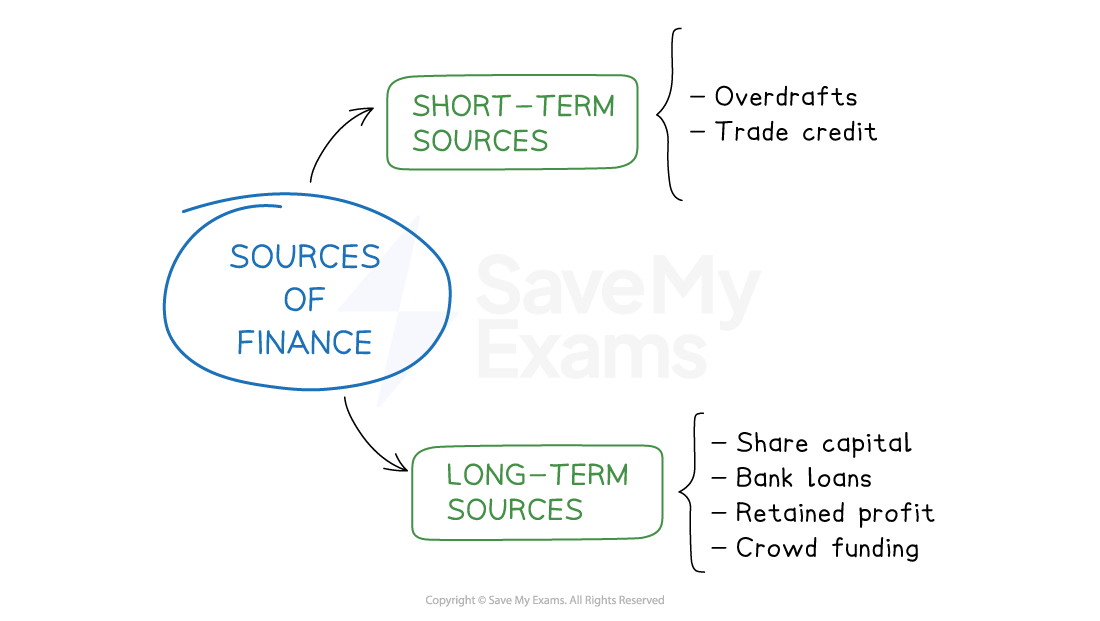
The purpose of the finance will ultimately determine if the business chooses a short, or long-term source
Evaluating short-term sources of finance
| Source | Advantages | Disadvantages |
|---|---|---|
| Overdrafts | - A limit is agreed and interest is charged only when a business ‘goes overdrawn’ - Offers significant flexibility and aids cash flow | - An overdraft may be called in if the bank is concerned about a business's ability to repay what it owes - Interest on overdrafts tends to be higher than on other loans |
| Trade credit | - Trade credit is usually interest-free - A business can increase its stock without having to immediately pay for it, which can significantly enable positive cash flow if the stock is sold before payment becomes due | - Suppliers may prioritise delivery to customers who have the shortest repayment dates - Cash needs to be carefully managed to ensure the business has the money available to pay its suppliers on the agreed date |
| Debt factoring | - Debt factoring provides a source of Immediate cash to the business - The business does not have to handle the debt collection themselves | - The third-party debt company will keep a percentage of the debts collected as reward - The business does not get paid the total value of their debts |
Long-term sources of finance
-
Long-term finance is available for more than a year and can be paid back over a long period of time
- Many forms of long-term finance appear as non-current liabilities in the balance sheet
Evaluating long-term sources of finance
| Source | Advantages | Disadvantages |
|---|---|---|
| Bank loans | - **Bank loans are usually unsecured and are typically repaid over two to ten years - Interest rates are fixed for the term of the loan so repayments are made in equal instalments, which helps with business planning | - Interest is payable and the business assets are at risk if the business does not make repayments as planned |
| Hire Purchase | - The firms** does not need to spend a large sum of money **to acquire and use an asset | - A deposit is usually payable before the asset is delivered - Interest charges can make the overall cost higher that buying an asset outright |
| Leasing | - The business does not own the asset during the period of the lease and so is not responsible for maintenance or repair costs | - Leasing is usually more expensive in the long run than buying an asset |
| Share Issue | - Large amounts of money can be quickly raised from wealthy investors - Shareholders who buy a large number of shares may also bring and share expertise, which can be beneficial to the business | - Shareholders are the owners of shares and they are entitled to a share of the company’s profit when dividends are declared - Shareholders usually have a** vote at a company’s Annual General Meeting (AGM) where they can have a say in the composition of the Board of Directors |
| Debentures | - Can be used to raise very long-term finance, e.g. over 30 years - Unlike share capital, debenture holders have no share in the company itself | - Interest and the loan itself has to be repaid |
Was this revision note helpful?
Build on this topic