Types of Training (Cambridge International IGCSE Business)
The Importance of Training to a Business
Spec point — "• Importance of training to a business and to employees • Benefits and limitations of induction training, on-the-job training and off-the-job training"
The importance of training to a business
-
Training is the process of increasing the knowledge and skills of the workforce to enable them to perform their jobs effectively
-
Businesses need to make sure that new and existing staff are trained and developed appropriately
- Training is the teaching of new skills E.g., learning a new process or how to use new equipment
- Development is the improvement of existing skills E.g., a refresher course for an existing piece of software used
-
A well-trained workforce is important for several reasons
- Well-trained staff are likely to be more productive
- Staff may feel valued if a business invests in training and development
- Staff are more likely to be flexible and resilient in the face of change
- Training decreases errors or waste in the production process
- Improves the opportunities for internal promotion
Types of Training
- There are three main types of training that a business uses
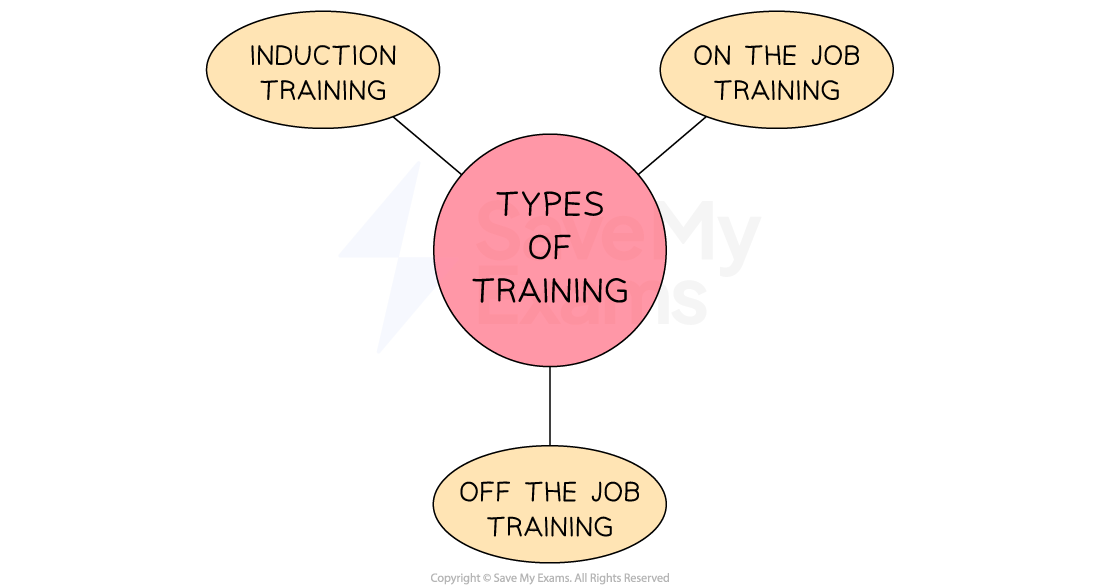
Three common types of training that businesses put their new employees through
1. Induction training
-
Induction training is given to new employees when they start working for a business
-
It introduces them to the organisation, its culture, policies, procedures and their job roles and responsibilities
- E.g. when new employee joins Marks & Spencer they receive induction training that covers customer service, product knowledge, store policies, and safety procedures
-
Evaluating induction training
| Advantages | Disadvantages |
|---|---|
| - Helps new employees to understand their job roles and responsibilities - Improves employee confidence and motivation - Reduces the time taken for new employees to become productive | - Can be time-consuming and expensive to organise - May not cover all aspects of the job role - May not be effective in all cases, leading to employee dissatisfaction and higher turnover rates |
2. On-the-job training
-
A type of training that takes place while employees are working in their job roles
- It allows employees to learn new skills and knowledge from colleagues while performing their job duties
- For example, a sous chef at The Ivy Restaurant in York receives on-the-job training from the Head Chef to learn how to prepare new dishes, use equipment or improve cooking techniques
Evaluating on-the-job training
| Advantages | Disadvantages |
|---|---|
| - Employees learn new skills and knowledge while performing their job duties - Training is tailored to the employee's specific job role and responsibilities - Training is often more practical and relevant to the employee's job duties - Can be cost-effective as it takes place during working hours | - Employees may make mistakes while learning or trainers could pass on bad habits which may impact productivity and quality - Can be disruptive to the workplace as it requires the trainer to devote time to training the employee - May not be effective in all cases, leading to employee dissatisfaction and higher turnover rates |
3. Off-the-job training
-
A type of training that takes place outside of the workplace
-
It can be in the form of workshops, seminars, conferences or online courses
- For example, teachers attend exam board training days at which they learn how to deliver the syllabus and help their students to prepare for exams
-
Evaluating off-the-job training
| Advantages | Disadvantages |
|---|---|
| - Employees learn new skills and knowledge outside of the workplace, which can bring fresh ideas and perspectives to the workplace - Training can be tailored to the employee's specific needs and interests - Training can be used as a reward or incentive for high-performing employees - Can be cost-effective if training is provided online or through webinars | - Can be expensive to organise, especially if travel and accommodation are required - Employees may miss work while attending training, which can impact productivity - The training may not be directly applicable to the employee's job role or the needs of the firm |
Exam Hint Different types of training are required for different job roles. You may need to evaluate a particular type of training or recommend one to a business. Think about the nature of the role and whether on- or off-the-job training would be the most appropriate.
E.g., On-the-job training may be suitable for a hotel porter who has many hands-on aspects to the role and needs to learn quickly. In comparison, employees that need training in a new software may need training sessions from an expert so show step by step how to use it in their role
Was this revision note helpful?