Product: The Product Life Cycle (Cambridge International IGCSE Business)
The Product Life Cycle
Spec point — "• The product life cycle: main stages and extension strategies; draw and interpret a product life cycle diagram • How stages of the product life cycle can influence marketing decisions, e.g. promotion and pricing decisions"
The product life cycle
- The product life cycle describes the different stages a product goes through from its conception to its eventual decline in sales
- There are typically five stages in the product life cycle: development, introduction, growth, maturity, and decline
The product life cycle diagram
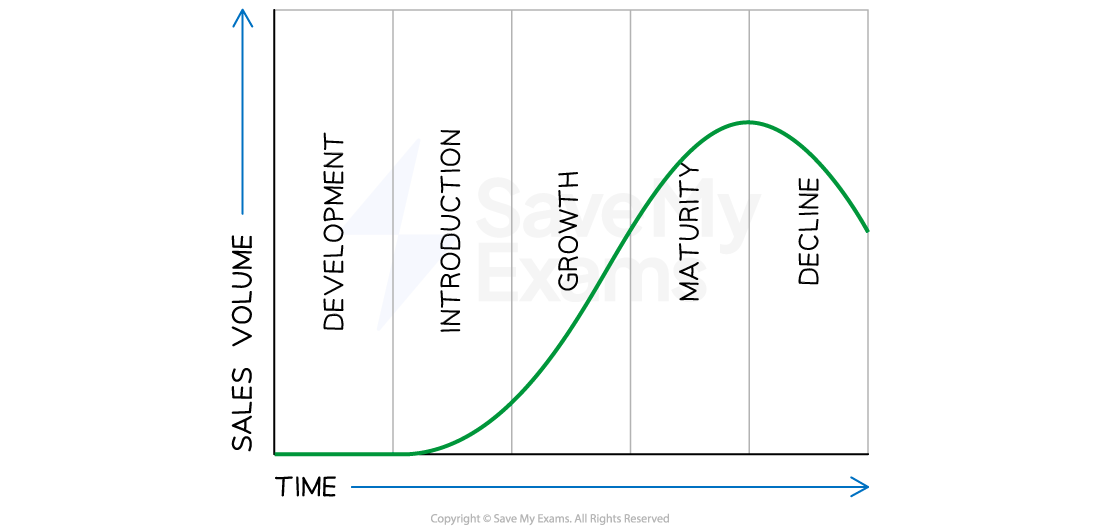
*The five stages a product goes through over its life span - from initial development to eventual decline *
- The implications for cash flow and marketing vary at each stage of the product life cycle
- Companies should tailor their marketing strategies and manage their cash flow to ensure long-term profitability and success
The impact of the product life cycle on cash flow and marketing strategy
| Stage | Explanation | Implication |
|---|---|---|
| Development | - The focus is on designing and developing the product - The business usually incurs high costs for research and development, market research, and product testing | - Cash flow is usually negative during this stage, as the company is investing heavily in the product without generating any revenue - The marketing strategy during this stage is focused on creating awareness and generating interest in the product |
| Introduction | - The stage begins when the product is launched - Characterised by slow sales growth as the product is still new and unknown to most consumers | - Cash flow is usually negative as the business usually incurs high costs for promotion, advertising and distribution - Marketing efforts are focused on creating awareness and generating interest in the product |
| Growth | - The product enters this stage when sales begin to increase rapidly - The business focus shifts to **building market share and increasing production to meet this growing demand | -** Cash flow usually turns positive during this stage as sales revenue increases and costs are spread out over a larger volume of production - The marketing strategy is to differentiate the product from its competitors and build brand loyalty |
| Maturity | - Characterised by high sales but slowing sales growth - Market saturation is likely | - Cash flow is usually positive during this stage as sales revenue continues to come in and costs are reduced through economies of scale and efficient production processes - The marketing strategy aims to maintain market share and increase profitability by cutting costs and finding new markets |
| Decline | - Starts when sales begin to decline as the product becomes obsolete or is replaced by newer products - The business focus shifts to managing the product's decline and reducing costs | - Cash flow usually turns negative as sales revenue declines and costs associated with the product's decline increase - The marketing strategy may involve discontinuing the product, reducing prices to clear stock, or finding new uses for the product |
Extension Strategies
-
Extension strategies refer to the techniques used by businesses to extend the life of a product beyond its natural life cycle
-
These strategies are designed to boost sales and maintain profitability for a product that has reached the late maturity or decline stage of its life cycle
-
There are two types of extension strategies which are often implemented at the same time
- Product-related extension strategies
Product-related extension strategies
-
These are strategies that changing or modify the product to make it more appealing to customers
-
This could involve improving or adding features, increasing capacity or redesigning its appearance
- Product improvements e.g. Samsung releases new versions of its Galaxy Smartphone every year with upgraded features and improvements to the previous model
- Line extensions, e.g. Coca-Cola introduced Diet Coke and Coke Zero as line extensions of its original Coca-Col
- Repositioning e.g. when IBM's personal computer division started losing market share to other brands, it repositioned its products as high-end business machines and focused on the enterprise market
Promotion-related extension strategies
-
These strategies aim to change the promotional activity related to the product
-
This could involve:
- Changes to advertising e.g Kellogg's continues to recreate adverts for its Corn Flakes cereal, which has been around since 1906
- Price promotions, e.g. Cyber Monday occurs on the first Monday after Thanksgiving in the USA and electronic firms discount prices significantly in order to boost sales of their products
- Sales promotions, e.g. many coffee shops offer a loyalty programme where customers can earn a free drink for every six consumed
Was this revision note helpful?
Build on this topic