Transpiration Stream (Cambridge International IGCSE Biology)
Exam board Cambridge International · IGCSEUpdated 2026-08-27
Water vapour loss: Extended
Spec point —
8.3.4· Explain how water vapour loss is related to: the large internal surface area provided by the interconnecting air spaces between mesophyll cells and the size and number of stomata
Water vapour loss: Extended
Extended Tier Only
- Evaporation takes place from the surfaces of spongy mesophyll cells
- The many interconnecting air spaces between these cells and the stomata create a large surface area
- This means evaporation can happen rapidly when stomata are open
Transpiration stream: Extended
Spec point —
8.3.5· Explain the mechanism by which water moves upwards in the xylem in terms of a transpiration pull that draws up a column of water molecules, held together by forces of attraction between water molecules
Extended Tier Only
- Water molecules are attracted to each other (cohesion), forming a continuous column of water up the plant
- Water moves through the xylem vessels in a continuous transpiration stream from roots to leaves via the stem
- Transpiration produces a tension or ‘pull’ on the water in the xylem vessels by the leaves
- As water molecules are held together by cohesive forces (each individual molecule ‘pulls’ on the one below it), so water is pulled up through the plant
- If the rate of transpiration from the leaves increases, water molecules are pulled up the xylem vessels quicker
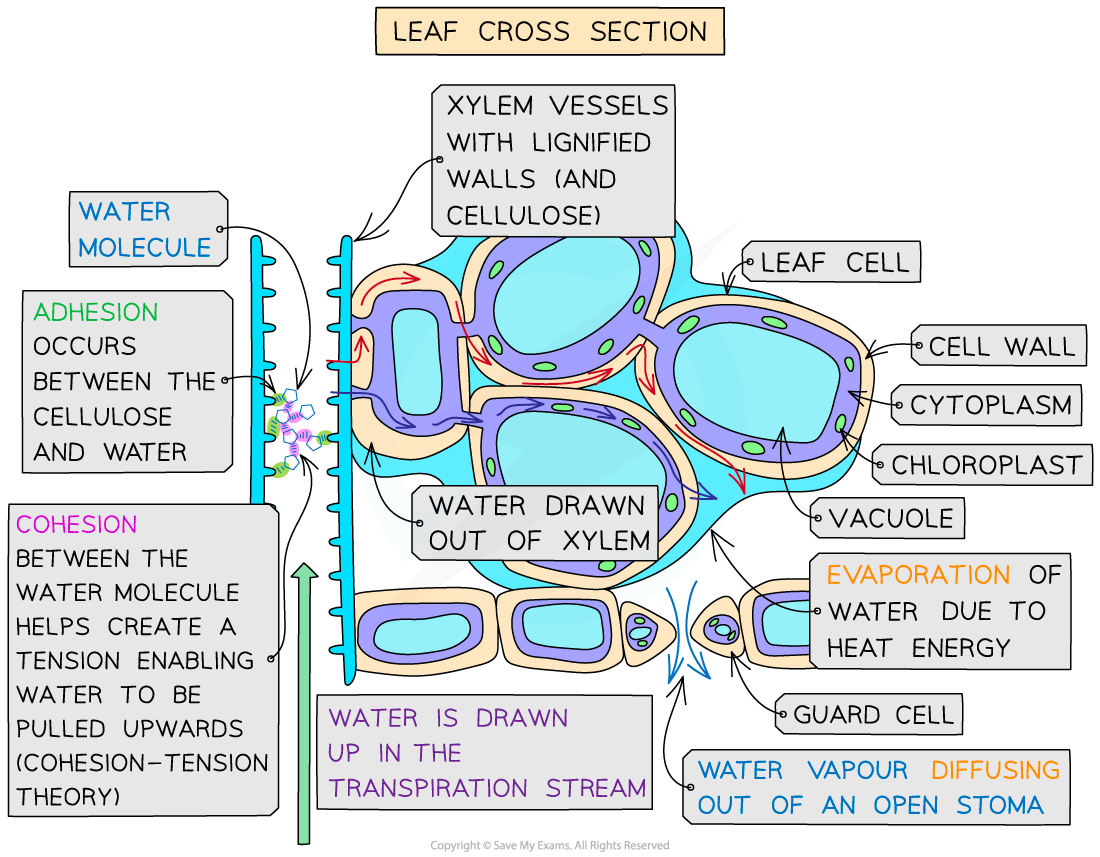
The generation of the transpiration stream
Was this revision note helpful?
Build on this topic