Minerals in Plants (Cambridge International IGCSE Biology)
Exam board Cambridge International · IGCSEUpdated 2026-08-25
Spec point —
6.1.4· Explain the importance of: (a) nitrate ions for making amino acids (b) magnesium ions for making chlorophyll
Minerals in plants
- Photosynthesis produces carbohydrates, but plants contain many other types of biological molecule; such as proteins, lipids and nucleic acid (DNA)
- As plants do not eat, they need to make these substances themselves
- Carbohydrates contain the elements carbon, hydrogen and oxygen but proteins, for example, contain nitrogen as well (and certain amino acids contain other elements too)
- Other chemicals in plants contain different elements as well, for example chlorophyll contains magnesium and nitrogen
- This means that without a source of these elements, plants cannot photosynthesise or grow properly
- Plants obtain these elements in the form of mineral ions actively absorbed from the soil by root hair cells
- ‘Mineral’ is a term used to describe any naturally occurring inorganic substance
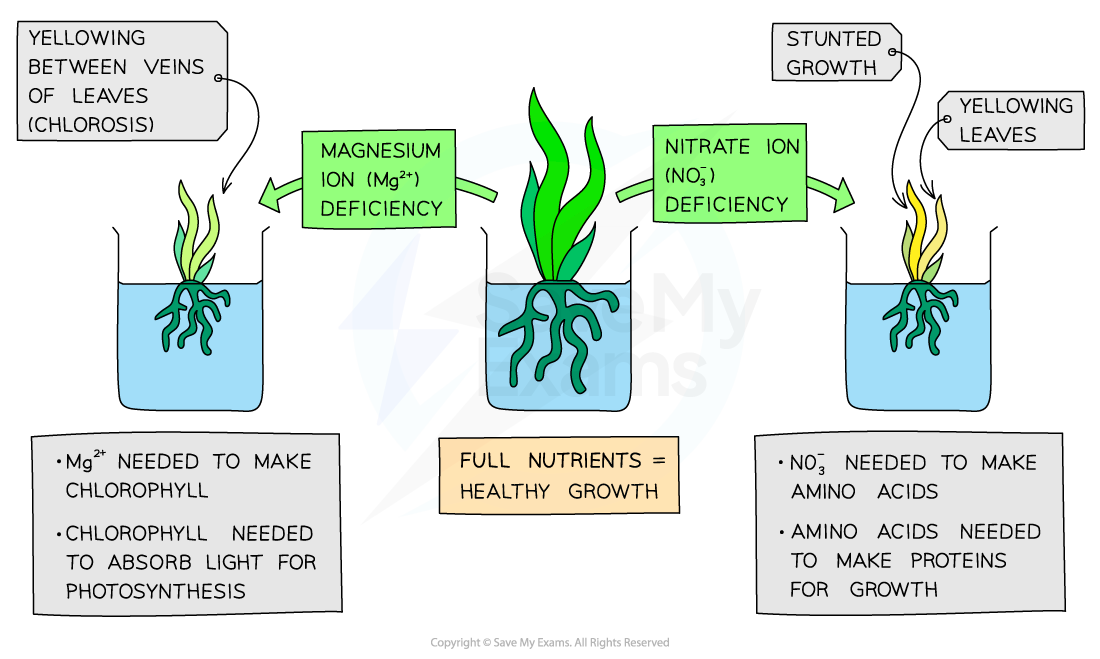
Mineral deficiencies in plants
Mineral deficiencies table
| Mineral ion | Function | Deficiency |
|---|---|---|
| Magnesium | Magnesium is needed to make chlorophyll | Causes yellowing between the veins of leaves (chlorosis) |
| Nitrate | Nitrates are a source of nitrogen which is needed to make amino acids (which are used to build proteins) | Causes stunted growth and yellowing of leaves |
Was this revision note helpful?
Build on this topic