Enzyme Action & Specificity (Cambridge International IGCSE Biology)
Enzyme action & specificity: Extended
Spec point —
5.1.3· Explain enzyme action with reference to: active site, enzyme-substrate complex, substrate and product Explain the specificity of enzymes in terms of the complementary shape and fit of the active site with the substrate
Enzyme action & specificity: Extended
Extended Tier Only
- Enzymes are specific to one particular substrate(s) as the active site of the enzyme, where the substrate attaches, is a complementary shape to the substrate
- This is because the enzyme is a protein and has a specific 3-D shape
- This is known as the lock and key hypothesis
- When the substrate binds with the enzyme's active site, the enzyme and substrate together are known as the enzyme-substrate complex
- After the reaction has occurred, the products leave the enzyme’s active site as they no longer fit it and it is free to take up another substrate
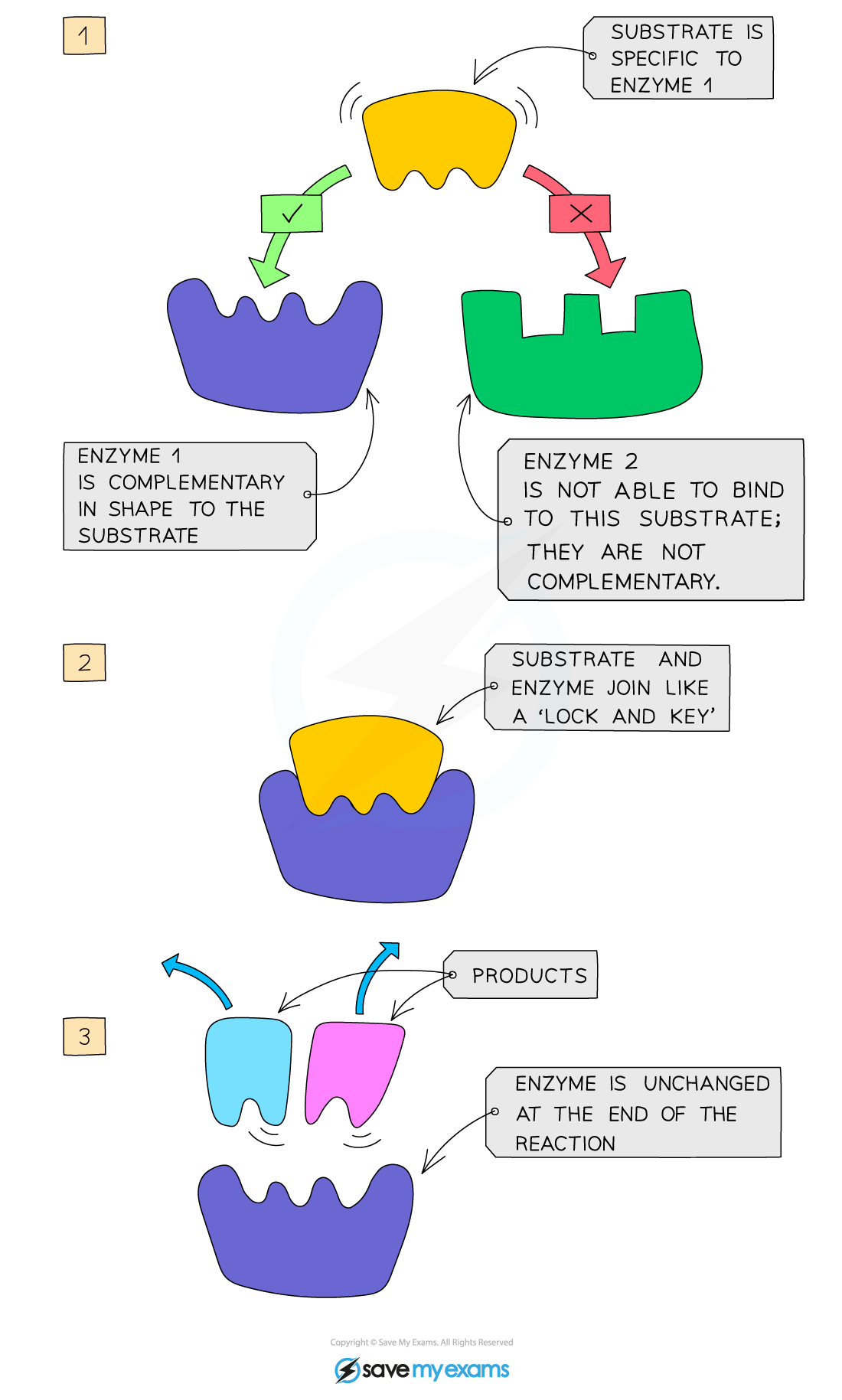
How enzymes bind with complementary substrates to break them down/build them up into products
-
Enzymes and substrates randomly move about in solution.
-
When an enzyme and its complementary substrate randomly collide - with the substrate fitting into the active site of the enzyme - an enzyme-substrate complex forms, and the reaction occurs.
-
A product (or products) forms from the substrate(s) which are then released from the active site. The enzyme is unchanged and will go on to catalyse further reactions.
Was this revision note helpful?
Build on this topic