Components of Blood (Cambridge International IGCSE Biology)
Spec point —
9.4.1· List the components of blood as: red blood cells, white blood cells, platelets and plasma
Components of blood
- Blood consists of red blood cells, white blood cells, platelets and plasma
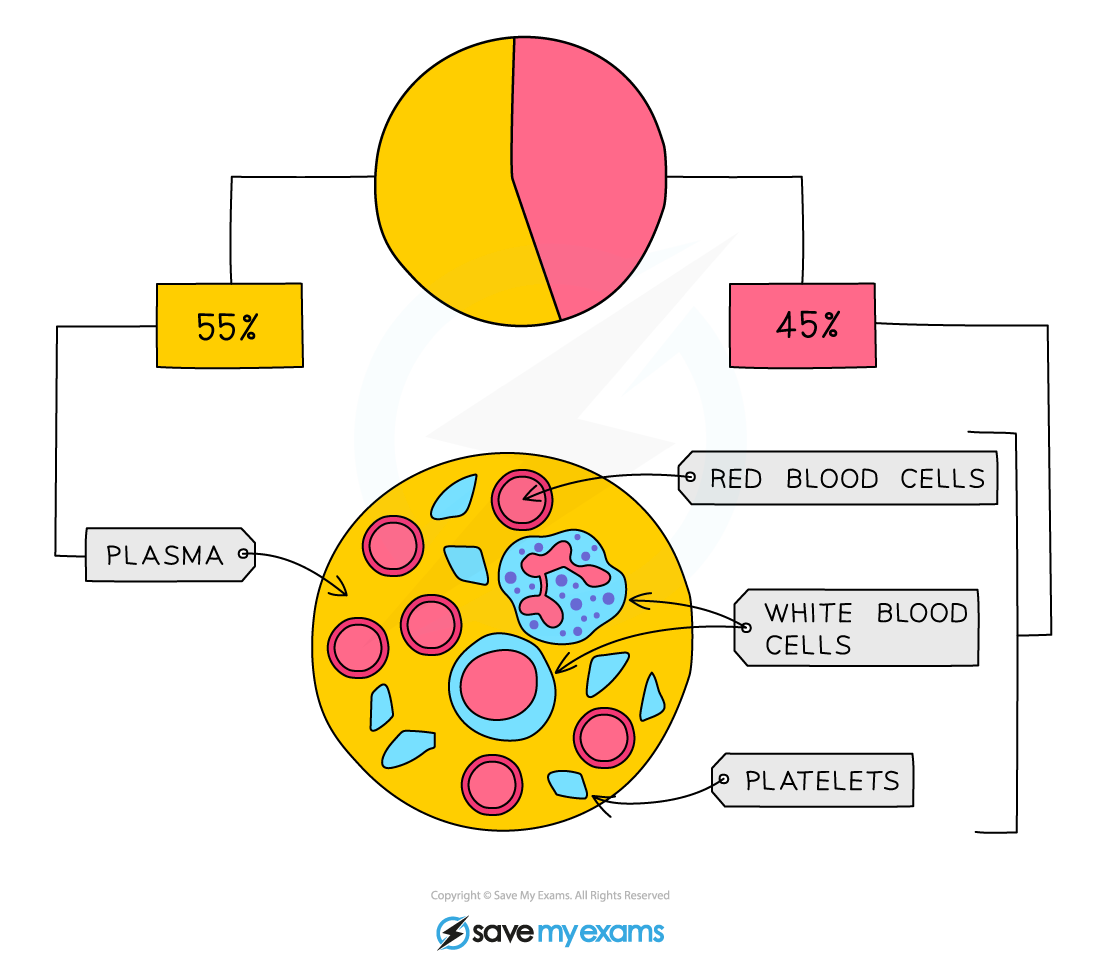
Composition of human blood
Components of the blood table
| Component | Structure |
|---|---|
| Red blood cells | Biconcave discs with no nucleus, containing a large amount of the protein haemoglobin |
| White blood cells | Large cells with a large nucleus; different types (e.g. phagocytes and lymphocytes) have slightly different structures and functions |
| Platelets | Small fragments of cells, with no nucleus |
| Plasma | Pale yellow (straw-coloured) liquid, made mostly of water |
Identifying red & white blood cells
Spec point —
9.4.2· Identify red and white blood cells in photomicrographs and diagrams
-
Red and white blood cells can be identified in photomicrographs and diagrams by:
- red blood cells have a concave disc shape with no nucleus
- white blood cells are usually round in shape with a nucleus
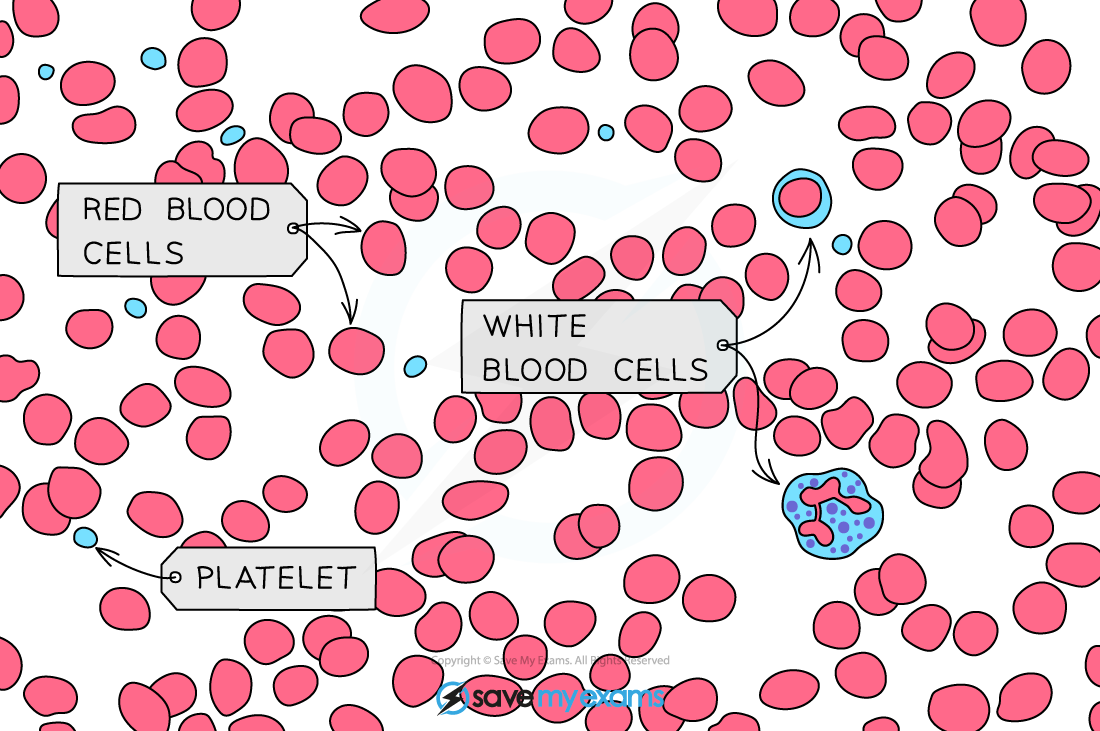
An illustration of a blood micrograph
Components of blood: function
Spec point — State the functions of the following components of blood: (a) red blood cells in transporting oxygen, including the role of haemoglobin (b) white blood cells in phagocytosis and antibody production (c) platelets in clotting (details are not required) (d) plasma in the transport of blood cells, ions, nutrients, urea, hormones and carbon dioxide
Components of blood: function
-
Plasma is important for the transport of:
- the blood cells (red blood cells, white blood cells and platelets)
- nutrients
- urea
- ions
- hormones
- carbon dioxide
-
Red blood cells transport oxygen around the body from the lungs to cells around the body; oxygen is required for aerobic respiration
- Red blood cells carry oxygen in the form of oxyhaemoglobin
-
White blood cells defend the body against infection by pathogens by carrying out phagocytosis and antibody production
-
Platelets are involved in blood clotting
Was this revision note helpful?
Build on this topic