Concept & Uses of Classification Systems Continued (Cambridge International IGCSE Biology)
Reflecting evolutionary relationships: Extended
Spec point — nan
Extended Tier Only
-
Classification systems aim to reflect evolutionary relationships between species
-
Traditional biological classification systems grouped organisms based on the features that they shared
- If organisms shared more similar features then they were said to be more closely related
-
In the past, scientists have encountered many difficulties when trying to determine the evolutionary relationships of species based on this method
-
Using the physical features of species (such as colour/shape/size) has many limitations and can often lead to the wrong classification of species
Using DNA to classify organisms: Extended
Spec point — nan
Extended Tier Only
-
Organisms share features because they originally descended from a common ancestor
- Example: all mammals have bodies covered in hair, feed young from mammary glands and have external ears (pinnas)
-
Originally, organisms were classified using morphology (the overall form and shape of the organism, e.g. whether it had wings or legs) and anatomy (the detailed body structure as determined by dissection)
-
As technology advanced, microscopes, knowledge of biochemistry and eventually DNA sequencing allowed us to classify organisms using a more scientific approach
-
Studies of DNA sequences of different species show that organisms sharing a more recent ancestor have more similar base sequences than those that share only a distant ancestor
-
This means that the base sequences in a mammal’s DNA are more closely related to all other mammals than to any other vertebrate groups
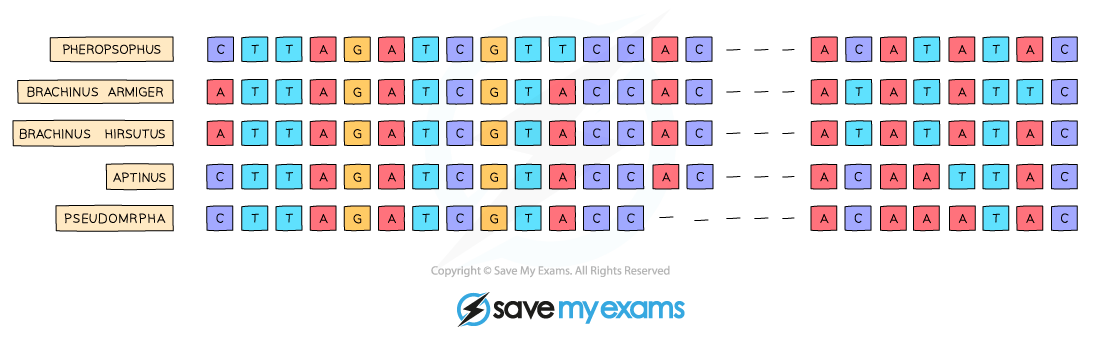
DNA sequences can show how closely related different species are
- The sequences above show that Brachinus armiger and Brachinus hirsutus are more closely related than any other species in the list as their DNA sequences are identical except for the last but one base (Brachinus armiger has a T in that position whereas Brachinus hirsutus has an A)
- As DNA base sequences are used to code for amino acid sequences in proteins, amino acid sequences can also be compared to determine how closely related organisms are - the more similar the sequence, the more closely related (and vice versa)
Was this revision note helpful?
Build on this topic