Meiosis (Cambridge International IGCSE Biology)
Meiosis: Extended
Spec point —
17.1.7· State that meiosis is involved in the production of gametes Describe meiosis as a reduction division in which the chromosome number is halved from diploid to haploid resulting in genetically different cells (details of the stages of meiosis are not required)
Meiosis: Extended
Extended Tier Only
-
Meiosis is a type of nuclear division that gives rise to cells that are genetically different
-
Meiosis is involved in the production of gametes (sex cells)
-
The number of chromosomes must be halved when the gametes are formed
-
Otherwise there would be double the number of chromosomes after they join at fertilisation in the zygote (fertilised egg)
-
This halving occurs during meiosis, and so it is described as a reduction division in which the chromosome number is halved from diploid to haploid, resulting in genetically different cells
-
Meiosis starts with chromosomes doubling themselves (as in mitosis) and lining up in the centre of the cell
-
After this has happened the cells divide twice so that only one copy of each chromosome passes to each daughter cell
-
These daughter cells form the gametes
- Gametes are described as being haploid - having half the normal number of chromosomes
-
Because there is a double division, each cell division by meiosis produces four haploid cells
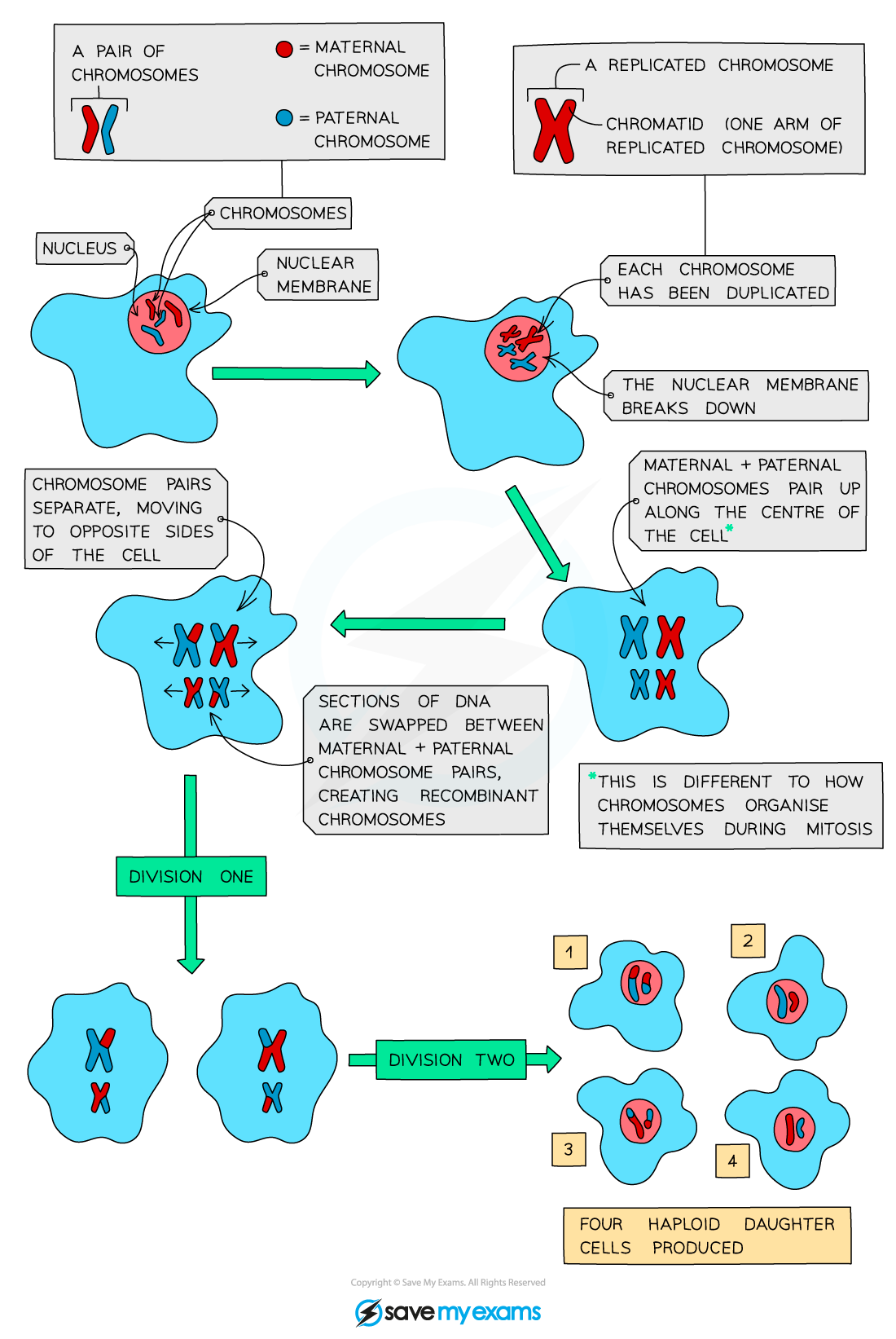
The process of cell division by meiosis to produce haploid gamete cells
What is the process of meiosis?
- Each chromosome makes identical copies of itself (forming X-shaped chromosomes)
- First division: chromosomes pair up along the centre of the cell, recombination occurs and then cell fibres will pull the pairs apart, each new cell will have one of each recombinant chromosome pair
- Second division: chromosomes will line up along the centre of the cell, cell fibres will pull them apart (as with mitosis)
- A total of four haploid daughter cells will be produced
Why is meiosis important?
- Production of gametes e.g. sperm cells and egg cells, pollen grains and ovum
- Increases genetic variation of offspring
- Meiosis produces variation by forming new combinations of maternal and paternal chromosomes every time a gamete is made, meaning that when gametes fuse randomly at fertilisation, each offspring will be different from any others
Differences between mitosis and meiosis
| Mitosis | Meiosis |
|---|---|
| Two daughter cells produced | Four daughter cells produced |
| Daughter cells are diploid | Daughter cells are haploid |
| Daughter cells are genetically identical to each other and to the parent cell | Daughter cells are genetically different from each other and the parent cell |
| One cell division occurs | Two cell divisions occur |
Exam Hint Questions on cell division often ask for differences between mitosis and meiosis. Learn two or three and remember to be specific when giving your answer.
You should also know the reasons for a specific type of cell division taking place and the types of cells where each happen.
Was this revision note helpful?