Mass & Weight (Cambridge International AS Physics)
What is Mass?
- Mass is a measure of the amount of matter in an object
- Consequently, this is the property of an object that resists change in motion
- The greater the mass of a body, the smaller the change produced by an applied force
- The SI unit for mass is the kilogram (kg)
Exam Hint
- Since mass is measured in kilograms in physics, if it is given in grams in a question, make sure you convert to kg by dividing the value by 1000
Weight
- Weight is the effect of a gravitational field on a mass
- Since it is a force, it is measured in newtons (N) and is a vector quantity
- The weight of a body is equal to the product of its mass and the acceleration of free fall
-
Where:
- W = weight in newtons (N)
- m= mass in kilograms (kg)
- *g *= acceleration of freefall in metres per second (m s-2)
-
The acceleration of freefall, g, on Earth, is 9.81 m s-2
Exam Hint Gravitational field strength (in N kg-1) and acceleration due to freefall (in m s-2) are just two ways of describing the same thing.
They have the same value but have different units depending on the context.
Free fall
- An object in free fall is falling solely under the influence of gravitational attraction
- In the absence of air resistance, all bodies near the Earth fall with the same acceleration regardless of their mass
Mass v weight
- An object’s mass always remains the same, however, its weight will **differ **depending on the strength of the gravitational field at different locations within the Universe
- For example, the gravitational field strength on the Moon is 1.63 N kg-1, meaning an object’s weight will be about 6 times less than on Earth
Comparison of a person's weight on Earth and on the Moon
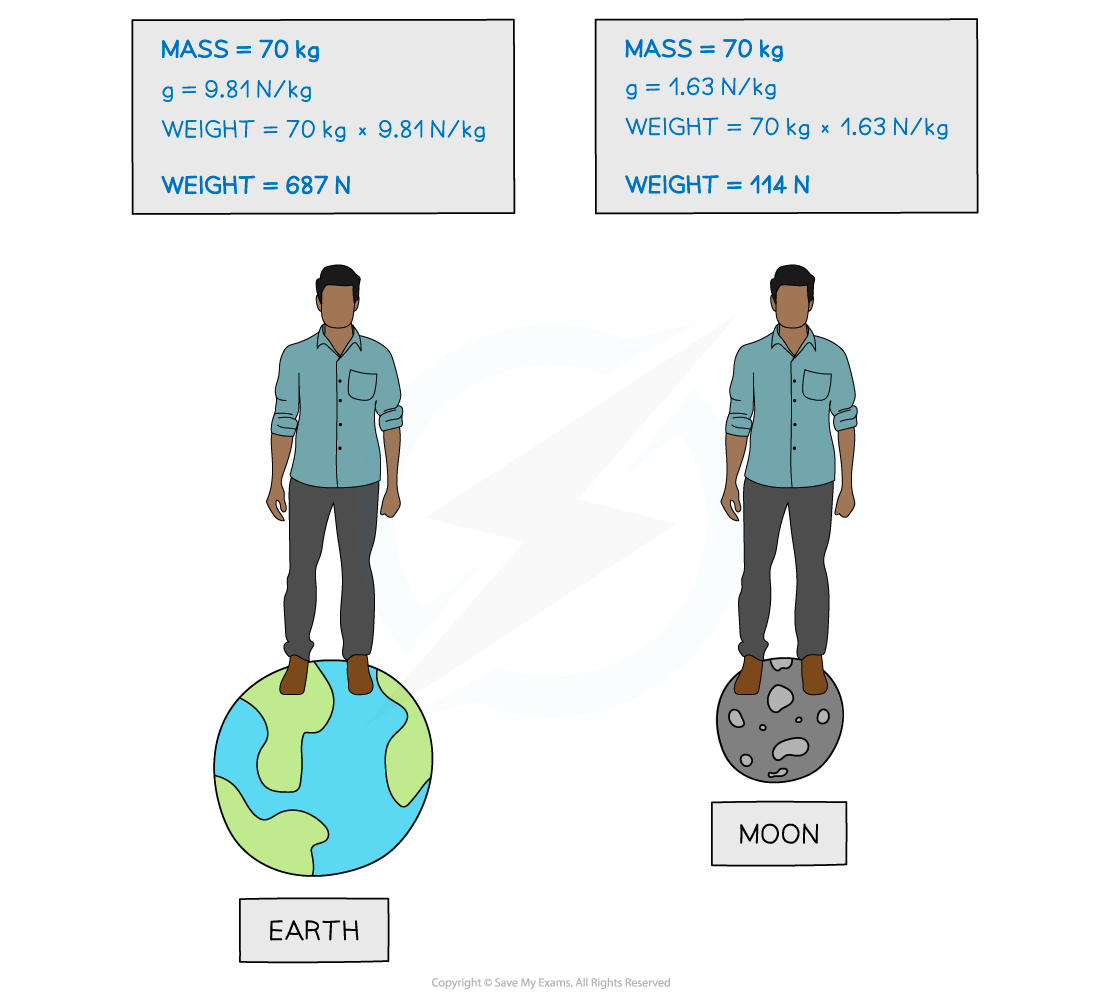
On the moon, your mass will stay the same but your weight will be much lower
- Although you only need to memorise g on Earth, its value on other planets in our solar system is given in the diagram below. Notice how much this varies according to the size of the planet
Gravitational field strengths of bodies in the solar system
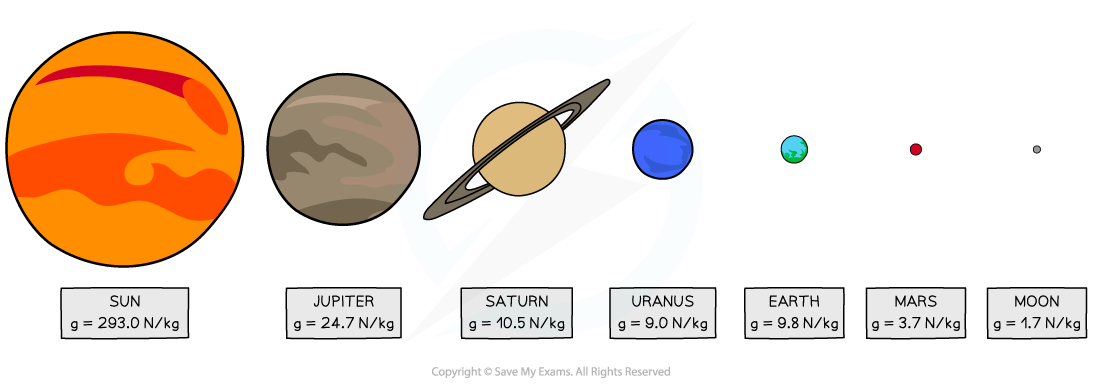
More massive planets and objects have a greater gravitational field strength
Worked Example The acceleration due to gravity on the moon is 1/6 of that on Earth. If the weight of a space probe on the moon is 491 N, calculate its mass.
Answer:
Step 1: State the equation for weight
Step 2: Rearrange to make mass, m, the subject
Step 3: Find g for the moon
Step 4: Substitute in the known values
Was this revision note helpful?
Build on this topic