Stationary Waves (Cambridge International AS Physics)
Spec point —
8.1.2
Stationary waves
- Stationary waves, or standing waves, are produced by the superposition of two waves of the same frequency and amplitude travelling in opposite directions
- This is usually achieved by a travelling wave and its reflection. The superposition produces a wave pattern where the peaks and troughs do not move
Formation of a stationary wave
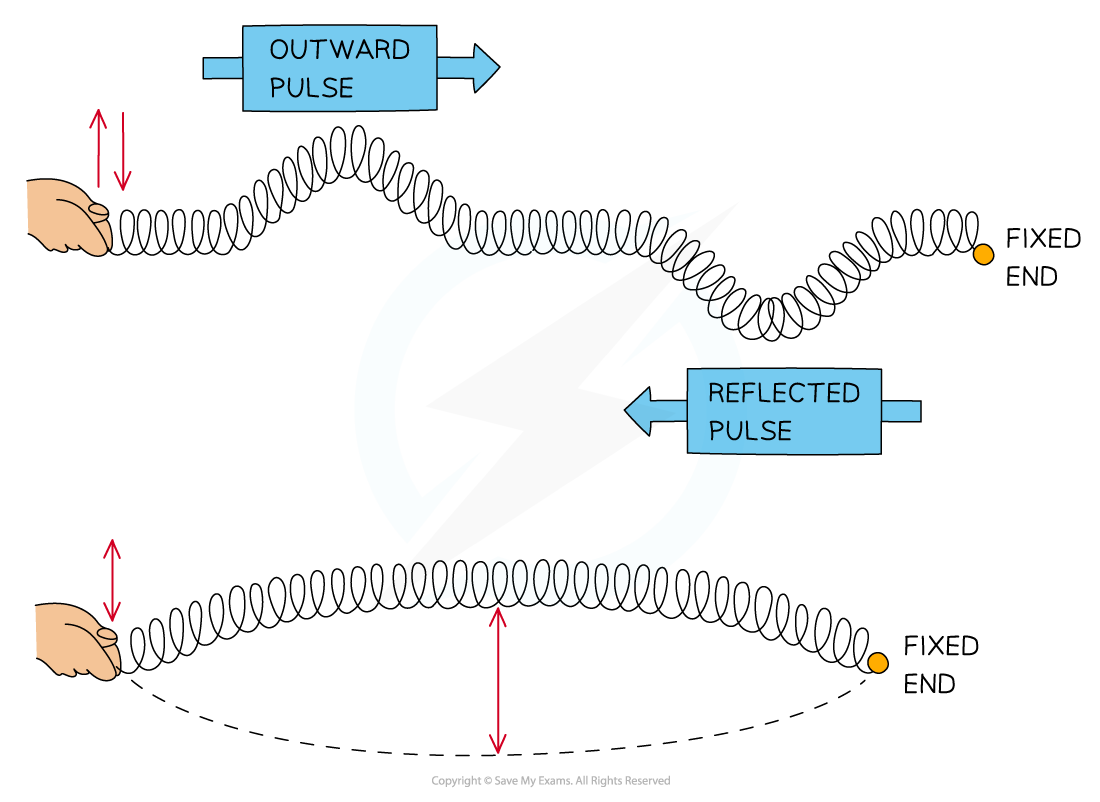
Formation of a stationary wave on a stretched spring fixed at one end
Stretched strings
-
Vibrations caused by stationary waves on a stretched string produce sound
- This is how stringed instruments, such as guitars or violins, work
-
This can be demonstrated by a length of string under tension fixed at one end and forced to vibrate due to an oscillator:
Standing wave experiment
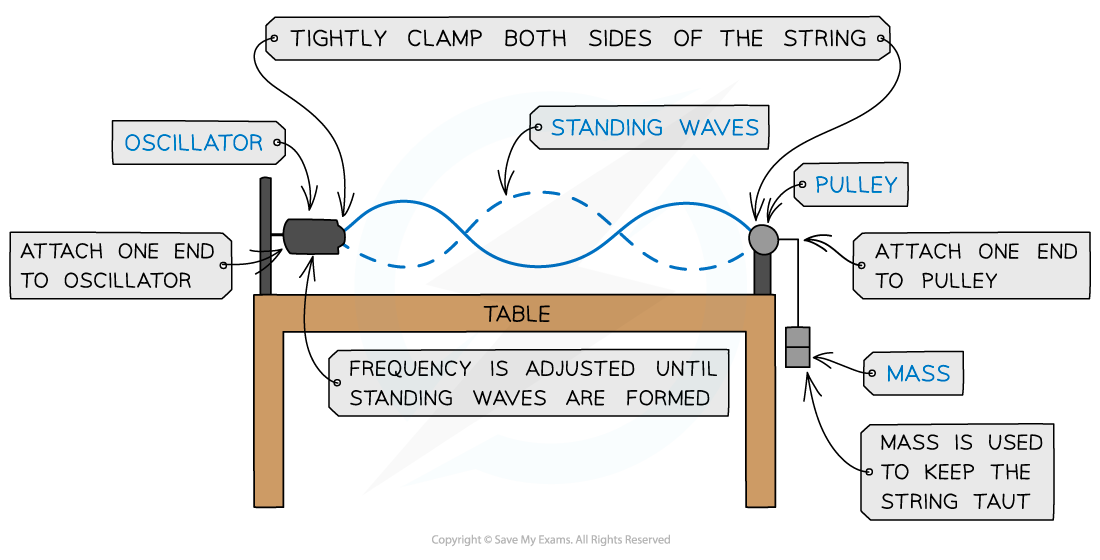
Stationary wave on a stretched string kept taut by a mass and pulley system
- As the frequency of the oscillator changes, standing waves with different numbers of minima (nodes) and maxima (antinodes) form
Microwaves
- A microwave source is placed in line with a reflecting plate and a small detector between the two
- The reflector can be moved to and from the source to vary the stationary wave pattern formed
- By moving the detector, it can pick up the minima (nodes) and maxima (antinodes) of the stationary wave pattern
Stationary microwaves
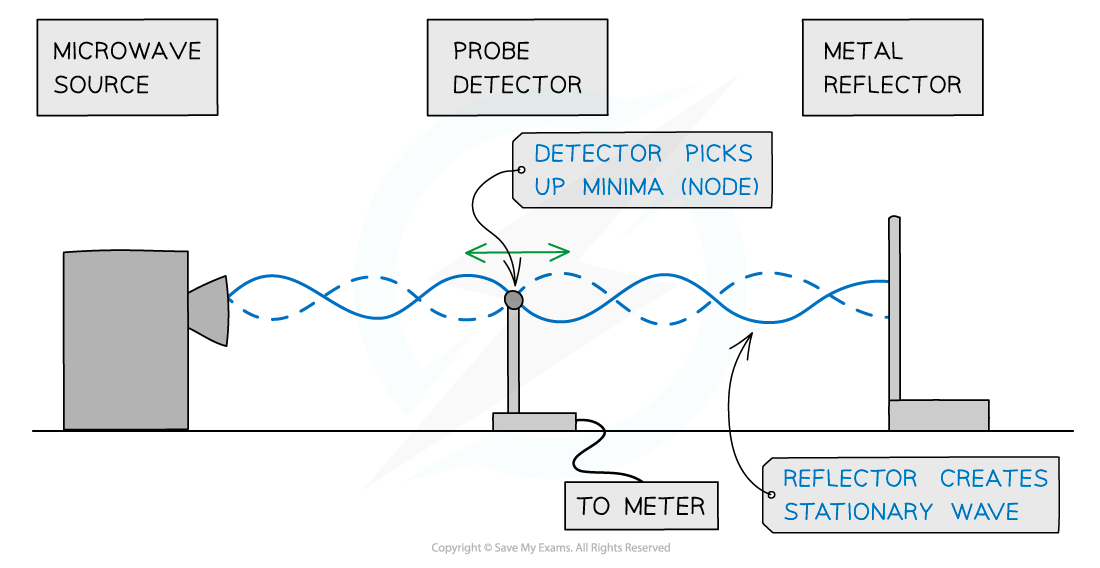
Using microwaves to demonstrate stationary waves
Air columns
-
The formation of stationary waves inside an air column can be produced by sound waves
- This is how musical instruments, such as clarinets and organs, work
-
This can be demonstrated by placing a loudspeaker at the open end of an air column with fine powder inside
-
At certain frequencies, the powder forms evenly spaced heaps along the tube, showing where there is zero disturbance as a result of the nodes of the stationary wave
Stationary waves in an air column
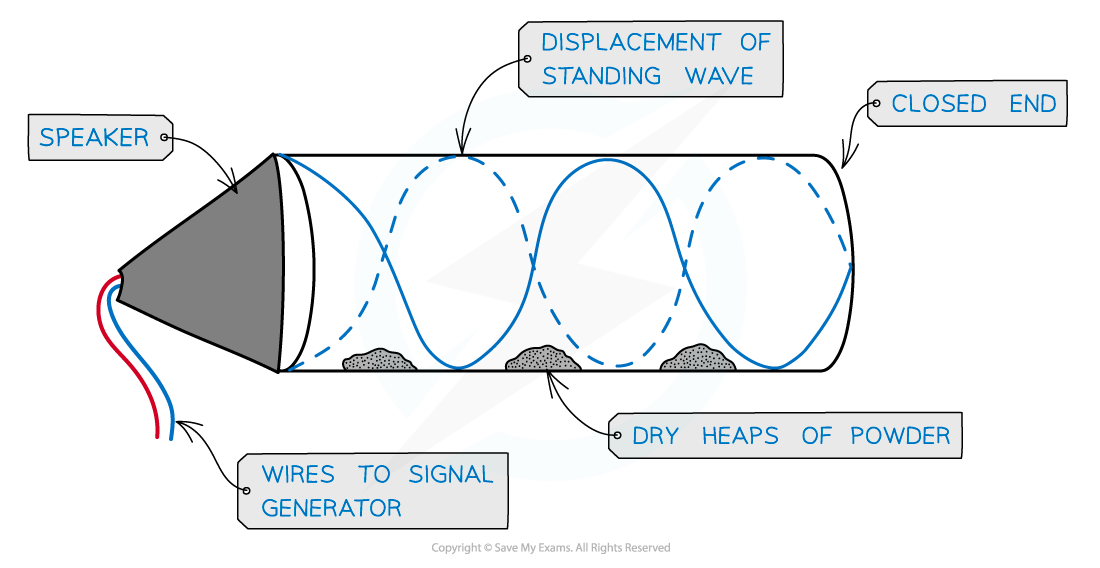
Stationary waves can be seen in air columns using dry powder
- In order to produce a stationary wave, there must be a minima (node) at one end and a maxima (antinode) at the end with the loudspeaker
Exam Hint Always refer back to the experiment or scenario in an exam question e.g. the wave produced by a loudspeaker reflects at the end of a tube. This reflected wave, with the same frequency, overlaps the initial wave to create a stationary wave.
Formation of Stationary Waves
-
A stationary wave is made up of nodes and antinodes
- Nodes are where there is no vibration
- Antinodes are where the vibrations are at their maximum amplitude
-
The nodes and antinodes do not move along the string
- Nodes are fixed and antinodes only move in the vertical direction
-
Between nodes, all points on the stationary wave are in phase
-
The image below shows the nodes and antinodes on a snapshot of a stationary wave at a point in time
Nodes and antinodes on a stationary wave
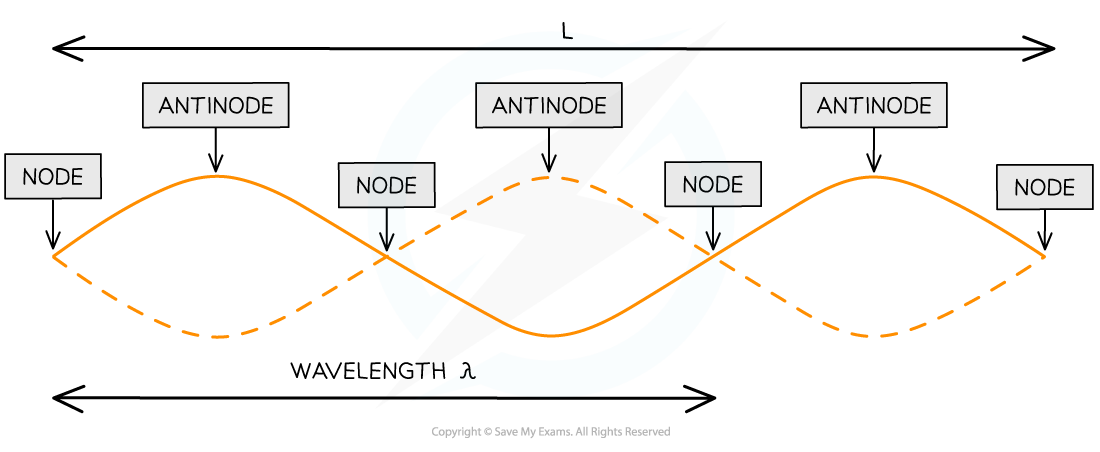
- Nodes are points of zero amplitude, anti-nodes are points of maximum amplitude
-
L is the length of the string
- 1 wavelength *λ *is only a portion of the length of the string
-
Changing the frequency of the stationary wave produced will change the number of nodes and antinodes produced and consequently the wavelength
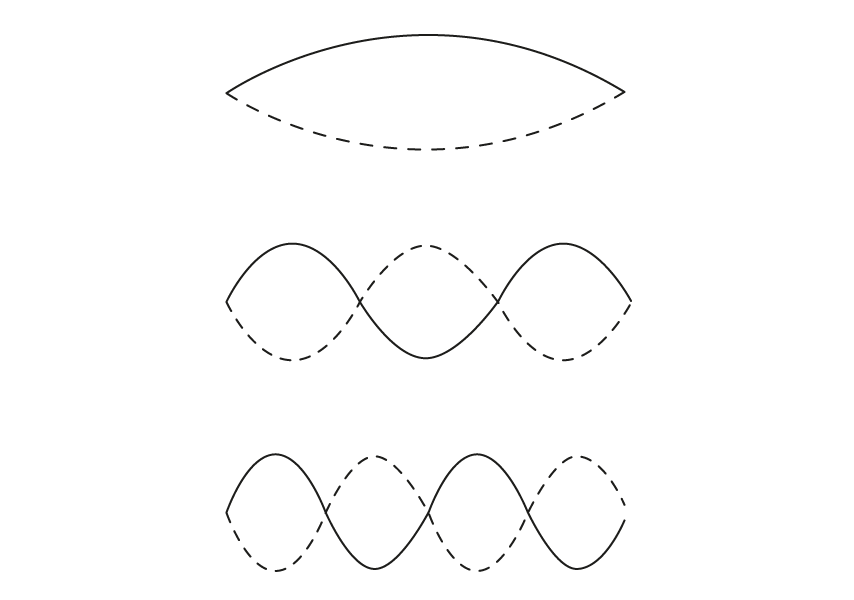
Stationary waves are produced at varying frequencies
Worked Example A stretched string is used to demonstrate a stationary wave, as shown in the diagram.
Which row in the table correctly describes the length of L and the name of X and Y?
Length L Point X Point Y A 5 wavelengths Node Antinode B 2 wavelengths Antinode Node C 2 wavelengths Node Antinode D 5 wavelengths Antinode Node Answer: C
Step 1: Determine the number of wavelengths in the length of the string
The string has 2 wavelengths
- This rules out A and D
Step 2: Determine points X and Y
X has zero amplitude – a node
Y has maximum amplitude – an antinode
- Therefore, the correct row is C

Exam Hint The lengths of the strings will only be in terms of whole or ½ wavelengths. For example, a wavelength could be made up of 3 nodes and 2 antinodes or 2 nodes and 3 antinodes.
Was this revision note helpful?
Build on this topic