11 markeasy
A physical quantity has the unit m s−2 and the symbol .
What is the correct name for this quantity?
Choose your answer
Activity of a radioactive source
Amplitude
Avogadro constant
Acceleration
10 questions · 60 marks · ≈ 60 min · spans 5 of 64 topics
Assembled from the topic question banks — not an official Cambridge International paperA physical quantity has the unit m s−2 and the symbol .
What is the correct name for this quantity?
Choose your answer
Activity of a radioactive source
Amplitude
Avogadro constant
Acceleration
Which unit is not an SI base unit?
Choose your answer
A
K
mol
N
An experiment is done to measure the acceleration of free fall of a body from rest.
Which measurements are needed?
Choose your answer
The height of fall and the time of fall
The height of fall and the weight of the body
The mass of the body and the height of fall
The mass of the body and the time of fall
A resultant force of 20 N is 30° to the horizontal.
What is the horizontal and vertical component of the resultant force?
| Horizontal Component / N | Vertical Component / N | |
|---|---|---|
| A | 17 | 10 |
| B | 10 | 17 |
| C | 11.5 | 10 |
| D | 17 | 11.5 |
Choose your answer
Complete Table 1.1 to show the SI base unit of each physical quantity and a reasonable estimate of the order of magnitude.
Table 1.1
| physical quantity | SI base unit | order of magnitude |
|---|---|---|
| acceleration of free-fall on Earth (g) | m s−2 | |
| Stefan-Boltzmann constant (σ) | 10−7 | |
| speed of a β particle | ||
| specific heat capacity of water (c) |
Table 1.1 shows some SI base quantities and their corresponding unit.
Table 1.1
| quantity | SI base unit |
|---|---|
| mass | kg |
| time | |
| length |
(i) Complete Table 1.1 to show the SI base unit of each quantity.
(2 marks)
(ii) State two other SI base quantities and their corresponding units.
(2 marks)
Newton's second law of motion describes the relationship between force F mass m and acceleration a:
The derived unit for force is the newton (N).
Use Newton's second law to write 1 N in SI units.
The kinetic energy equation describes the relationship between energy E, mass, m, and velocity, v.
The derived unit for energy is the joule (J).
Use the equation linking kinetic energy and speed to write 1 J in SI base units.
Extract:
The kinetic energy equation describes the relationship between energy E, mass, m, and velocity, v. E_k = (1/2) m v^2. The derived unit for energy is the joule (J). 1 J = kg m^2 s^-2
The derived unit for power P is the watt W.
Given that power is the energy transferred E per unit time t, deduce the SI base units for power
A student used the apparatus shown to investigate the time taken for a hollow cylinder to roll down a ramp as shown in Fig. 1.1.
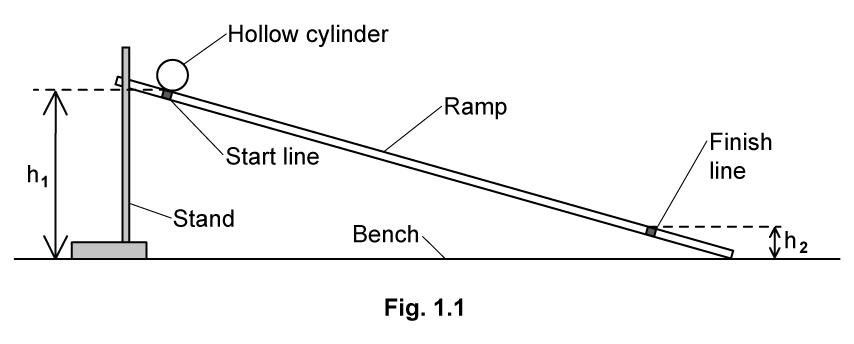
State the most appropriate instrument for the measurement of the following, and describe how they can ensure the measurements are as accurate as possible
(i) the heights h1 and h2
(2 marks)
(ii) the time taken for the cylinder to roll down the ramp
(2 marks)
The student wants to find the difference in height Δh between the start line and finish line
The heights are recorded as
= 67.5 ± 0.1 cm
= 8.6 ± 0.1 cm
Determine the change in height Δh, quoting your answer with its uncertainty
Δh = …………………… ± …………………… cm
Extract:
A student used the apparatus shown to investigate the time taken for a hollow cylinder to roll down a ramp as shown in Fig. 1.1. State the most appropriate instrument for the measurement of the following... (i) the heights h1 and h2 (ii) the time taken for the cylinder to roll down the ramp
The student placed the cylinder on the start line and released it. She measured the time* t* for the cylinder to roll to the finish line. She repeated the measurements several times as shown in Table 1.1.
Table 1.1
| t / s | 0.88 | 0.82 | 0.80 | 0.86 |
|---|
(i) Use the data in Table 1.1 to calculate the mean value of t and its uncertainty.
mean value of t = ............................... ± .......................... [2]
(ii) Comment on the accuracy and precision of the data the student collected.
(2 marks)
(iii) Explain how reducing the value of h1 could improve the measurement of t.
(2 marks)
Extract:
The heights are recorded as h₁ = 67.5 ± 0.1 cm, h₂ = 8.6 ± 0.1 cm. The change in height Δh = h₁ − h₂ = 67.5 − 8.6 = 58.9 cm, with uncertainty 0.1 cm + 0.1 cm = 0.2 cm, so Δh = 58.9 ± 0.2 cm.
Table 1.1 times t / s: 0.88, 0.82, 0.80, 0.86. Mean value of t = (0.88 + 0.82 + 0.80 + 0.86)/4 = 0.84 s. Uncertainty in t = ±½(range) = ±½(0.88 − 0.80) = ±0.04 s. So t = 0.84 ± 0.04 s.
The relationship between t and the acceleration of free fall g is given by
where s is the distance along the ramp between the start line and the finish line.
The student recorded the ramp length as s = 102.0 cm ± 0.1 cm
(i) Determine a value for g.
(2 marks)
(ii) Determine the percentage uncertainty in the value of g.
(2 marks)
(iii) Deduce whether the value of g is accurate.
(2 marks)
A small cannon fires a projectile at an angle of 22° to the horizontal with an initial velocity v.
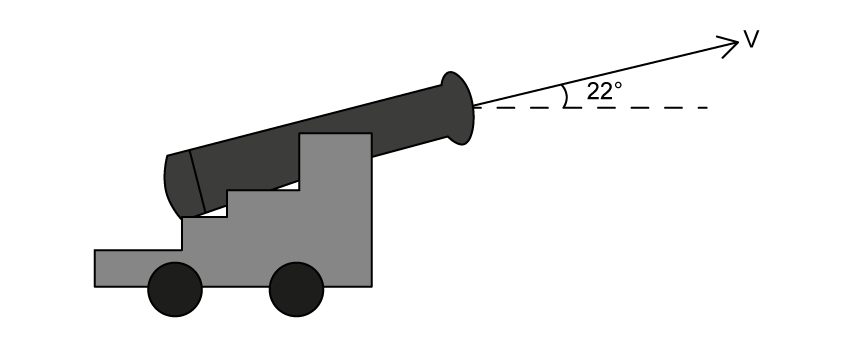
Calculate the vertical component of velocity if its initial velocity has a magnitude of v = 15 m s–1.
Extract:
A small cannon fires a projectile at an angle of 22° to the horizontal with an initial velocity v. Calculate the vertical component of velocity if its initial velocity has a magnitude of v = 15 m s^–1^.
State the direction of the horizontal component of velocity.
The cannon fires a second projectile. The initial horizontal component of velocity is 8.4 m s-1 and the initial vertical component of velocity is 5.8 m s-1.
Calculate the initial velocity, v2, of the second projectile.
Extract:
The cannon fires a second projectile. The initial horizontal component of velocity is 8.4 m s^-1^ and the initial vertical component of velocity is 5.8 m s^-1^. Calculate the initial velocity, v2, of the second projectile. v2 = 10.2 m s^-1^
Calculate the angle to the horizontal that the second projectile was fired at.
A sprinter runs a 200 m race in a straight line. He starts from rest and accelerates at 2.5 m s–2 until reaching a maximum speed of 10 m s–1. He maintains this speed until he crosses the finish line.
How long does it take the sprinter to run the race?
Choose your answer
8 s
20 s
22 s
40 s
State the difference between
(i) distance and displacement,
(2 marks)
(ii) speed and velocity.
(2 marks)
Complete the table in Table 1.1 to describe the features of displacement-time, velocity-time and acceleration-time graphs represent.
Place a cross (✘) in any grid space which does not represent anything. Some grid spaces have been completed for you.
Table 1.1
| displacement-time | velocity-time | acceleration-time | |
|---|---|---|---|
| gradient represents | ✘ | ||
| area under curve represents | |||
| y-intercept represents | |||
| horizontal line represents | zero velocity | ||
| straight section represents | |||
| curved section represents | non-uniform acceleration |
On Fig. 1.2, sketch the variation of time with distance, velocity, and acceleration for an object moving with constant velocity.
Take the initial position to be zero.
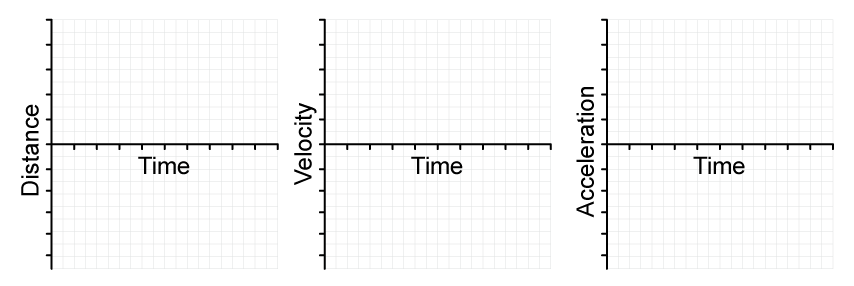
Fig. 1.2
On Fig. 1.3, sketch the variation of time with distance, velocity, and acceleration for an object moving with uniform acceleration.
Take the initial position to be zero.
Fig. 1.3