A skydiver of mass 75 kg jumps from an aircraft.
(i) State the difference between the mass of a body and its weight.
(2 marks)
(ii) Calculate the weight of the skydiver.
(2 marks)
Extract:
A skydiver of mass 75 kg jumps from an aircraft.
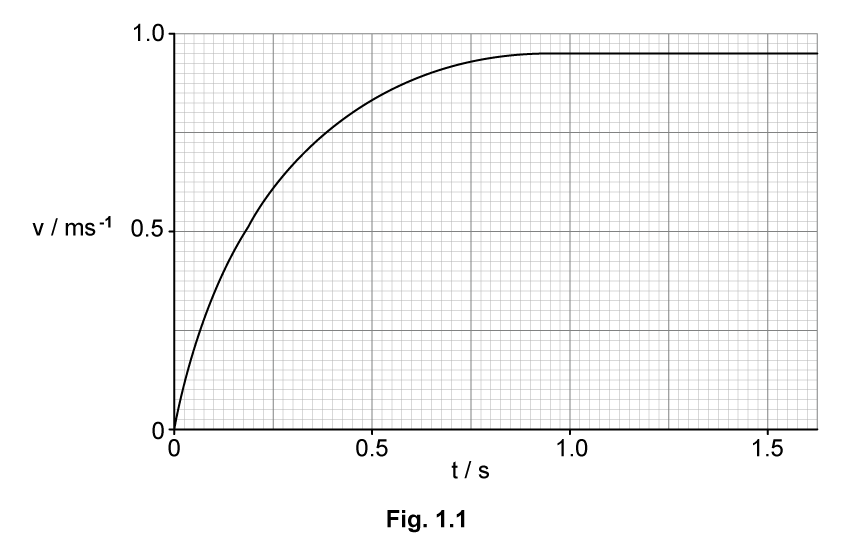
The graph in Fig. 1.1 shows the vertical velocity of the skydiver during the first 40 s of the fall before opening his parachute.
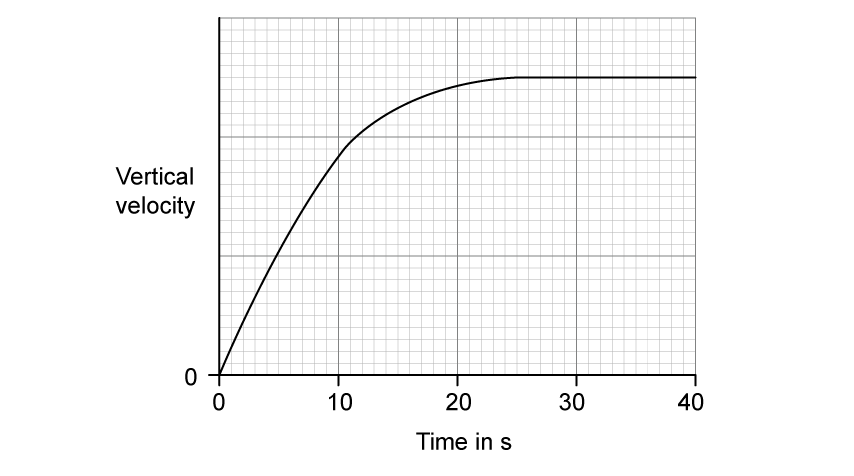
Fig. 1.1
Explain the shape of the graph
(i) between 0 and 5 s
(2 marks)
(ii) between 5 and 25 s
(2 marks)
(iii) between 25 and 40 s
(2 marks)
Extract:
A skydiver of mass 75 kg jumps from an aircraft.
(ii) Calculate the weight of the skydiver: W = m g = 75 × 9.81 = 735.75 = 740 N
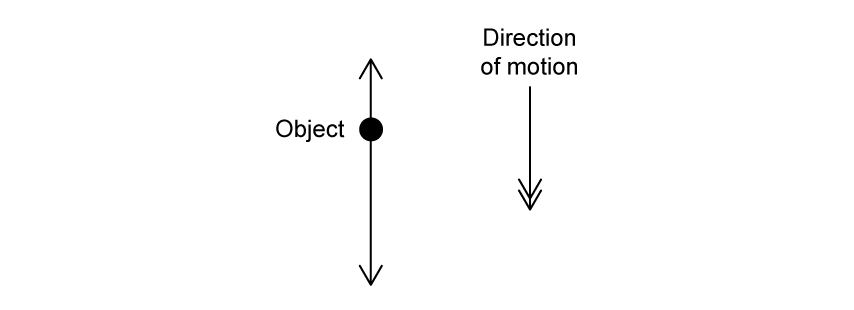
Fig. 1.2 shows the skydiver falling at a constant velocity.
Add labelled arrows to Fig. 1.2 to show the forces acting on the skydiver.

Fig. 1.2
Extract:
A skydiver of mass 75 kg jumps from an aircraft.
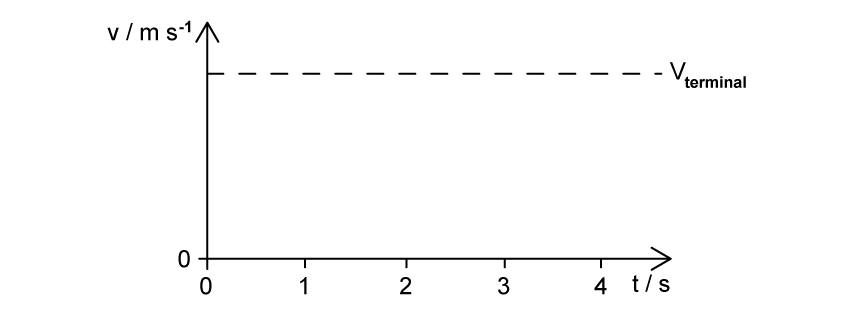
The graph in Fig. 1.1 shows the vertical velocity of the skydiver during the first 40 s of the fall before opening his parachute. Between 25 and 40 s the forces of drag and weight are equal/balanced and the skydiver reaches terminal velocity.
The skydiver opens his parachute after 40 s.
On Fig. 1.3 below, complete the graph to show how the skydiver’s vertical velocity changes after 40 s.
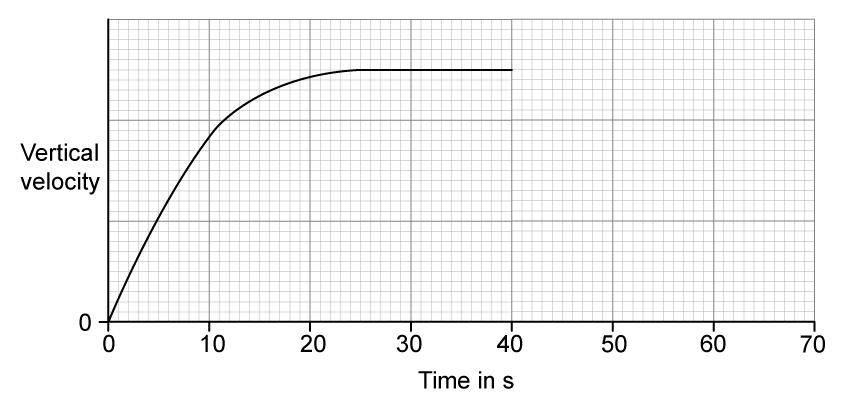
Fig. 1.3