Discrete Probability Distributions (Cambridge International AS Mathematics)
Discrete Random Variables
What is a discrete random variable?
-
A random variable is a variable whose value depends on the outcome of a random event
- The value of the random variable is not known until the event is carried out (this is what is meant by 'random' in this case)
-
Random variables are denoted using upper case letters (X , Y , etc )
-
Particular outcomes of the event are denoted using lower case letters ( x, y, etc)
-
means "the probability of the random variable X taking the value "
-
A discrete random variable (often abbreviated to DRV) can only take certain values within a set
- Discrete random variables usually count something
- Discrete random variables usually can only take a finite number of values but it is possible that it can take an infinite number of values (see the examples below)
-
Examples of discrete random variables include:
- The number of times a coin lands on heads when flipped 20 times (this has a finite number of outcomes: 0,1,2,…,20)
- The number of emails a manager receives within an hour (this has an infinite number of outcomes: 1,2,3,…)
- The number of times a dice is rolled until it lands on a 6 (this has an infinite number of outcomes: 1,2,3,…)
- The number on a bingo ball when one is drawn at random (this has a finite number of outcomes: 1,2,3…,90)
Probability Distributions (Discrete)
What is a probability distribution?
-
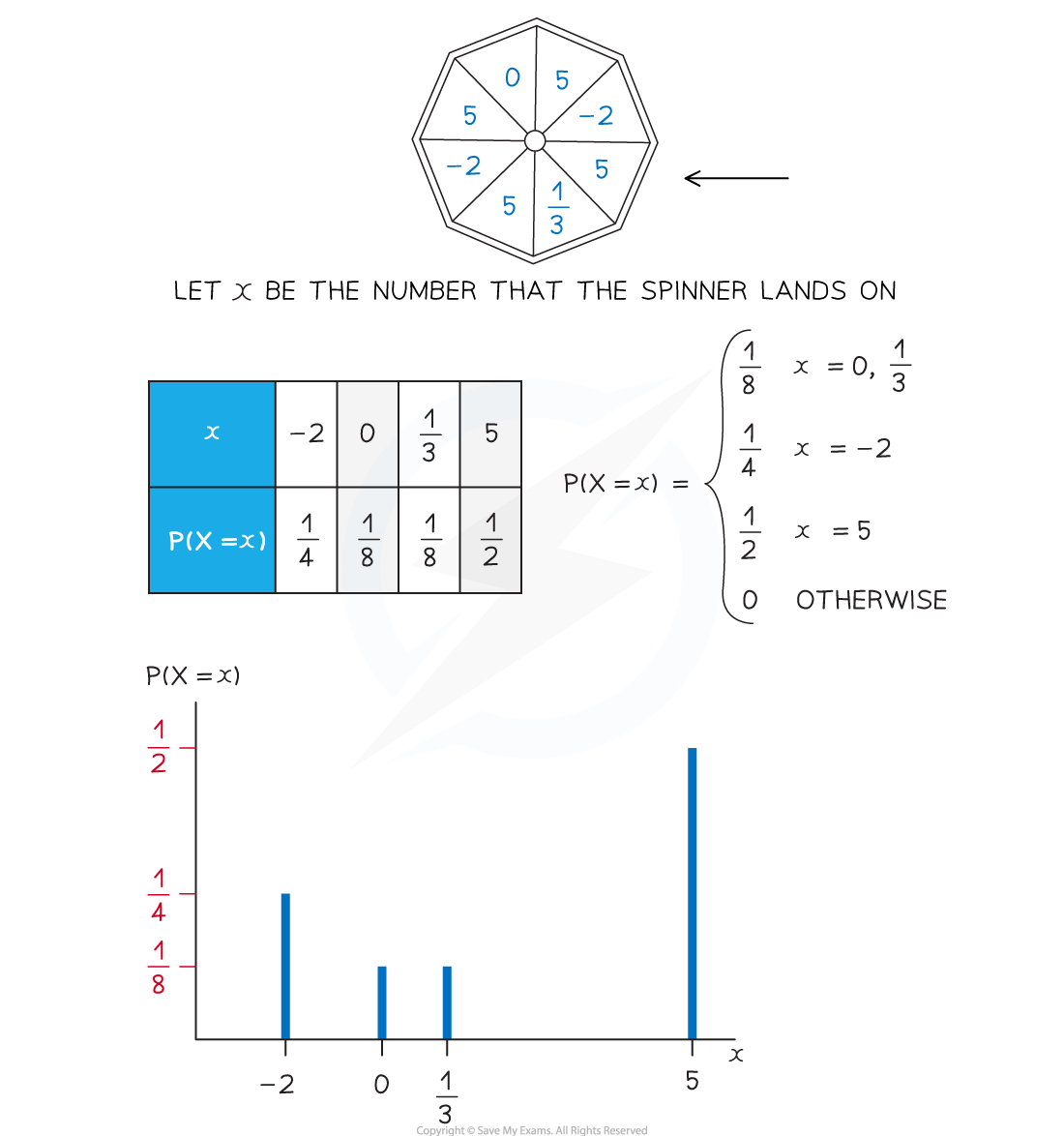
A discrete probability distribution fully describes all the values that a discrete random variable can take along with their associated probabilities
- This can be given in a table
- Or it can be given as a function (called a probability mass function)
- They can be represented by vertical line graphs (the possible values for X along the horizontal axis and the probability on the vertical axis)
-
The sum of the probabilities of all the values of a discrete random variable is 1
- This is usually written
Cumulative Probabilities (Discrete)
How do I calculate probabilities using a discrete probability distribution?
-
First draw a table to represent the probability distribution
- If it is given as a function then find each probability
- If any probabilities are unknown then use algebra to represent them
-
Form an equation using
- Add together all the probabilities and make the sum equal to 1
-
To find
- If k is a possible value of the random variable X then will be given in the table
- If is not a possible value then
-
To find
-
Identify all possible values, , that X can take which satisfy
-
Add together all their corresponding probabilities
-
-
Some mathematicians use the notation F(x) to represent the cumulative distribution
-
-
Using a similar method you can find and
-
As all the probabilities add up to 1 you can form the following equivalent equations:
-
To calculate more complicated probabilities such as
- Identify which values of the random variable satisfy the inequality or event in the brackets
- Add together the corresponding probabilities
How do I know which inequality to use?
-
would be used for phrases such as:
- At most k, no greater than k, etc
-
would be used for phrases such as:
- Fewer than k
-
would be used for phrases such as:
- At least k , no fewer than k, etc
-
would be used for phrases such as:
- Greater than k, etc
Worked Example The probability distribution of the discrete random variable is given by the function
(a) Show that = .
(b) Calculate
(c) Calculate
Answer:
Exam Hint
- Try to draw a table if there are a finite number of values that the discrete random variable can take
- When finding a probability, it will sometimes be quicker to subtract the probabilities of the unwanted values from 1 rather than adding together the probabilities of the wanted values
- Always make sure that the probabilities are between 0 and 1, and that they add up to 1!
Was this revision note helpful?
Build on this topic