Database design (Cambridge International AS Computer Science)
Exam board Cambridge International · ASUpdated 2025-04-17
Entity-relationship (E-R) diagrams
What is an entity?
-
An entity in something worthy of capturing and storing data about e.g. students, orders, products, courses, customers
-
Entities become **tables **in a relational database
-
Relational databases store different entities in separate tables
-
Linking tables depends on the** relationships between entities**
-
There are 3 types of (sometimes called degrees of) relationships:
- One-to-one
- One-to-many
- Many-to-many
-
Imagine a company has
- A table of
products - A table of
customers - A table of the
ordersthe customers have made
- A table of
-
What is the relationship between a customer and an order?
- One customer can make multiple (many) orders
- But each order relates to a specific (one) customer
- So the relationship between customer and order is one-to-many
-
Now consider the relationship between a product and an order
- An order could have more than one (many) products on it
- A product could be on more than one (many) order
- So the relationship between order and product is many-to-many
-
One-to-one relationships also exist but are not very common in databases
What is an entity-relationship (E-R) diagram?
- An entity relationship diagram (E-R) is a diagram that represents the entities (tables) that will be in a database and the relationships between these entities
- The entities are drawn as boxes with the entity name in
- The relationships are drawn in as what is known as ‘crow’s feet notation’
- This is how to draw the relationships in the exam:
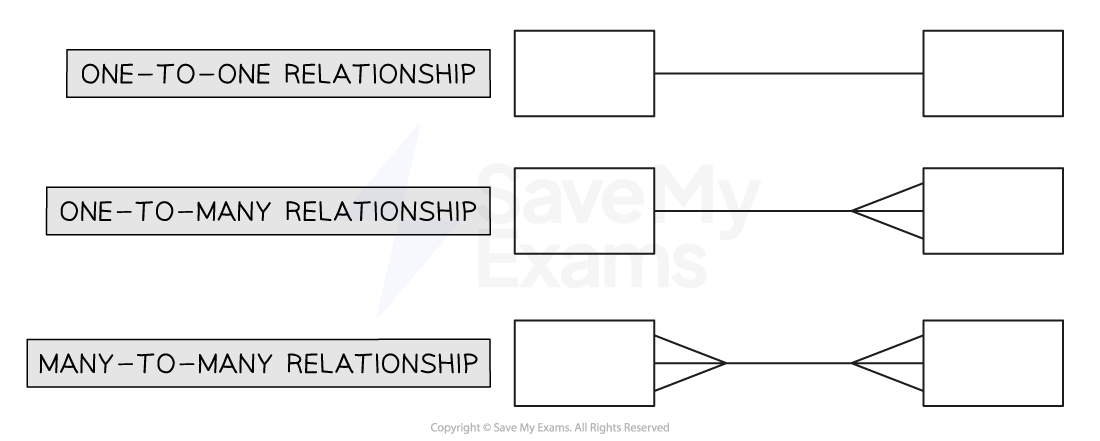
- The names of the entities would go inside the boxes
Exam Hint These diagrams are simple but tell us some important things about the database:
- The names of all the tables
- Which tables will have a foreign key - when an entity has a ‘many’ relationship against it that means it will have a foreign key in it that links to the primary key of the connected entity
Was this revision note helpful?
Build on this topic