Physical Properties of the Group 17 Elements (Cambridge International AS Chemistry)
Physical Trends in Group 17
- The Group 17 elements are called halogens
- The halogens have uses in water purification as bleaching agents (chlorine), as flame-retardants and fire extinguishers (bromine) and as antiseptic and disinfectant agents (iodine)
Colours
- All halogens have distinct colours which get darker going down the group
The colours and states of the Group 17 elements
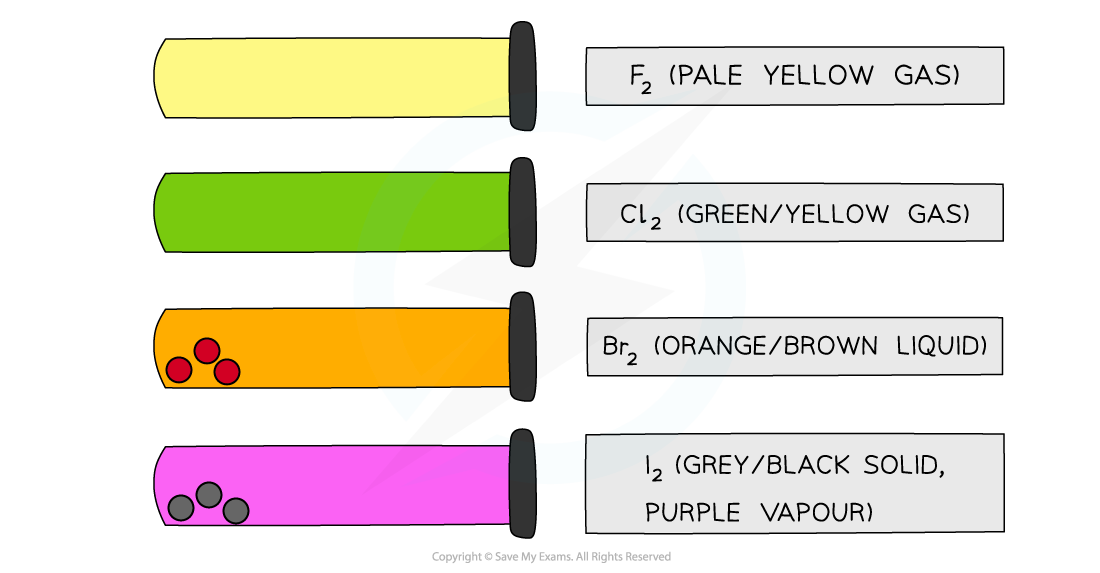
The colours of the Group 17 elements get darker going down the group
Volatility
-
Volatility refers to how easily a substance can evaporate
- A volatile substance will have a low melting and boiling point
Melting & boiling points of the Group 17 elements
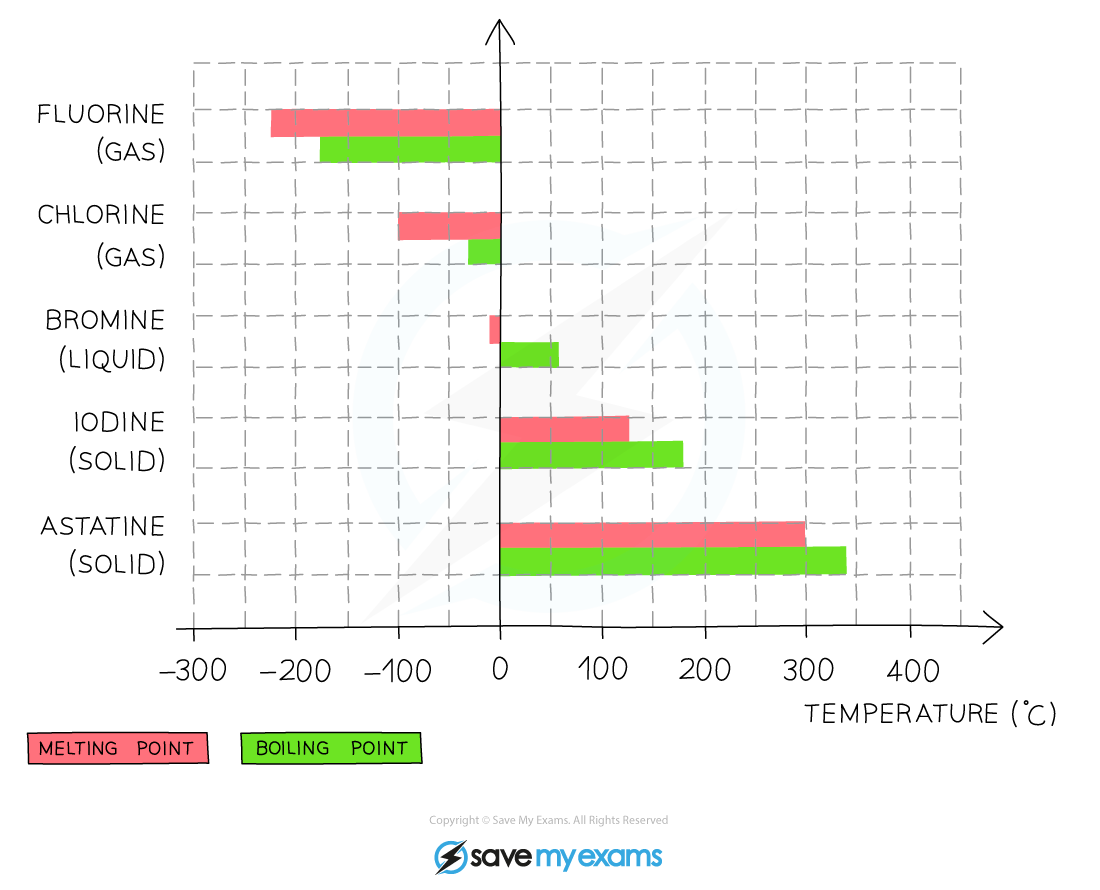
The melting & boiling points of the Group 17 elements increase going down the group which indicates that the elements become less volatile
-
Going down the group, the boiling point of the elements increases which means that the volatility of the halogens decreases
-
This means that fluorine is the most volatile and iodine the least volatile
Trends in Bond Strength of Group 17
- Halogens are diatomic molecules in which covalent bonds are formed by overlapping their orbitals
- In a covalent bond, the bonding pair of electrons is attracted to the nuclei on either side and it is this attraction that holds the molecule together
- Going down the group, the atomic size of the halogens increases
- The bonding pair of electrons get further away from the halogen nucleus and are therefore less strongly attracted towards in
Covalent bonding in Group 17 elements
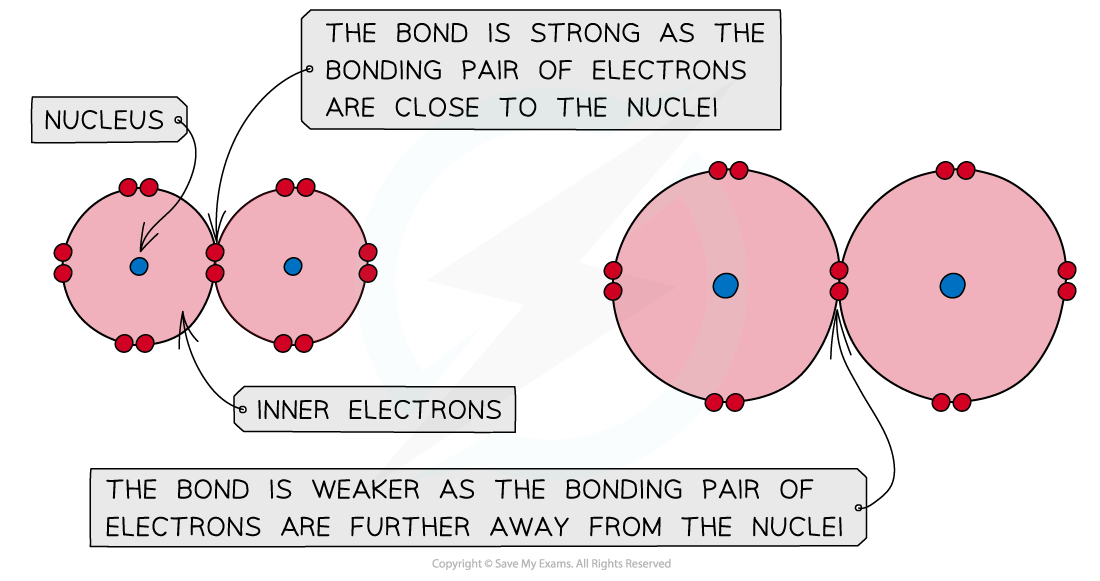
A covalent bond is formed by the orbital overlap of two atoms and the attraction of electrons towards the nuclei; the bigger the atom, the weaker the covalent bond
- The bond strength of the halogen molecules therefore decreases going down the group
Group 17 bond energies
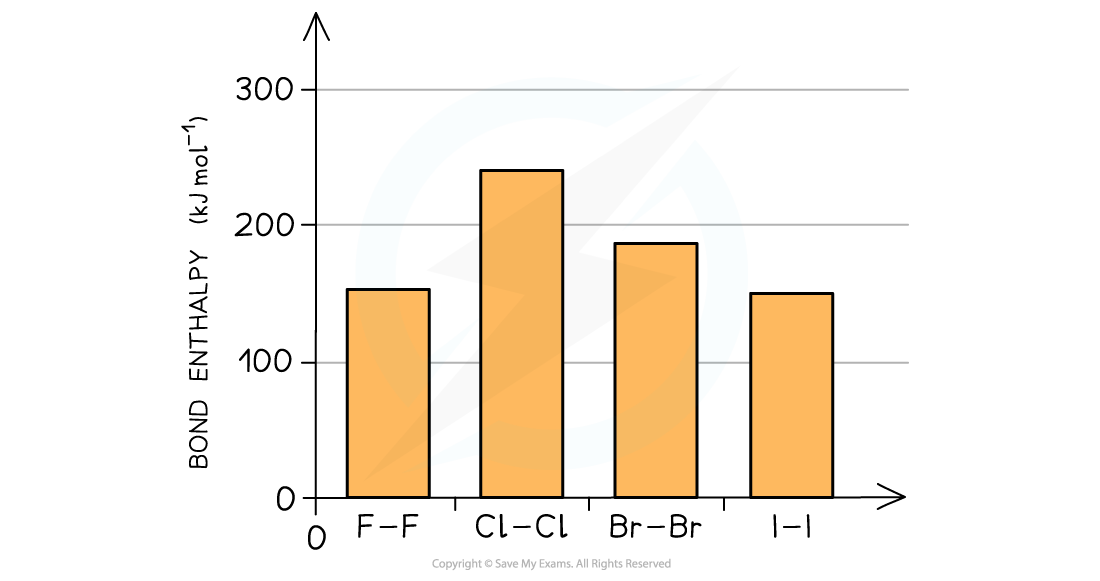
The bond energies of Cl-Cl, Br-Br and I-I decrease, indicating that the bond strengths decrease going down the group
- Bond energy is the energy required to break one mole of a particular covalent bond in the gaseous state
- The higher the bond energy, the stronger the bond
- An exception to this is fluorine which has a smaller bond energy than chlorine and bromine
- Fluorine is so small that when two atoms of fluorine get together their lone pairs get so close that they cause significant repulsion counteracting the attracting between the bonding pair of electrons and two nuclei
Lone pair repulsion in fluorine
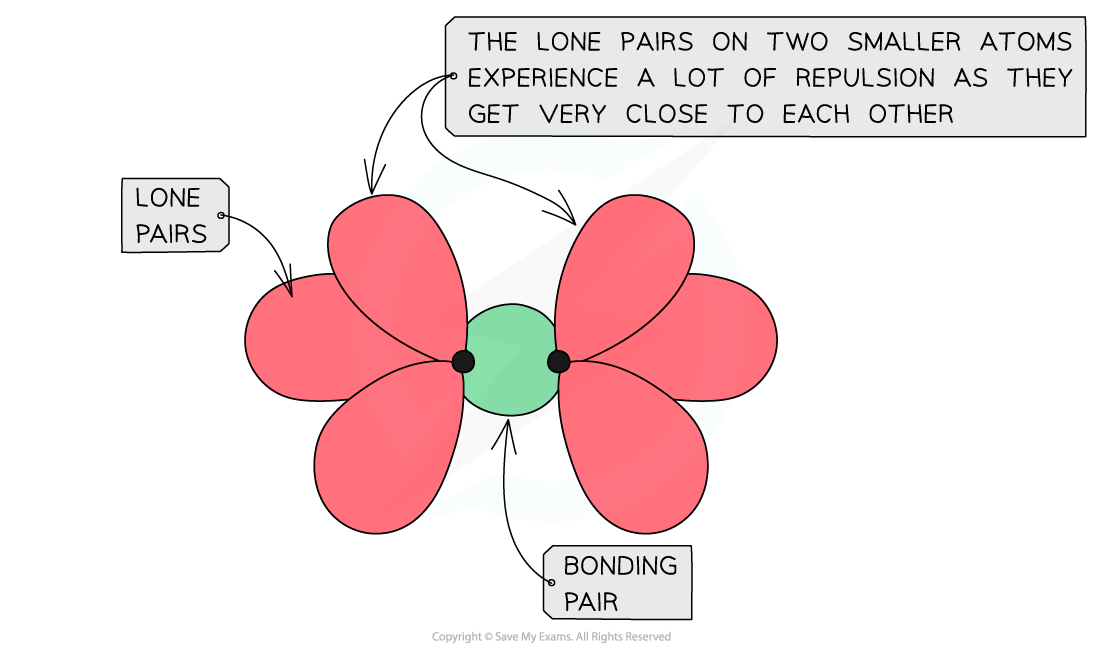
The lone pairs of fluorine get so close to each other in a fluorine molecule that they cause repulsion which decreases the bond strength
Dipole Forces & Volatility in Group 17
-
Halogens are non-metals and are diatomic molecules at room temperature
- This means that they exist as molecules which are made up of two similar atoms, such as F2
-
The halogens are simple molecular structures with weak van der Waals’ forces between the diatomic molecules caused by instantaneous dipole-induced dipole forces
Electron distribution in a nonpolar molecule
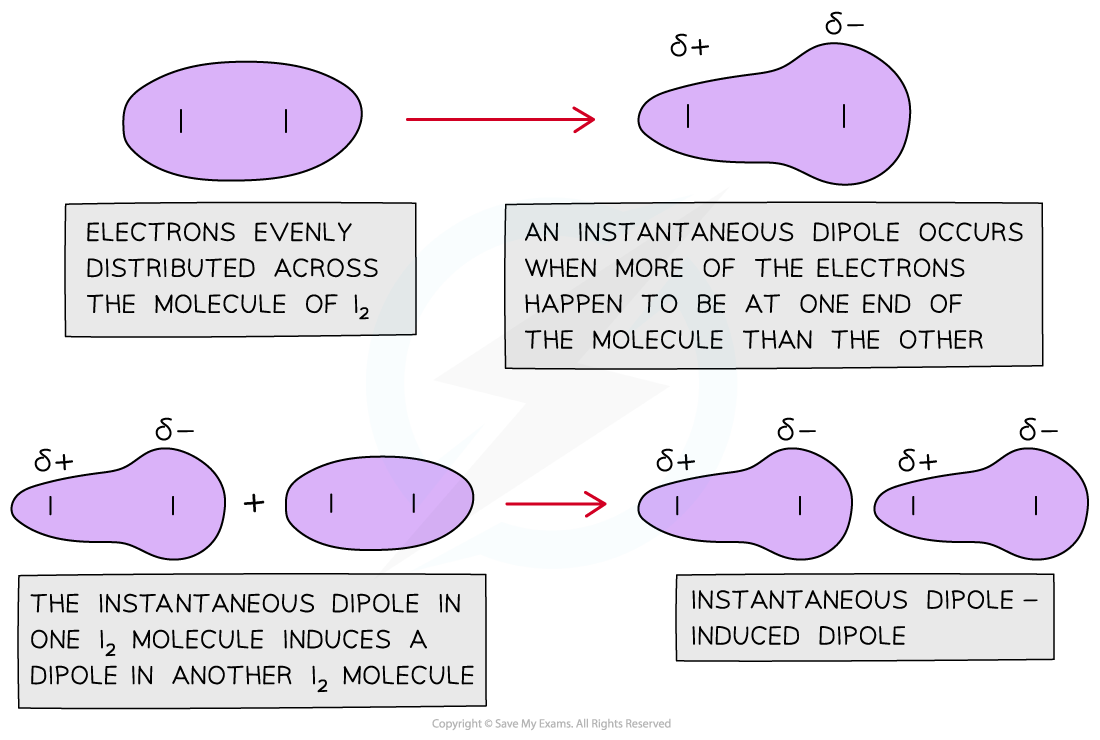
The diagram shows that a sudden distribution of electrons in a nonpolar molecule can cause an instantaneous dipole. When this molecule gets close to another non-polar molecule it can induce a dipole as the cloud of electrons repel the electrons in the neighbouring molecule to the other side
- The more electrons there are in a molecule, the greater the instantaneous dipole-induced dipole forces
- Therefore, the larger the molecule the stronger the van der Waals’ forces between molecules
- This is why as you go down the group, it gets more difficult to separate the molecules and the melting and boiling points increase
- As it gets more difficult to separate the molecules, the volatility of the halogens decreases going down the group
Van der Waals' forces and volatility in Group 17
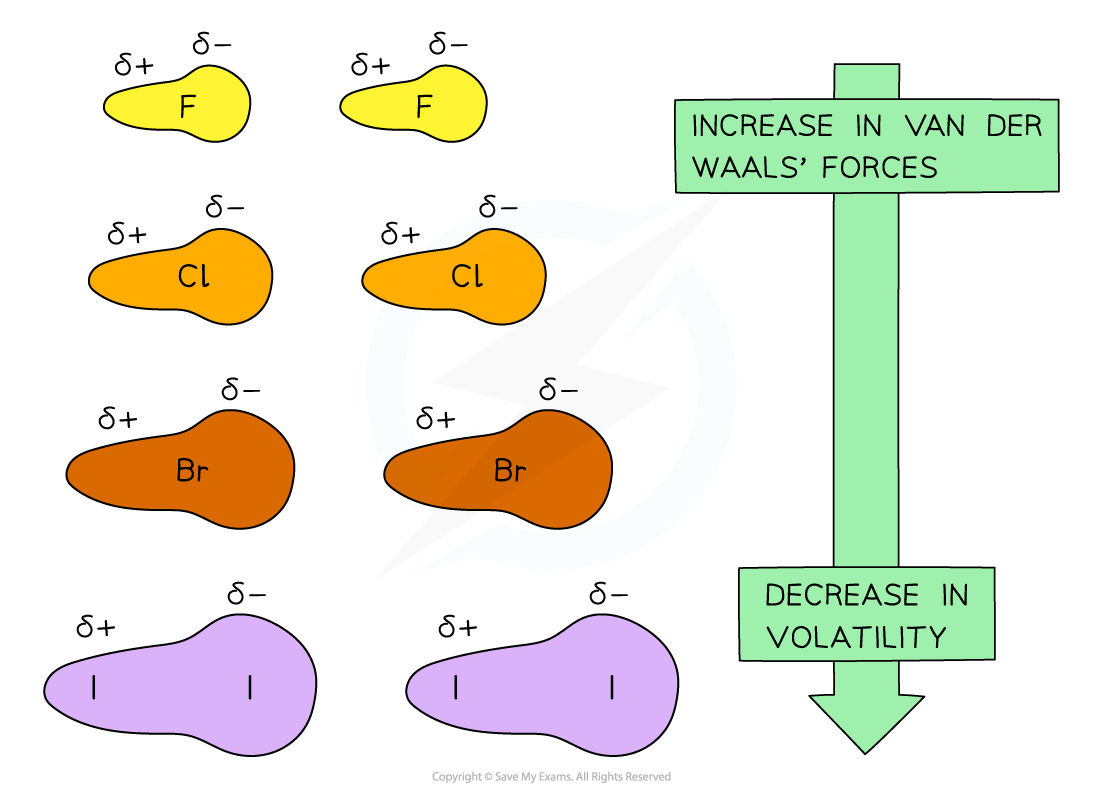
Going down the group, the van der Waals’ forces increase due to an increased number of electrons in the molecules which means that the volatility decreases
Exam Hint Instantaneous dipole – induced dipole (id–id) forces, also called London dispersion forces, are a type of van der Waals’ forces.
Was this revision note helpful?