Combustion & Free Radical Substitution of Alkanes (Cambridge International AS Chemistry)
Combustion & Free Radical Substitution of Alkanes
- Alkanes are combusted(burnt) on a large scale for their use as fuels
- They also react in free-radical substitution reactions to form more reactive halogenoalkanes
Complete combustion
-
When alkanes are burnt in excess(plenty of) oxygen, complete combustion will take place and all carbon and hydrogen will be oxidised to carbon dioxide and water respectively
- For example, the complete combustion of octane to carbon dioxide and water
The complete combustion of alkanes
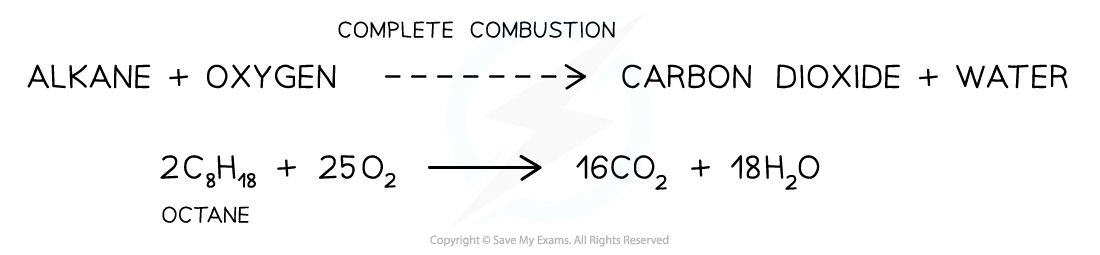
Complete combustion involves a plentiful supply of oxygen
Incomplete combustion
-
When alkanes are burnt in only a limited supply of oxygen, incomplete combustion will take place and not all the carbon is fully oxidised
-
Some carbon is only partially oxidised to form carbon monoxide
- For example, the incomplete combustion of octane to form carbon monoxide
The incomplete combustion of alkanes
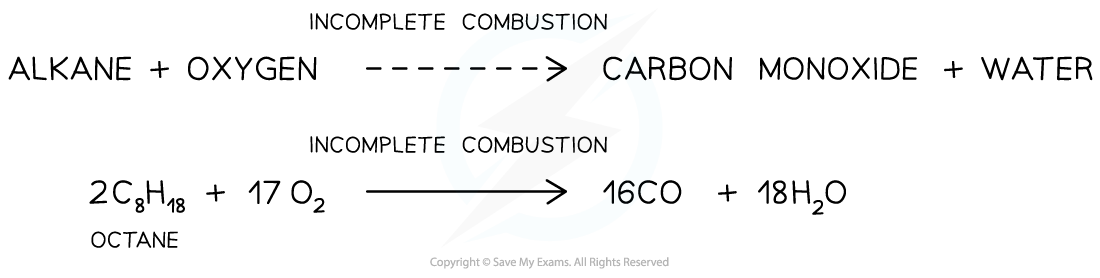
Incomplete combustion involves a limited supply of oxygen
- Carbon monoxide is a toxic gas as it will bind to haemoglobin in blood which can then no longer bind to oxygen
- As no oxygen can be transported around the body, victims will feel dizzy, lose consciousness and if not removed from the carbon monoxide, they can die
- Carbon monoxide is extra dangerous as it is odourless(it doesn’t smell) and will not be noticed
- Incomplete combustion often takes place inside a car engine due to a limited amount of oxygen present
Free-radical substitution of alkanes
-
Alkanes can undergo free-radical substitution in which a hydrogen atom gets substituted by a halogen (chlorine/bromine)
-
Since alkanes are very unreactive, ultraviolet light (sunlight) is needed for this substitution reaction to occur
-
The free-radical substitution reaction consists of three steps:
- In the initiation step, the halogen bond (Cl-Cl or Br-Br) is broken by UV energy to form two radicals
- These radicals create further radicals in a chain type reaction called the propagation step
- The reaction is terminated when two radicals collide with each other in a termination step
Was this revision note helpful?
Build on this topic