Acid & Base Dissociation (Cambridge International AS Chemistry)
Acid & Base Dissociation
Strong acids
-
A strong acid is an acid that dissociates almost completely in aqueous solutions
- E.g. HCl (hydrochloric acid), HNO3 (nitric acid) and H2SO4 (sulfuric acid)
-
The position of the equilibrium is so far over to the right that you can represent the reaction as an irreversible reaction
Diagram showing the dissociation of a strong acid in aqueous solution
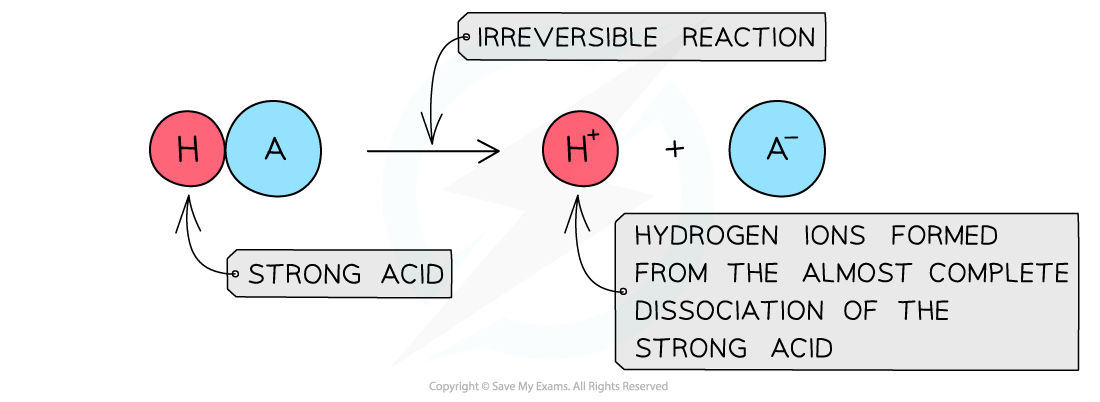
In an aqueous solution, a strong acid almost completely dissociates
-
The solution formed is highly acidic due to the high concentration of the H+ / H3O+ ions
-
Since the pH depends on the concentration of H+ / H3O+ ions, the pH can be calculated if the concentration of the strong acid is known
- The concentration of H+ / H3O+ ions can be written as [H+ (aq)]
-
pH is the negative log of the concentration of H+ / H3O+ ions and can be calculated, if the concentration of the strong acid is known, using the stoichiometry of the reaction (A Level only)
pH = –log10[H+(aq)]
Weak acids
-
A weak acid is an acid that partially (or incompletely) dissociates in aqueous solutions
- E.g. most organic acids (ethanoic acid), HCN (hydrocyanic acid), H2S (hydrogen sulfide) and H2CO3 (carbonic acid)
-
The position of the equilibrium is more to the left and an equilibrium is established
Diagram showing the dissociation of a weak acid in aqueous solution
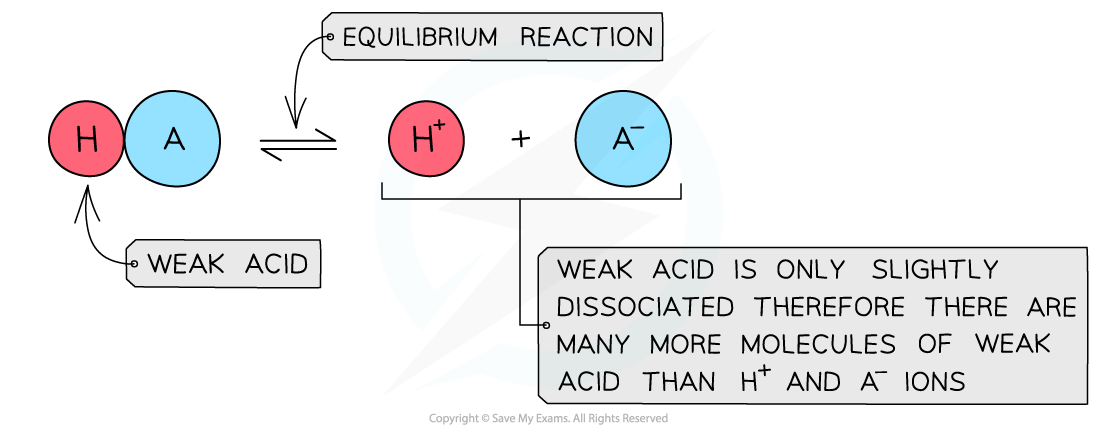
In an aqueous solution, a weak acid does not fully dissociate
- The solution is less acidic due to the lower concentration of H+ / H3O+ ions
- Finding the pH of a weak acid is a bit more complicated as now the concentration of H+ ions is not equal to the concentration of acid
- To find the concentration of H+ ions, the acid dissociation constant (Ka) should be used
Acid & equilibrium position summary
-
Position of equilibrium
- Strong acid; right
- Weak acid; left
-
Dissociation
- Strong acid; fully dissociated (→)
- Weak acid; partially dissociated ()
-
H+ concentration
- Strong acid; high concentration
- Weak acid; low concentration
-
pH
- Strong acid; use [strong acid] for [H+]
- Weak acid; use Ka to find [H+]
-
Examples
- Strong acid; HCl, HNO3, H2SO4 (first ionisation)
- Weak acid; Organic acids, e.g. ethanoic acid, HCN, H2S, H2CO3
Strong bases
-
A strong base is a base that dissociates almost completely in aqueous solutions
- E.g. Group 1 metal hydroxides such as NaOH (sodium hydroxide)
-
The position of the equilibrium is so far over to the right that you can represent the reaction as an irreversible reaction
Diagram showing the dissociation of a strong base in aqueous solution
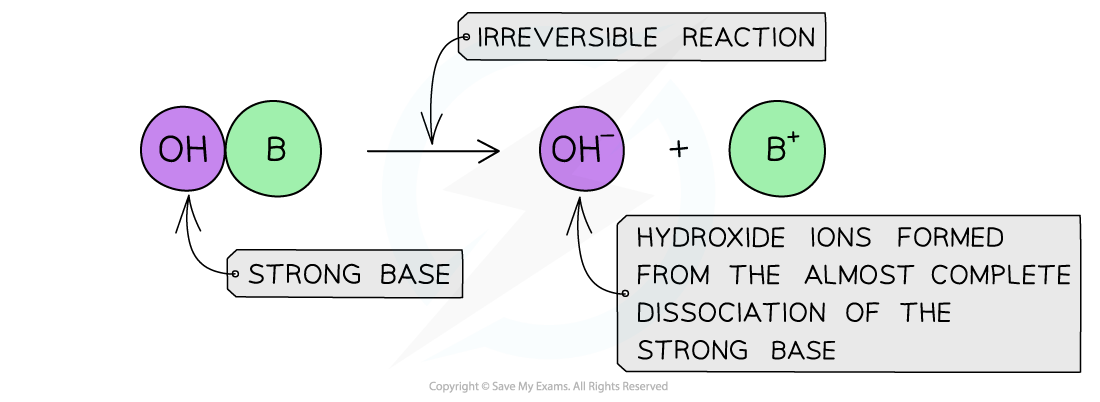
In an aqueous solution, a strong base almost completely dissociates
- The solution formed is highly basic due to the high concentration of the OH– ions
Weak bases
-
A weak base is a base that partially (or incompletely) dissociates in aqueous solutions
- E.g. NH3 (ammonia), amines and some hydroxides of transition metals
-
The position of the equilibrium is more to the left and an equilibrium is established
Diagram showing the dissociation of a weak base in aqueous solution
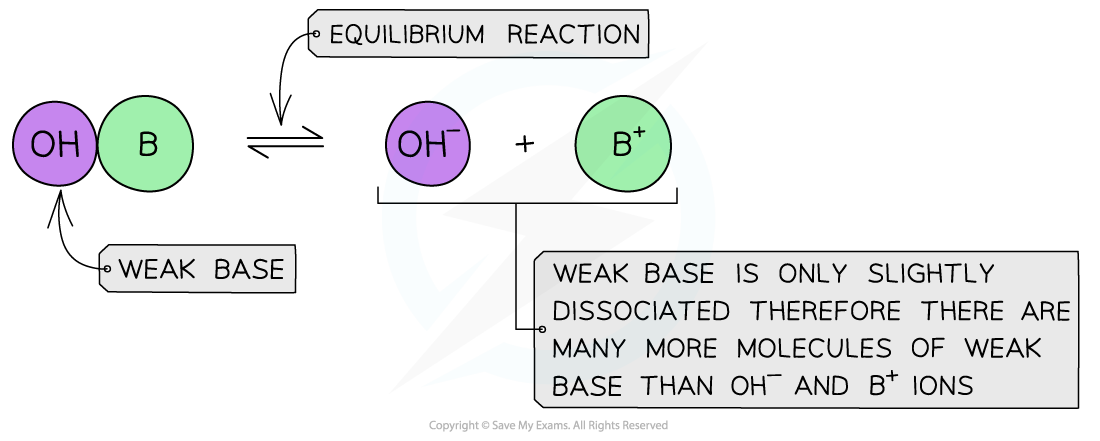
In an aqueous solution, a weak base does not fully dissociate
- The solution is less basic due to the lower concentration of OH- ions
Base & equilibrium position summary
-
Position of equilibrium
- Strong base; right
- Weak base; left
-
Dissociation
- Strong base; fully dissociated (→)
- Weak base; partially dissociated ()
-
OH- concentration
- Strong base; high concentration
- Weak base; low concentration
-
Examples
- Strong base; Group 1 metal hydroxides
- Weak base; NH3 amines, some transition metal hydroxides
Exam Hint
- Hydrogen ions in aqueous solutions can be written as either as H3O+ or as H+ however, if H3O+ is used, H2O should be included in the chemical equation:
HCl (g) → H+ (aq) + Cl- (aq) ** or HCl (g) + H2O (l) → H3O+ (aq) + Cl**- (aq)
Remember that some acids are both strong and weak acids – for example, H2SO4 (sulfuric acid) has two hydrogen ions that can ionise.
- H2SO4 acts as a strong acid: H2SO4→ H++ HSO4-
- HSO4- acts as a weak acid: HSO4-⇌ H+ + SO42-
Also, don't forget that the terms strong and weak acids and bases are related to the degree of dissociation and not the concentration.
- The appropriate terms to use when describing concentration are dilute and concentrated.
Was this revision note helpful?
Build on this topic