Nitriles & Hydroxynitriles (Cambridge International AS Chemistry)
Production of Nitriles
- Nitriles are compounds with a -CN functional group
- They can be prepared from the nucleophilic substitution of halogenoalkanes
Propanenitrile, an example of a nitrile

There are 2 alkyl type carbon atoms and the nitrile carbon for a total of 3 carbon atoms in propanenitrile
Reaction with KCN
-
The nucleophile in this reaction is the cyanide, CN- ion
-
Ethanolic solution of potassium cyanide (KCN in ethanol) is heated under reflux with the halogenoalkane
-
The product is a nitrile
- If an aqueous solution of potassium cyanide (KCN (aq)) is heated under reflux with the halogenoalkane, an alcohol can be formed instead of the nitrile
The reaction of bromoethane with ethanolic KCN
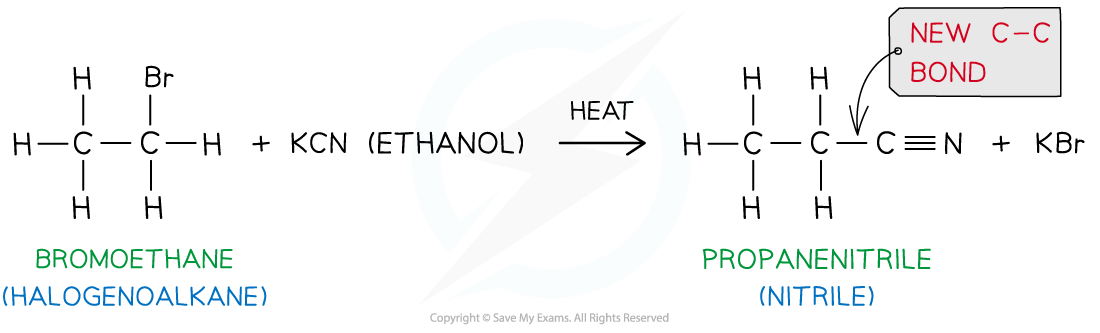
Bromoethane reacts with ethanolic potassium cyanide when heated under reflux to form propanenitrile
Exam Hint The nucleophilic substitution of halogenoalkanes with KCN adds an extra carbon atom to the carbon chain
This reaction can therefore be used by chemists to make a compound with one more carbon atom than the best available organic starting material
Production of Hydroxynitriles
- Hydroxynitriles are compounds with both a hydroxy (-OH) and cyanide (-CN) functional group
- They can be prepared from the nucleophilic addition of aldehydes and ketones
2-hydroxy-2-methylpropanenitrile, an example of a hydroxynitrile compound

Hydroxynitriles contain an OH and a CN group, typically attached to the same carbon atom
Reaction with HCN
- The nucleophilic addition of hydrogen cyanide to carbonyl compounds is a two-step process
- In step 1, the cyanide ion attacks the carbonyl carbon to form a negatively charged intermediate
- In step 2, the negatively charged oxygen atom in the reactive intermediate quickly reacts with aqueous H+ (either from HCN, water or dilute acid) to form a 2-hydroxynitrile
Nucleophilic addition of HCN to carbonyl compounds
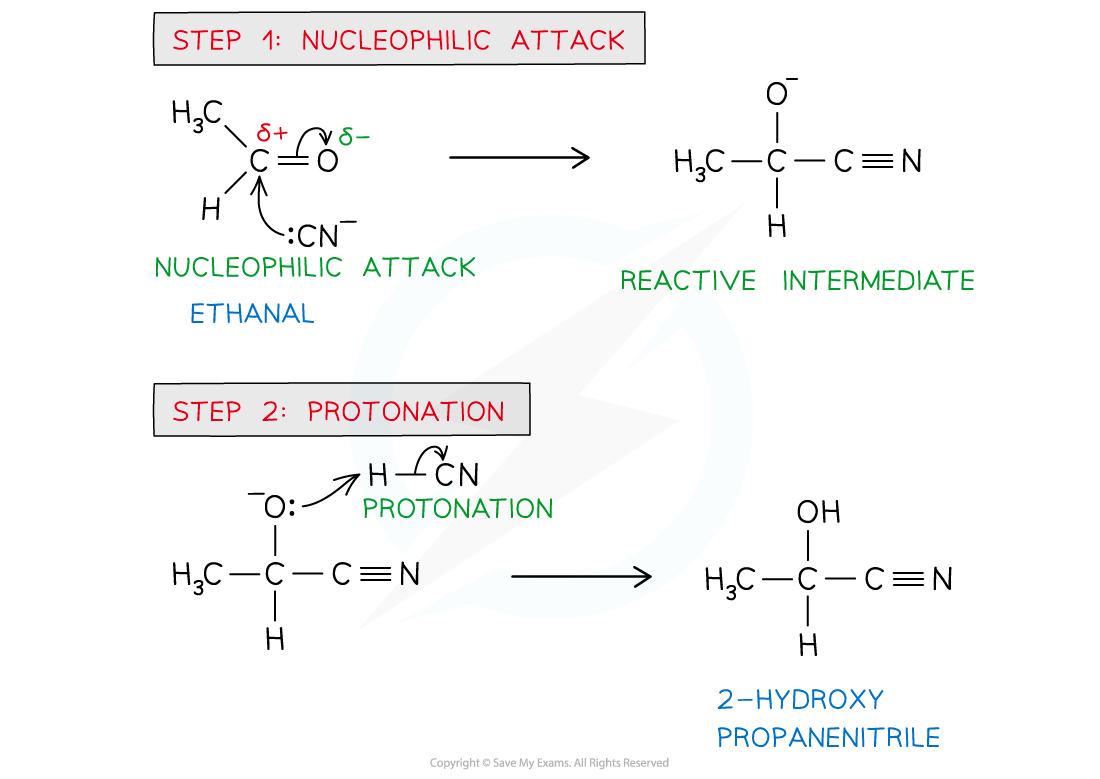
The cyanide ion attacks the carbonyl carbon to form a negatively charged intermediate which quickly reacts with a proton to form a 2-hydroxynitrile compound
Exam Hint The actual negative charge on the cyanide ion is on the carbon atom and not on the nitrogen atom
Hydrolysis of Nitriles
Spec point —
19.2.3
-
Nitriles are hydrolysed by either dilute acid or dilute alkali followed by acidification to give a carboxylic acid
- Hydrolysis is the breakdown of a compound using water
Hydrolysis of nitriles
-
Nitriles are hydrolysed by either dilute acid or dilute alkali followed by acidification
- Hydrolysis by dilute acid results in the formation of a carboxylic acid and ammonium salt
- Hydrolysis by dilute alkali results in the formation of a sodium carboxylate salt and ammonia; Acidification is required to change the carboxylate ion into a carboxylic acid
-
The -CN group at the end of the hydrocarbon chain is converted to a -COOH group
Hydrolysis of nitriles
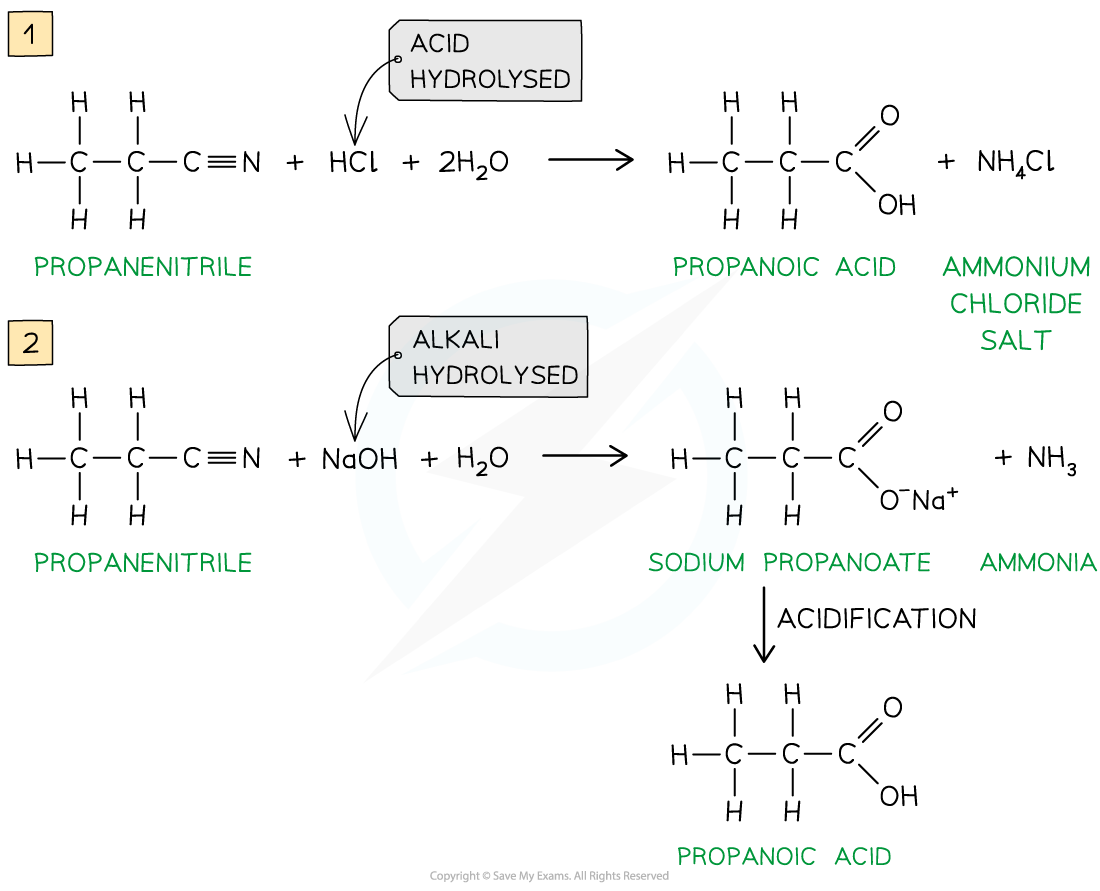
Hydrolysis of nitriles by either dilute acid (1) or dilute alkali and acidification (2) will form a carboxylic acid
Exam Hint Unlike the formation of nitriles which add an extra carbon atom to the carbon chain, hydrolysis doesn’t change the number of carbon atoms
Was this revision note helpful?