Period 3 Chlorides (Cambridge International AS Chemistry)
Exam board Cambridge International · ASUpdated 2026-10-19
Reaction of Period 3 Chlorides & Water
- Chlorides of Period 3 elements show characteristic behaviour when added to water which can be explained by looking at their chemical bonding and structure
Chemical bonding & structure of Period 3 chlorides table
| Period 3 chloride | NaCl | MgCl2 | Al2Cl6 | SiCl4 | PCl5 | SCl2 |
|---|---|---|---|---|---|---|
| Chemical bonding | Ionic | Ionic | Covalent | Covalent | Covalent | Covalent |
| Structure | Giant ionic | Giant ionic | Simple molecular | Simple molecular | Simple molecular | Simple molecular |
| Observations | White solids dissolve to form colourless solutions | Chlorides react with water giving off white fumes of hydrogen chloride gas | ||||
| pH of solution formed | 7.0 | 6.5 | 3.0 | 2.0 | 2.0 | 2.0 |
Sodium & magnesium chloride
- NaCl and MgCl2 do not react with water as the polar water molecules are attracted to the ions dissolving the chlorides and breaking down the giant ionic structures: the metal and chloride ions become hydrated ions
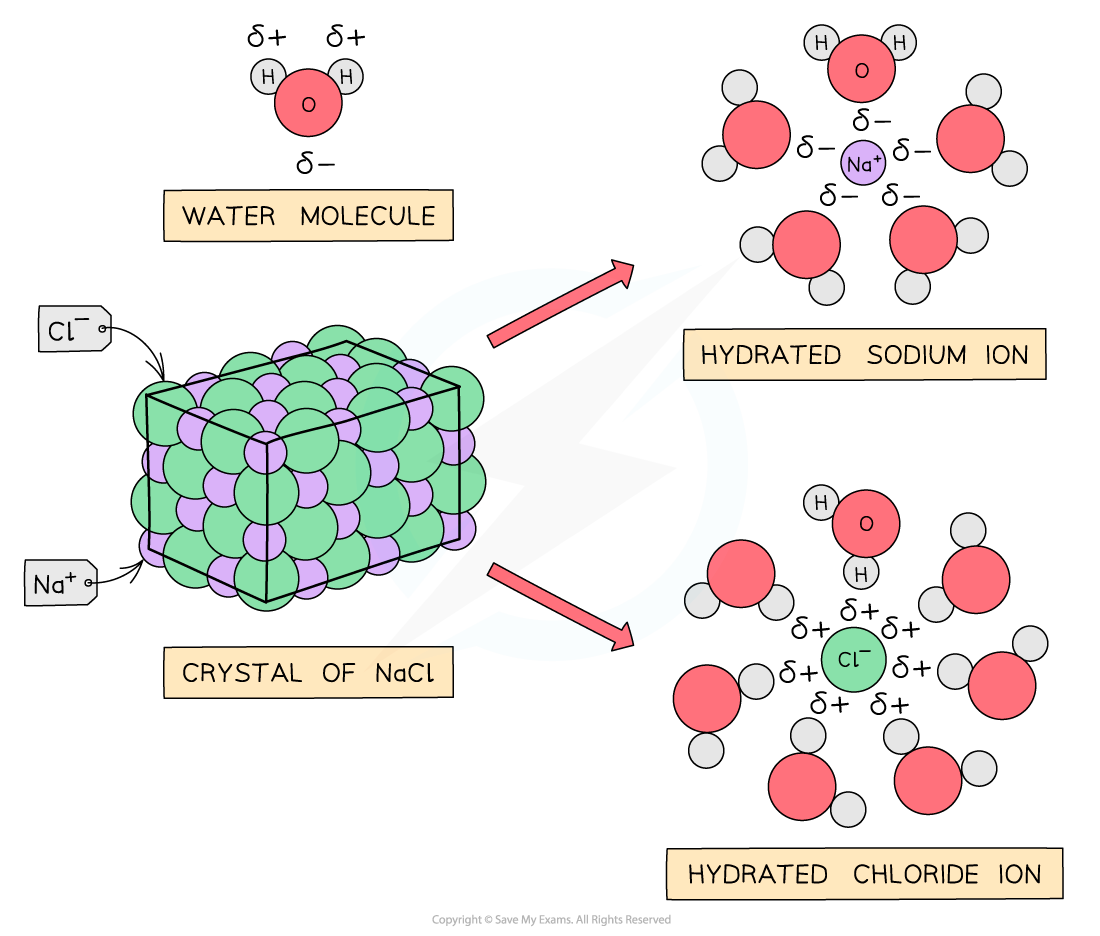
The diagram shows water molecules breaking down the giant ionic structure of NaCl to form hydrated ions
Aluminium chloride
-
Aluminium chloride exists in two different forms depending on conditions: #### The two forms of aluminium chloride
- Anhydrous AlCl3 is covalent and exists as a dimer, Al2Cl6
- In aqueous solution, AlCl3 dissociates into Al3+ and Cl- ions and behaves ionically
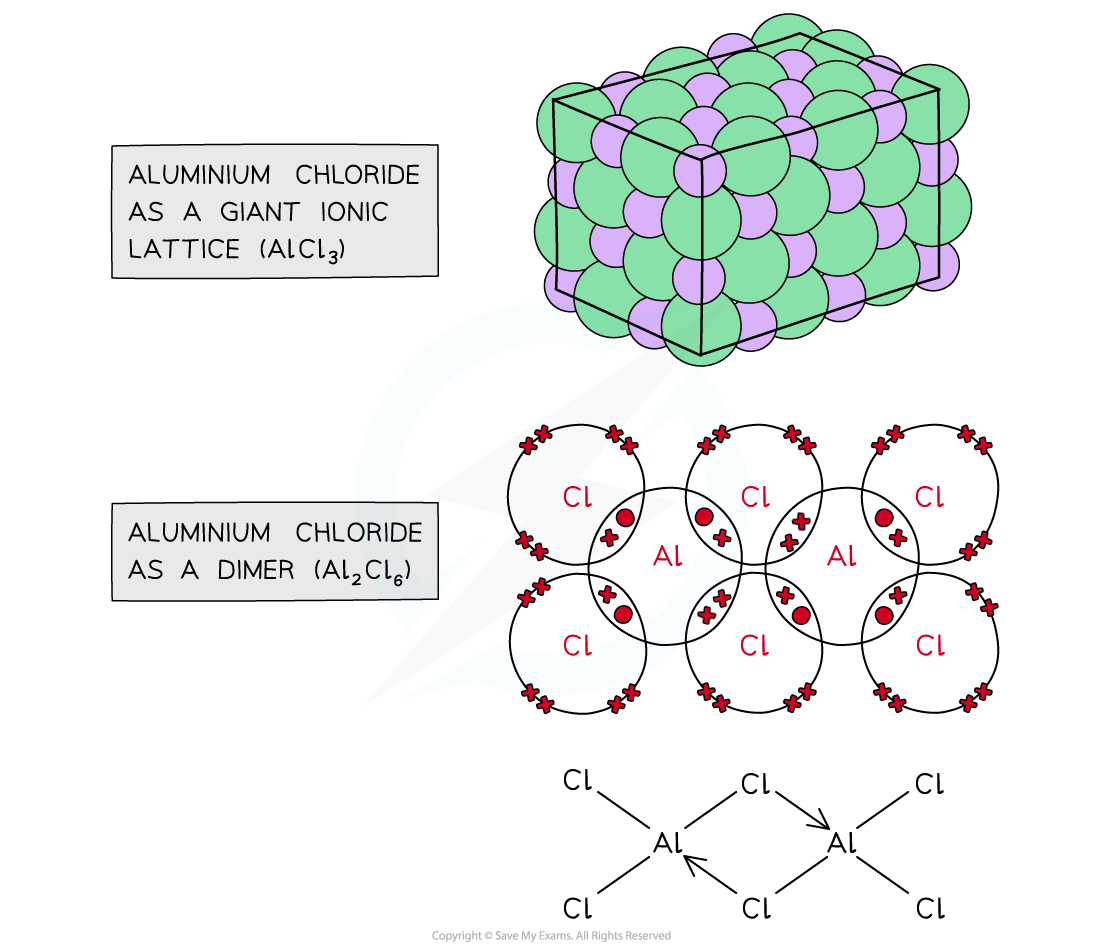
Aluminium chloride exists as a giant ionic lattice or a covalent dimer
- When water is added to aluminium chloride the dimers are broken down and Al3+ and Cl- ions enter the solution
- The highly charged Al3+ ion becomes hydrated and causes a water molecule that is bonded to the Al3+ to lose an H+ ion which turns the solution acidic
- The H+ and the Cl- form hydrogen chloride gas which is given off as white fumes
How the Al3+ makes an acidic solution
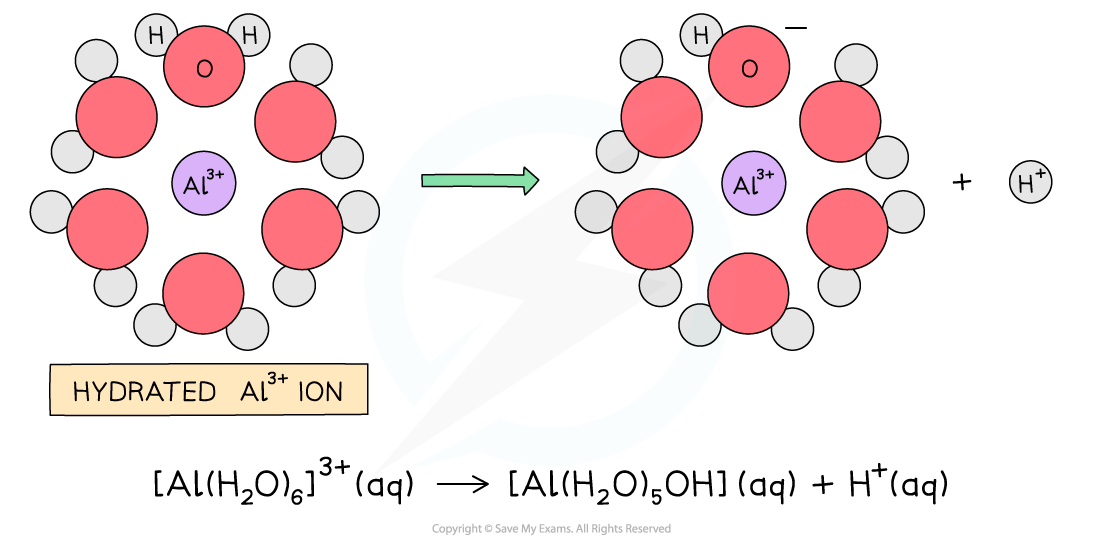
The hydrated aluminium causes a water molecule to lose a hydrogen ion turning the solution acidic
Silicon chloride
- SiCl4 is hydrolysed in water, releasing white fumes of hydrogen chloride gas in a rapid reaction
SiCl4 (l) + 2H2O (l) → SiO2 (s) + 4HCl (g)
- The SiO2 is seen as a white precipitate and some of the hydrogen chloride gas produced dissolves in water to form an acidic solution
Phosphorus(V) chloride
- PCl5 also gets hydrolysed in water
PCl5 (s) + 4H2O (l) → H3PO4 (aq) + 5HCl (g)
- Both H3PO4 and dissolved HCl are highly acidic
Was this revision note helpful?
Build on this topic