Testing for Carbonyl Compounds (Cambridge International AS Chemistry)
Testing for Carbonyls: 2,4-DNPH
-
2,4-dinitrophenylhydrazine (also known as 2,4-DNPH) is a reagent which detects the presence of carbonyl compounds(compounds with -C=O group)
-
The carbonyl group of aldehydes and ketones undergoes a condensation reaction with 2,4-dinitrophenylhydrazine
- A condensation reaction is a reaction in which two molecules join together and a small molecule (such as H2O or HCl) is eliminated
-
The product formed when 2,4-DNPH is added to a solution that contains an aldehyde or ketone is a deep-orange precipitate which can be purified by recrystallisation
-
The melting point of the formed precipitate can then be measured and compared to literature values to find out which specific aldehyde or ketone had reacted with 2,4-DNPH
Example reaction of a ketone with 2,4-DNPH
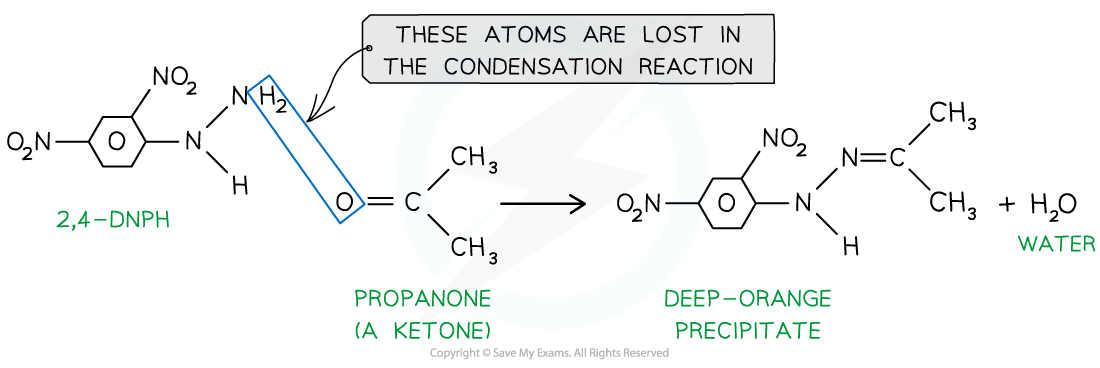
Ketones and aldehydes react with 2,4-DNPH in a condensation reaction
Results of chemical tests using 2,4-DNPH
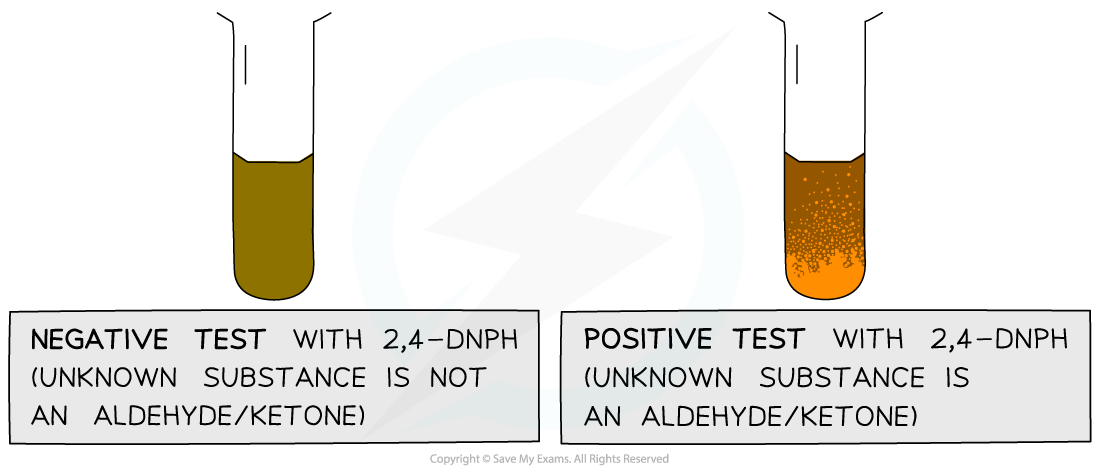
The test tube on the left shows a negative 2,4-DNPH test and the tube on the right shows a positive test
Exam Hint The 2,4-DNPH is especially useful as other carbonyl compounds such as carboxylic acids and esters do not give a positive test
Identifying Carbonyls: Fehling's Solution & Tollens' Reagent
- The presence of an aldehyde group (-CHO) in an unknown compound can be determined by the oxidising agents Fehling’s and Tollens’ reagents
Fehling’s solution
-
Fehling’s solution is an alkaline solution containing copper(II) ions which act as the oxidising agent
-
When warmed with an aldehyde, the aldehyde is oxidised to a carboxylic acid and the Cu2+ ions are reduced to Cu+ ions
- In the alkaline conditions, the carboxylic acid formed will be neutralised to a carboxylate ion (the -COOH will lose a proton to become -COO- )
- The carboxylate ion (-COO-) will form a salt with a positively charged metal ion such as sodium (-COO-Na+)
-
The clear blue solution turns opaque due to the formation of a red precipitate, copper(I) oxide
-
Ketones cannot be oxidised and therefore give a negative test when warmed with Fehling’s solution
Colour change using Fehling's solution
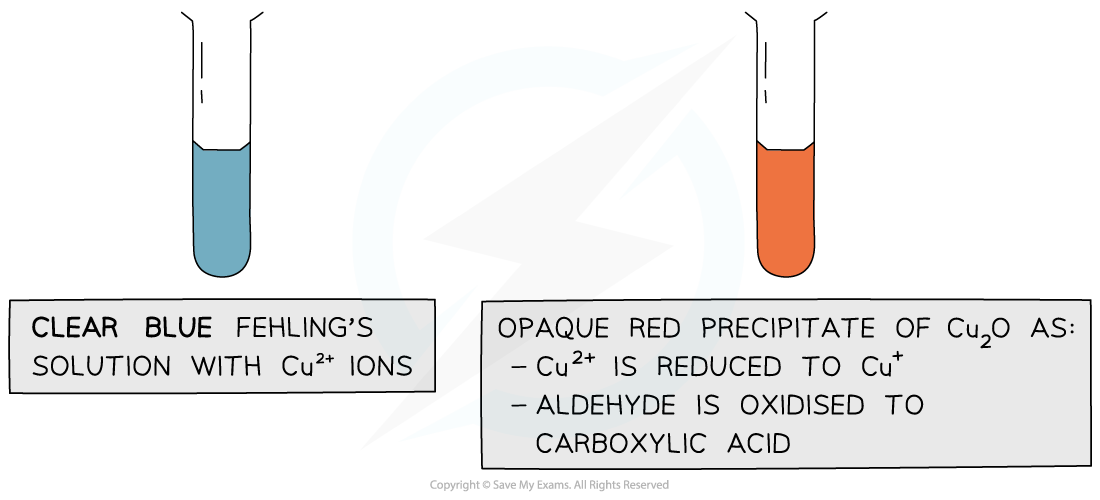
The copper(II) ions in Fehling’s solution are oxidising agents. They can oxidise an aldehyde to a carboxylic acid and are themselves reduced to copper(I) ions in the copper(I)oxide precipitate
Tollens’ reagent
-
Tollens' reagent is an aqueous alkaline solution of silver nitrate in excess ammonia solution
- Tollens' reagent is also called ammoniacal silver nitrate solution
-
When warmed with an aldehyde, the aldehyde is oxidised to a carboxylic acid and the Ag+ ions are reduced to Ag atoms
- In the alkaline conditions, the carboxylic acid will become a carboxylate ion and form a salt
-
The Ag atoms form a silver ‘mirror’ on the inside of the tube
-
Ketones cannot be oxidised and therefore give a negative test when warmed with Tollens’ reagent
Colour change using Tollens' reagent
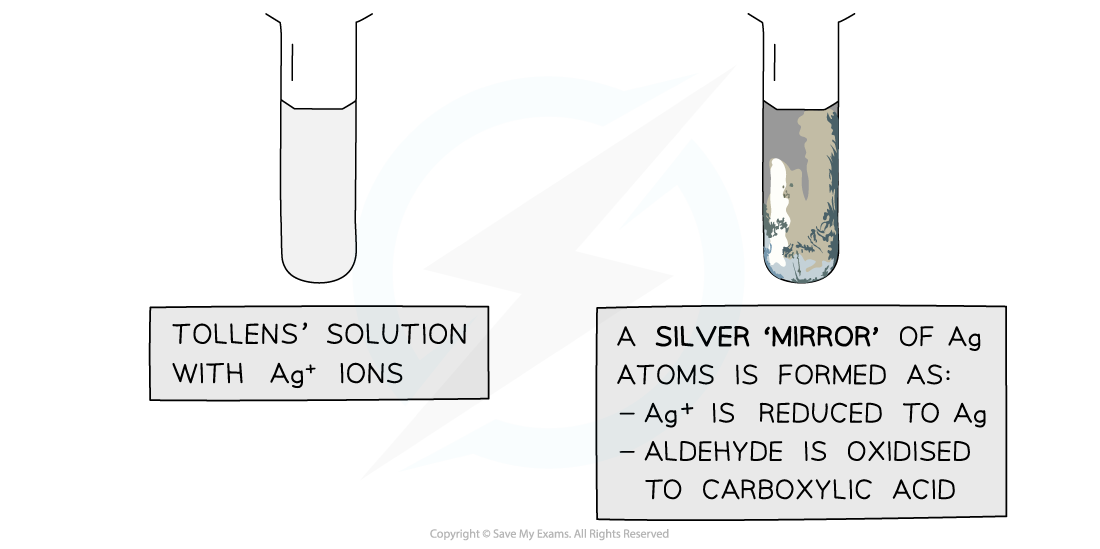
The Ag+ ions in Tollens’ reagent are oxidising agents. They can oxidise an aldehyde to a carboxylic acid and are themselves reduced to silver atoms
Was this revision note helpful?
Build on this topic