Classifying & Testing for Alcohols (Cambridge International AS Chemistry)
Classifying Alcohols
- Primary alcohols are alcohols in which the carbon atom bonded to the -OH group is attached to one other carbon atom (or alkyl group)
- Secondary alcohols are alcohols in which the carbon atom bonded to the -OH group is attached to two other carbon atoms (or alkyl groups)
- Tertiary alcohols are alcohols in which the carbon atom bonded to the -OH group is attached to three other carbon atoms (or alkyl groups)
Primary, secondary and tertiary alcohols
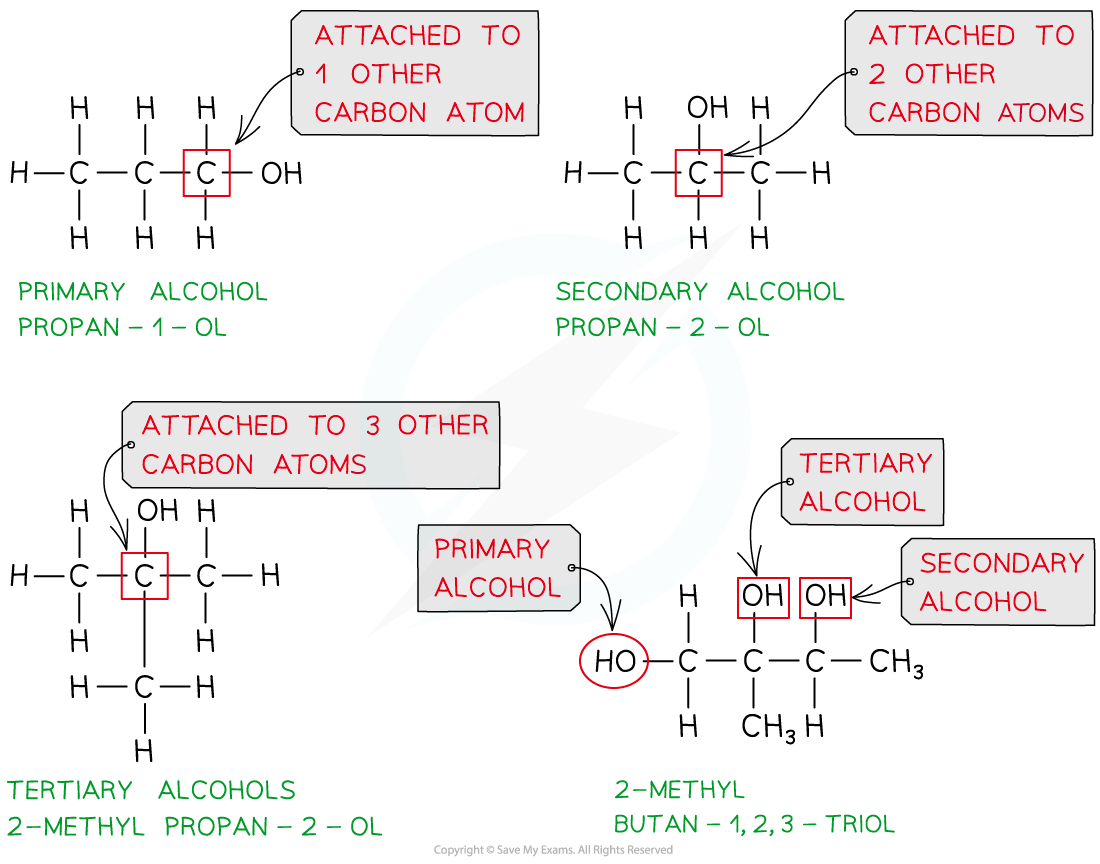
Classifying primary, secondary and tertiary alcohols and alcohols with more than one alcohol group
-
Only primary and secondary alcohols can get oxidised when mildly oxidised with acidified K2Cr2O7
- Primary alcohols get mildly oxidised to aldehydes
- Secondary alcohols get mildly oxidized to ketones
-
Tertiary alcohols do not undergo oxidation with acidified K2Cr2O7
-
Therefore, only the oxidation of primary and secondary alcohols will change the colour of K2Cr2O7 solution as the orange Cr2O72- ions are reduced to green Cr3+ ions
Testing for alcohols
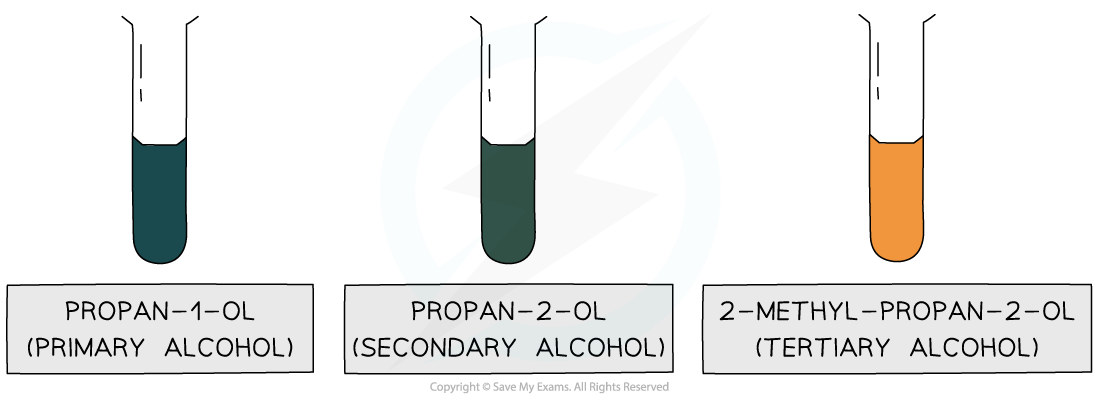
Only propan-1-ol and propan-2-ol, which are primary and secondary alcohols respectively, can get oxidised, turning the orange solution green; no colour change is observed with 2-methyl-propan-2-ol, which is a tertiary alcohol
Test for Alcohols
-
Tri-iodomethane (also called iodoform) is a yellow precipitate
-
It is formed from the reaction of iodine in an alkaline solution with methyl ketones
- Methyl ketones are compounds that have a CH3CO-group
- Ethanal also contains a CH3CO- group and therefore also forms a yellow precipitate with alkaline iodine
-
The reagent is heated with an alkaline solution of iodine
-
This reaction involves a halogenation and hydrolysis step
- In the halogenation step, all three H-atoms in the -CH3 (methyl) group are replaced with iodine atoms, forming a -CI3 group
- The intermediate compound is hydrolysed by an alkaline solution to form a sodium salt (RCO2- Na+) and a yellow precipitate of CHI3
The iodoform reaction

The reaction of methyl ketones with alkaline iodine results in the formation of a yellow CHI3 precipitate
Iodoform & alcohols
-
The position of a secondary alcohol group in a molecule can be identified using the iodoform test with iodine in alkaline solution
-
If the –OH group is attached to a carbon atom that is next to a methyl group, the alcohol can be oxidised by the alkaline iodine to form a methyl ketone (RCOCH3)
-
The methyl ketone then undergoes:
- Halogenation, where the three hydrogen atoms of the methyl group are replaced by iodine atoms (–CI3), followed by
- Hydrolysis, forming a sodium carboxylate salt and a yellow precipitate of iodoform (CHI3)
-
-
A positive result (yellow precipitate) indicates that the alcohol has the structure CH₃CH(OH)R
-
No precipitate means the secondary alcohol is not adjacent to a methyl group and therefore cannot form a methyl ketone intermediate
Using the iodoform test
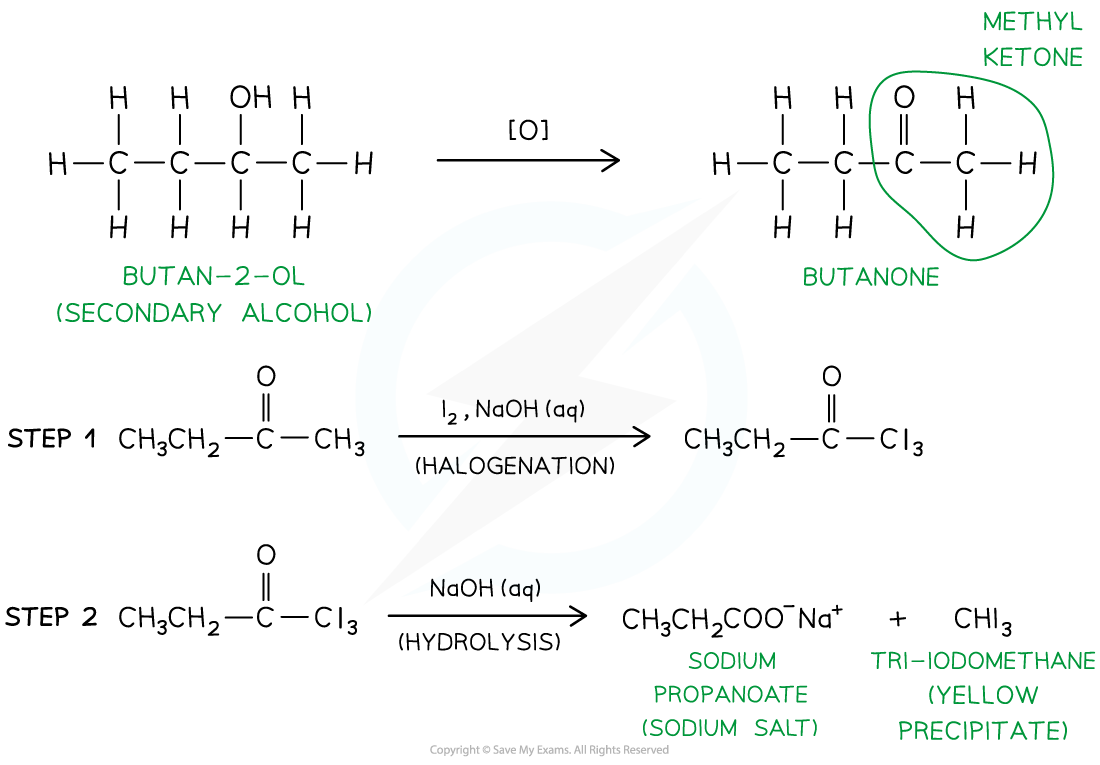
The secondary alcohol butan-2-ol will firstly get oxidised to the methyl ketone butanone which will form a yellow precipitate when reacted with alkaline iodine
Was this revision note helpful?
Build on this topic