Reactivity of Halogenoalkanes (Cambridge International AS Chemistry)
Exam board Cambridge International · ASUpdated 2026-10-19
Reactivity of Halogenoalkanes
- The halogenoalkanes have different rates of substitution reactions
- Since substitution reactions involve breaking the carbon-halogen bond the bond energies can be used to explain their different reactivities
Halogenoalkane bond energy table
| Bond | Bond Energy / kJ mol–1 |
|---|---|
| C–F | 467 (strongest bond) |
| C–Cl | 346 |
| C–Br | 290 |
| C–I | 228 (weakest bond) |
- The table above shows that the C-I bond requires the least energy to break, and is therefore the weakest carbon-halogen bond
- During substitution reactions the C-I bond will therefore heterolytically break as follows:
R3C-I + OH–→R3C-OH + I–
halogenoalkane → alcohol
- The C-F bond, on the other hand, requires the most energy to break and is, therefore, the strongest carbon-halogen bond
- Fluoroalkanes will therefore be less likely to undergo substitution reactions
Aqueous silver nitrate
- Reacting halogenoalkanes with aqueous silver nitrate solution will result in the formation of a precipitate
- The rate of formation of these precipitates can also be used to determine the reactivity of the halogenoalkanes
Halogenoalkane precipitates
-
Chlorides
- White (silver chloride) precipitate
-
Bromides
- Cream (silver bromide)
-
Iodides
- Yellow (silver iodide)
-
The formation of the yellow silver iodide is the fastest (fastest nucleophilic substitution reaction)
-
Fluoroalkanes react the slowest (slowest nucleophilic substitution reaction) and give no precipitate, because silver fluoride is soluble
-
This confirms that fluoroalkanes are the least reactive and iodoalkanes are the most reactive halogenoalkanes
The trend in reactivity of halogenoalkanes
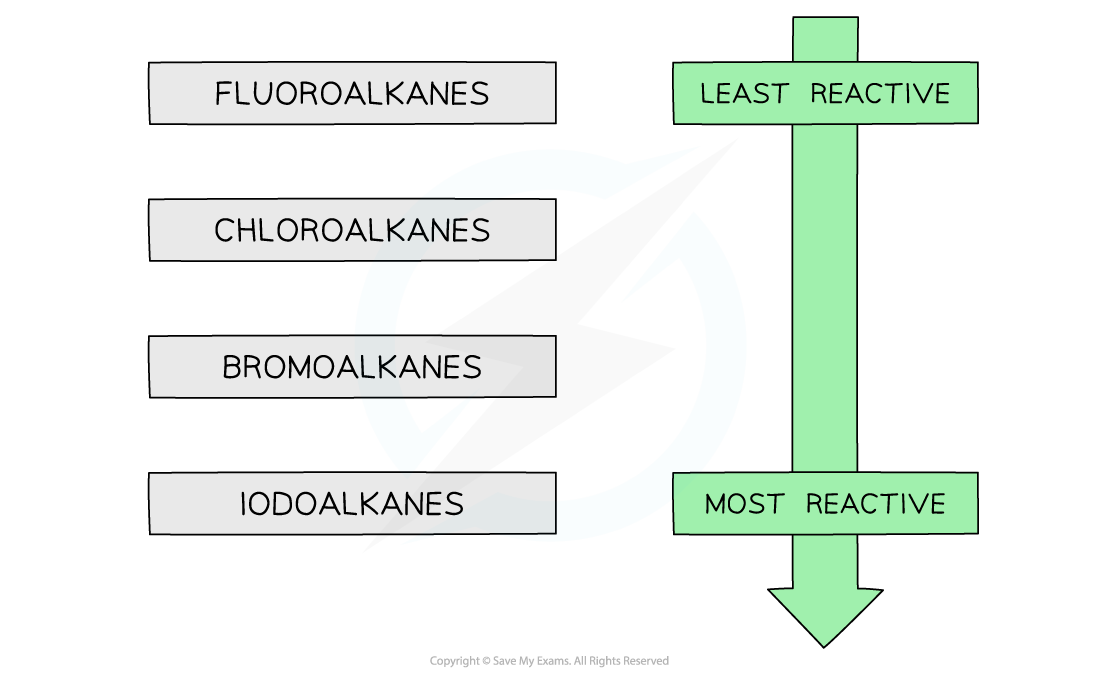
The halogenoalkanes become more reactive as you move down the group
Was this revision note helpful?
Build on this topic