11 markeasy
Which enthalpy change is indicated by X in the enthalpy cycle shown?
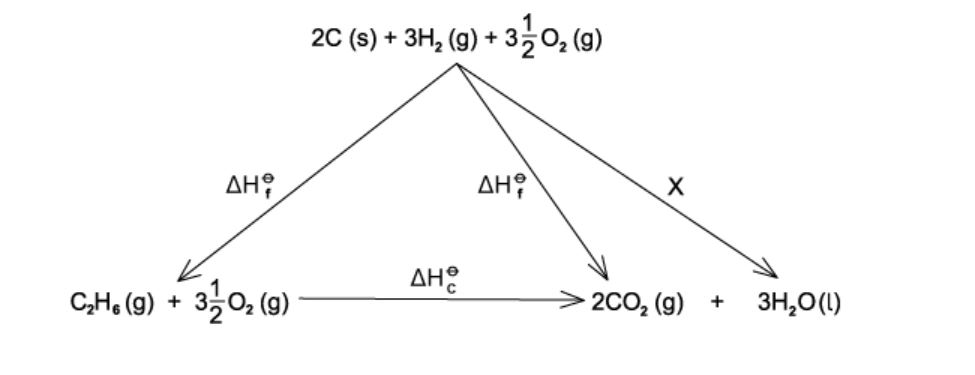
Choose your answer
+ΔHfθ(H2O)
−ΔHfθ(H2O)
+3ΔHfθ(H2O)
−3ΔHfθ(H2O)
12 questions · 12 marks · ≈ 12 min
Which enthalpy change is indicated by X in the enthalpy cycle shown?
Choose your answer
+ΔHfθ(H2O)
−ΔHfθ(H2O)
+3ΔHfθ(H2O)
−3ΔHfθ(H2O)
Which equation calculates enthalpy of reaction using enthalpy of formation data?
Choose your answer
ΔHrθ = ΣΔHfθ(products) + ΣΔHfθ(reactants)
ΔHrθ = ΣΔHfθ(products) − ΣΔHfθ(reactants)
ΔHrθ = ΣΔHfθ(reactants) − ΣΔHfθ(products)
ΔHrθ = −ΣΔHfθ(products) − ΣΔHfθ(reactants)
The diagram shows a Hess's law cycle for the conversion of graphite to diamond.
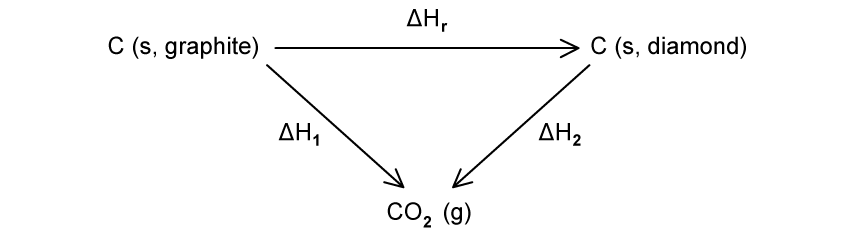
Which equation represents ΔHr?
Choose your answer
ΔHr = ΔH1 + ΔH2
ΔHr = ΔH1 − ΔH2
ΔHr = ΔH2 − ΔH1
ΔHr = −(ΔH1 + ΔH2)
What is the standard enthalpy change of formation, ΔHfθ, of propan-1-ol, C3H8O?
| Substance | ΔHcθ/ kJ mol-1 |
|---|---|
| C (s) | −394 |
| H2 (g) | −286 |
| C3H8O (l) | −1816 |
Choose your answer
−1136 kJ mol−1
−510 kJ mol−1
+510 kJ mol-1
+1136 kJ mol-1
The first stage in the industrial production of nitric acid from ammonia can be represented by the following equation.
4NH3 (g) + 5O2 (g) ⇌ 4NO (g) + 6H2O (g)
Using the following standard enthalpy change of formation data, what is the standard enthalpy change of reaction, ΔHrθ, for this reaction?
| Compound | ∆Hfθ/kJ mol–1 |
|---|---|
| NH3 (g) | −51.3 |
| NO (g) | +92.2 |
| H2O (g) | −239.6 |
Choose your answer
Titanium occurs naturally as the mineral rutile, TiO2. One possible method of extraction of titanium is to reduce it by heating with carbon.
TiO2 (s) + 2C (s) → Ti (s) + 2CO (g)
The standard enthalpy changes of formation of TiO2 (s) and CO (g) are –890 kJ mol−1 and –105 kJ mol−1 respectively.
What is the standard enthalpy change of reaction, ΔHrθ, for this reaction?
Choose your answer
−785 kJ mol−1
−680 kJ mol−1
+680 kJ mol−1
+785 kJ mol−1
The combustion of ethanol is increasingly being used to fuel cars.
| Substance | ΔHfθ/ kJ mol-1 |
|---|---|
| CO2 (g) | −382 |
| H2O (g) | −275 |
| C2H5OH (l) | −266 |
What is the standard enthalpy change of combustion, ΔHcθ, of ethanol?
Choose your answer
−1323 kJ mol−1
−391 kJ mol−1
+391 kJ mol−1
+1323 kJ mol−1
The equations for the formation of two sulfur oxides are shown.
S (s) + O2 (g) → SO2 (g) ∆Hfθ = –297 kJ mol–1
S (s) + 1.5O2 (g) → SO3 (g) ∆Hfθ = –395 kJ mol–1
What is the standard enthalpy change of reaction, ΔHrθ, for 2SO2 (g) + O2 (g) → 2SO3 (g)?
Choose your answer
−196 kJ mol–1
−98 kJ mol–1
+98 kJ mol–1
+196 kJ mol–1
A student calculated the standard enthalpy change of formation of propane, C3H8, using the standard enthalpy changes of combustion shown.
| Substance | ΔHcθ/ kJ mol-1 |
|---|---|
| C3H8 (g) | −2220 |
| H2 (g) | −286 |
| C (s) | Y |
The student used an incorrect value, Y, for the standard enthalpy change of combustion of carbon but performed the calculation correctly. The final answer obtained was −158 kJ mol−1.
What value did the student use for the standard enthalpy change of combustion of carbon?
Choose your answer
-1234 kJ mol-1
−697 kJ mol−1
−411 kJ mol−1
−306 kJ mol−1
Given the following standard enthalpy changes,
I2 (s) → I2 (g) ∆HƟ = +38 kJ mol–1
I2 (g) + 3Cl2 (g) → 2ICl3 (s) ∆HƟ = –214 kJ mol–1
What is the standard enthalpy change of formation, ΔHfθ, of ICl3 (s)?
Choose your answer
–214 kJ mol–1
–176 kJ mol–1
–107 kJ mol– 1
−88 kJ mol– 1
The following standard enthalpy changes are given.
CO (g) + O2 (g) → CO2 (g) ∆Hθ = –283 kJ mol–1
H2 (g) + O2 (g) → H2O (I) ∆Hθ = –286 kJ mol–1
H2O (g) → H2O (I) ∆Hθ = –44 kJ mol–1
What is the standard enthalpy change, ΔHθ, for the following reaction?
CO2 (g) + H2 (g) → CO (g) + H2O (g)
Choose your answer
-41 kJ mol-1
−3 kJ mol– 1
+3 kJ mol– 1
+41 kJ mol– 1
Iodine trichloride, ICl3, is made by reacting iodine with chlorine.
I2 (s) + Cl2 (g) → 2ICl (s) ΔHθ = +14 kJ mol–1
ICl (s) + Cl2 (g) → ICl3 (s) ΔHθ = –88 kJ mol–1
What is the standard enthalpy change of formation, ΔHfθ, of solid iodine trichloride?
Choose your answer
–162 kJ mol–1
–81 kJ mol–1
–74 kJ mol–1
–60 kJ mol–1