11 markeasy
Which equation can represent both an enthalpy change of formation and combustion?
Choose your answer
CH4 (g) + 2O2 (g) → CO2 (g) + 2H2O (l)
2Na (s) + ½O2 (g) → Na2O (s)
HCl (aq) + NaOH (aq) → NaCl (aq) + H2O (l)
C (s) + O2 (g) → CO2 (g)
19 questions · 19 marks · ≈ 19 min
Which equation can represent both an enthalpy change of formation and combustion?
Choose your answer
CH4 (g) + 2O2 (g) → CO2 (g) + 2H2O (l)
2Na (s) + ½O2 (g) → Na2O (s)
HCl (aq) + NaOH (aq) → NaCl (aq) + H2O (l)
C (s) + O2 (g) → CO2 (g)
The reaction pathway for a reversible reaction is shown below:
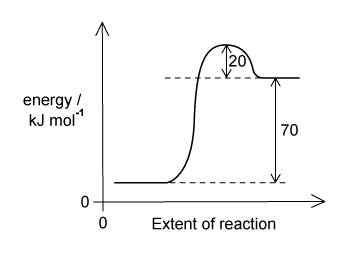
Which statement is correct?
Choose your answer
The activation energy of the reverse reaction is +90 kJ mol–1
The activation energy of the forward reaction is +20 kJ mol–1
The activation energy of the reverse reaction is +20 kJ mol–1
The enthalpy change of the forward reaction is −70 kJ mol–1
The energy profile for a reversible reaction is shown below.
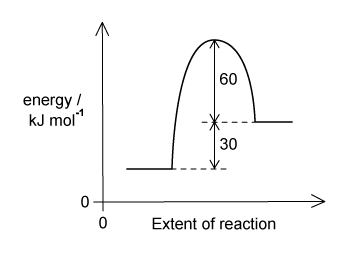
Which statement is correct?
Choose your answer
The activation energy of the forward reaction is +90 kJ mol–1
The activation energy of the reverse reaction is +90 kJ mol–1
The enthalpy change of the forward reaction is −30 kJ mol–1
The forward reaction is exothermic
A student carried out an experiment to determine the enthalpy change for the combustion of ethanol.
The following results were obtained by the student. The specific heat capacity of water is 4.18 J g−1 °C−1.
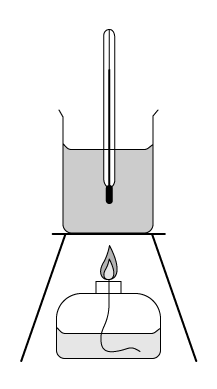
| Start temperature of the water | 21 °C |
|---|---|
| Final temperature of the water | 54 °C |
| Mass of spirit burner before burning | 259.75 g |
| Mass of spirit burner after burning | 259.18 g |
| Mass of glass beaker plus water | 150.00 g |
| Mass of glass beaker | 50.0 g |
How much heat energy is transferred to the water?
Choose your answer
6897 J
20691 J
22572 J
13794 J
PCl5 (g) dissociates as follows.
PCl5 (g) ⇌ PCl3 (g) + Cl2 (g)
The yield of the products increases as the temperature is raised from 80 °C to 110 °C.
Which row gives the PCl3 molecule and the forward reaction?
| Shape of PCl3molecule | The reaction is | |
|---|---|---|
| A | Trigonal pyramidal | Endothermic |
| B | Trigonal pyramidal | Exothermic |
| C | Trigonal planar | Endothermic |
| D | Trigonal planar | Exothermic |
Choose your answer
Which statement describes the bond energy of the H–I bond?
Choose your answer
The energy required to break one H–I bond in the gas phase.
The energy required to break one mole of H–I bonds in the gas phase.
The energy released when one mole of H–I bonds is formed in the gas phase.
The energy stored in one mole of H–I bonds in the gas phase.
A student mixed 30.0 cm3 of 0.0250 mol dm-3 potassium hydroxide solution with 30.0 cm3 of 0.0250 mol dm-3 nitric acid. The temperature rose by 0.50 oC. Assume no heat was lost to the surroundings.
The specific heat capacity of the mixture is 4.18 J g-1 K-1. Assume the mixture has a density of 1.00 g cm-3.
What is the enthalpy change of neutralisation?
Choose your answer
-41.8 kJ mol-1
-83.6 kJ mol-1
+167.2 kJ mol-1
-167.2 kJ mol-1
An experiment was carried out to determine the approximate value for the molar enthalpy change of neutralisation.
75 cm3 of 3.00 mol dm−3 hydrochloric acid was placed in a polystyrene cup of negligible heat capacity. Its temperature was recorded, then 75 cm3 of 3.00 mol dm−3 potassium hydroxide at the same temperature was quickly added and the solution was stirred.
The temperature rose by 14 oC. The resulting solution may be considered to have a specific heat capacity of 4.18 J g−1 K−1. Assume the density of the mixture is 1.00 g cm−3.
What is the molar enthalpy change of neutralisation?
Choose your answer
-19.5 kJ mol−1
-39.0 kJ mol−1
+39.0 kJ mol−1
-9.75 kJ mol−1
The standard enthalpy change ∆Hθ for the below reaction is -1776 kJ.
2N (g) + 6F (g) → 2NF3 (g)
What is the bond energy of the N–F bond?
Choose your answer
−592 kJ mol−1
−296 kJ mol−1
+296 kJ mol−1
+592 kJ mol−1
The complete combustion of ethyne, C2H2, is shown in the equation below.
H−C≡C−H + 2½ O=O → H−O−H + 2O=C=O
| Bond | Bond energy / kJ mol-1 |
|---|---|
| C−H | 390 |
| C≡C | 870 |
| O=O | 489 |
| C=O | 790 |
| O−H | 510 |
| O−C | 290 |
Using the bond energies given in the table, what is the enthalpy change of combustion of ethyne?
Choose your answer
−1552 kJ mol−1
−867.5 kJ mol−1
In a reaction converting compound R into compound T, it was found that the reaction proceeded by way of compound S, which could be isolated. The following steps were involved.
R → S; ΔH is positive
S → T; ΔH is negative
Which reaction profile fits these data?
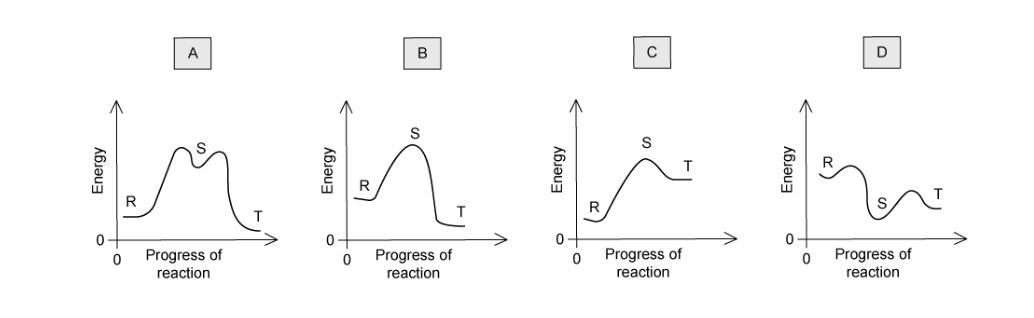
Choose your answer
The table shows three types of standard enthalpy change:
'+' means that this type of standard enthalpy change can only have positive values.
'–' means that this type of standard enthalpy change can only have negative values.
'+ / –' means that either positive or negative values are possible.
Which row is correct?
| Formation | Combustion | Neutralisation | |
|---|---|---|---|
| A | + | + | + / – |
| B | + / – | + | + / – |
| C | + / – | – | – |
| D | – | – | + |
Choose your answer
The enthalpy change for the reaction H2 (g) + X2 (g) → 2HX (g) is -184 kJ mol-1.
Bond energies: H-H = 436 kJ mol-1; H-X = 432 kJ mol-1
What is the bond energy of X-X?
Choose your answer
158 kJ mol−1
193 kJ mol−1
242 kJ mol−1
244 kJ mol−1
Which row in the table correctly identifies the requirements for the standard enthalpy of formation of liquid ethanol, C2H5OH (l)?
| Standard state of carbon | Standard state of hydrogen | Moles of ethanol formed | |
|---|---|---|---|
| A | graphite | gaseous atoms | 1 |
| B | graphite | gaseous molecules | 1 |
| C | diamond | gaseous molecules | 1 |
| D | graphite | gaseous molecules | 2 |
Choose your answer
In the gas phase, phosphorus pentachloride can be thermally decomposed into gaseous phosphorus trichloride and chlorine.
PCl5 (g) → PCl3 (g) + Cl2 (g)
The table below gives the relevant bond energies.
| Bond | Bond energy / kJ mol^−1^ |
|---|---|
| P−Cl (in both chlorides) | 328 |
| Cl−Cl | 241 |
What is the enthalpy change for this reaction?
Choose your answer
– 415 kJ mol–1
+656 kJ mol−1
−241 kJ mol−1
In a calorimetric experiment 2.50 g of a fuel is burnt in oxygen. 30% of the energy released during the combustion is absorbed by 500 g of water, the temperature of which rises from 25.0 oC to 68.0 oC.
The specific heat capacity of water is 4.18 J g−1 K−1.
What is the total energy released per gram of fuel burnt?
Choose your answer
10.8 kJ g−1
35.9 kJ g−1
120 kJ g−1
300 kJ g−1
Which equation shows how the bond energy for the covalent bond Y-Z can be calculated by dividing ΔH by n?
Choose your answer
n YZ (g) → n Y (g) + Z2 (g)
Z (g) + Y Zn-1 (g) → YZn (g)
2 YZn (g) → 2 YZn-1 (g) + Y2 (g)
YZn (g) → Y (g) + nZ (g)
The diagram shows the skeletal formula of cyclobutane.

The enthalpy change of formation of cyclobutane is +75.1 kJ mol– 1, and the enthalpy change of atomisation of graphite is +712 kJ mol–1.
The bond energy of C–H is 390 kJ mol–1 and of H–H is 429 kJ mol–1.
What is the average bond energy of the C–C bond in cyclobutane, rounded to the nearest whole number?
Choose your answer
361 kJ mol−1
380 kJ mol−1
342 kJ mol–1
732 kJ mol−1
Some bond energy values are listed below.
| Bond | Bond energy / kJ mol-1 |
|---|---|
| Br−Br | 194 |
| Cl−Cl | 247 |
| C−H | 412 |
| C−Cl | 338 |
These bond energy values relate to the following four reactions:
| W | Br2 (g) → 2Br (g) |
|---|---|
| X | 2Cl (g) → Cl2 (g) |
| Y | CH3 (g) + Cl (g) → CH3Cl (g) |
| Z | CH4 (g) → CH3 (g) + H (g) |
What is the correct order of enthalpy changes of the above reactions from most negative to most positive?
Choose your answer
Y, Z, W, X
Z, W, X, Y
Y, X, W, Z
X, Y, Z, W