Ammonia, NH3, reacts with a proton, H+, to form ammonium, NH4+.
Using the following key:
• N electron
H electron
Which dot-and-cross diagram correctly illustrates the electron movement in this reaction?
Choose your answer
9 questions · 9 marks · ≈ 9 min
Ammonia, NH3, reacts with a proton, H+, to form ammonium, NH4+.
Using the following key:
• N electron
H electron
Which dot-and-cross diagram correctly illustrates the electron movement in this reaction?
Choose your answer
Which species contains an atom with an incomplete outer shell?
Choose your answer
BF3
CH3-
H3O+
MgO
How many non-bonded, outer-shell electrons are present in one molecule of ammonia, NH3?
Choose your answer
0
2
5
6
Which ion has a central atom with exactly three lone pairs of electrons?
Choose your answer
BF2-
ClF2-
PF6-
SF5-
How many lone pairs of electrons are on the central atom in a molecule of chlorine trifluoride, ClF3?
Choose your answer
0
1
2
3
Which molecule obeys the octet rule?
Choose your answer
BeCl2
BF3
CS2
PCl5
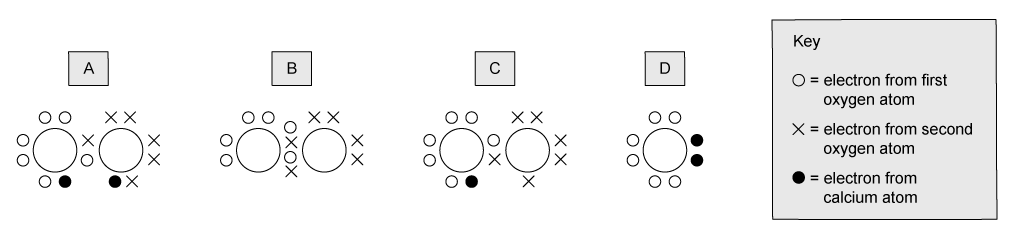
Calcium peroxide, CaO2, can be used in toothpaste as a teeth whitener.
Which dot-and-cross diagram represents the electron structure of the peroxide ion in CaO2?

Choose your answer
Which statement about 2-chloropropene, CH2=C(Cl)CH3, is not correct?
Choose your answer
Every atom in the molecule obeys the octet rule
There are 24 valence electrons in the molecule
The molecule contains exactly one π bond
The chlorine atom has three lone pairs of electrons
The number of outer-shell electrons in elements X and Y are 5 and 7 respectively.
What is the formula and the type of bonding in the compound formed between X and Y?
Choose your answer
X3Y, covalent
X3Y, ionic
XY3, covalent
XY3, ionic