State the three main types of intermolecular force and place them in ascending order of strength.
Draw a diagram to show hydrogen bonding between two molecules of methanol, CH3OH.
Your diagram should include all relevant lone pairs of electrons and dipoles.
Extract:
The three main types of intermolecular force, in ascending order of strength:
- Instantaneous dipole-induced dipole (id-id) forces / London dispersion forces, permanent dipole-permanent dipole (pd-pd) forces, and hydrogen bonding
- (In ascending order of strength) instantaneous dipole-induced dipole forces < permanent dipole-permanent dipole forces < hydrogen bonding
Methanol, CH3OH, can be oxidised to methanal, CH2O, and then to methanoic acid, HCOOH.
State the strongest type of intermolecular force present between:
i) Methanal molecules
(1 mark)
ii) Methanoic acid molecules
(1 mark)
iii) A molecule of water and a molecule of methanal
(1 mark)
iv) A molecule of water and a molecule of methanoic acid
(1 mark)
Methanoic acid reacts with sodium hydroxide to form sodium methanoate:
HCOOH + NaOH → HCOONa + H2O
Explain why sodium methanoate is a solid at room temperature and methanoic acid is a liquid.
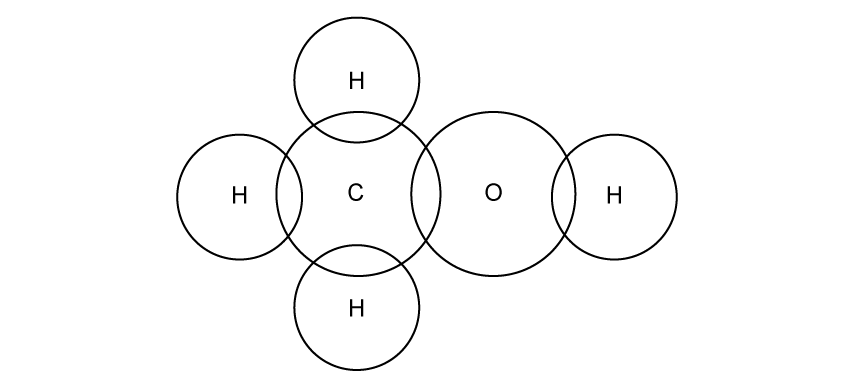
Complete the dot-and-cross diagram of methanol, CH3OH. Show outer shell electrons only.