Lactic acid occurs naturally, for example in sour milk.
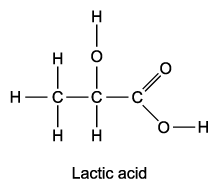
Which property does lactic acid have?
Choose your answer
It decolourises aqueous bromine rapidly.
It is insoluble in water.
It reacts with sodium carbonate.
It reduces Fehling’s reagent.
19 questions · 19 marks · ≈ 19 min
Lactic acid occurs naturally, for example in sour milk.

Which property does lactic acid have?
Choose your answer
It decolourises aqueous bromine rapidly.
It is insoluble in water.
It reacts with sodium carbonate.
It reduces Fehling’s reagent.
Which reagent can be used to convert CH3CH2CO2CH3 into CH3CH2CO2CH2Cl?
Choose your answer
Chlorine in bright sunlight at 100 °C
Concentrated hydrochloric acid at 100 °C
Phosphorus pentachloride at room temperature
Sulphur dichloride oxide (thionyl chloride, SOCl2) at 50 °C
Which reaction produces a coloured organic compound?
Choose your answer
CH2=CH2 + cold dilute acidified KMnO4
CH3CH2OH + acidified K2Cr2O7
CH3CHO + 2,4-dinitrophenylhydrazine reagent
CH3COCH3 + Fehling's solution
A compound X has the following properties:
Which of the following could be compound X?
Choose your answer
Propanoic acid
Propanol
Propene
Propyl propanoate
Tartaric acid (HO2CCH(OH)CH(OH)CO2H) can occur naturally, for example in wine, and may be synthesised in the laboratory.
The laboratory synthesis occurs in 2 steps:
OHCCHO intermediate HO2CCH(OH)CH(OH)CO2H
Which reagents could be used for this synthesis?
| Step 1 | Step 2 | |
|---|---|---|
| A | HCl (aq) | HCN (g) |
| B | H2SO4 (aq) | K2Cr2O7 / H2SO4 (aq) |
| C | KCN (aq/alcoholic) | K2Cr2O7 / H2SO4 (aq) |
| D | HCN, NaCN (aq/alcoholic) | H2SO4 (aq) |
Choose your answer
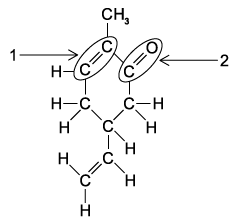
This molecule is responsible for the flavour of spearmint chewing gum.

Which statement about functional groups 1 and 2 is correct?
Choose your answer
1 will undergo electrophilic substitution
1 will undergo nucleophilic addition
2 will undergo electrophilic substitution
2 will undergo nucleophilic addition
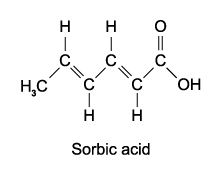
Sorbic acid is a natural organic compound which is used as a food preservative because it kills fungi. Sorbic acid reacts with bromine in an organic solvent and hydrogen in the presence of a nickel catalyst.

How many moles of bromine (in an organic solvent) and of hydrogen (in the presence of a Pt / Ni catalyst) will be incorporated into one mole of sorbic acid by these reactions?
| Moles of bromine | Moles of hydrogen | |
|---|---|---|
| A | 2 | 2 |
| B | 2 | 3 |
| C | 2 | |
| D | 2 | 3 |
Choose your answer
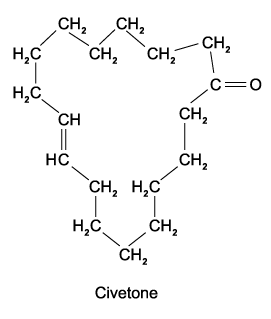
The naturally-occurring molecule civetone was one of the first known ingredients used in perfumery.

Which reagent will not react with civetone?
Choose your answer
2,4-dinitrophenylhydrazine reagent
Fehling’s reagent
Hydrogen bromide
Sodium tetrahydridoborate (III), NaBH4
An alkene is reacted with acidified manganate (VII) ions, MnO4- . The organic product has a relative molecular mass greater than that of the alkene by 34.
Which of the following are the correct conditions for this reaction?
Choose your answer
Cold, concentrated MnO4-
Cold, dilute MnO4-
Hot, concentrated MnO4-
Hot, dilute MnO4-
Pentanoic acid can be produced from 1-bromobutane using reagents Y and Z as shown below.
1-bromobutane compound X pentanoic acid
Which of the following could be reagents Y and Z?
| Y | Z | |
|---|---|---|
| A | KCN in ethanol | HCl (aq) |
| B | KCN in ethanol | NaOH (aq) |
| C | NaOH (aq) | HCl (aq) |
| D | NH3 in ethanol | H+/Cr2O72- (aq) |
Choose your answer
In which reaction does a carbocation intermediate form?
Choose your answer
CH2=CH2 + Br2 → CH2BrCH2Br
CH3CH2Br + NaOH → CH3CH2OH + NaBr
CH3CH3 + Cl2 → CH3CH2Cl + HCl
CH3CHO + HCN CH3CH(OH)CN
Hept-4-enal, shown below, naturally occurs in cow's milk.
CH3CH2CH=CHCH2CH2CHO
Which organic product is formed when hept-4-enal is reduced with either hydrogen with a nickel catalyst or sodium borohydride?
Choose your answer
CH3(CH2)5CH3 when hept-4-enal is reduced by H2 / Ni
CH3(CH2)5CHO when hept-4-enal is reduced by NaBH4
CH3CH2CH=CHCH2CH2CH2OH when hept-4-enal is reduced by H2 / Ni
CH3CH2CH=CHCH2CH2CH2OH when hept-4-enal is reduced by NaBH4
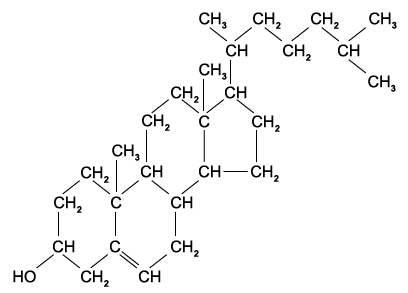
The diagram shows the structure of the naturally-occurring molecule cholesterol.

Two separate test tubes of cholesterol are used in an experiment. One test tube of cholesterol is treated with cold, dilute acidified KMnO4, and the other is treated with hot, concentrated acidified KMnO4.
Which row correctly describes the change in the number of chiral carbon atoms in the molecule during each reaction and the structure of the product in each test tube?
| Cold, dilute acidified KMnO4 | Hot, concentrated acidified KMnO4 | |||
|---|---|---|---|---|
| Change in the number of chiral carbons | Number of hydroxy groups in product | Change in the number of chiral carbons | Number of 6-membered rings remaining in product | |
| A | +1 | 1 | -1 | 3 |
| B | +1 | 1 | 0 | 2 |
| C | +2 | 3 | -1 | 2 |
| D | +2 | 3 | 0 | 3 |
Choose your answer
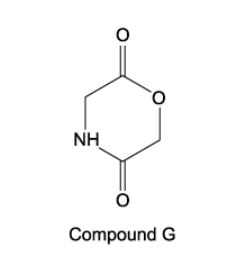
The cyclic compound G is heated with dilute hydrochloric acid.

Which of the following are the products of the reaction?
Choose your answer
H2NCOCH2OH and HOCH2CHO
HO2CCH2NH3+ and HO2CCH2OH
HOCH2CO2H and H2NCH2CO2H
HOCH2CONH3+ and HOCH2CHO
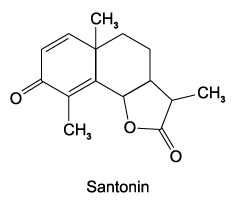
Santonin is a drug that has been used to treat a worm infection.

When santonin is first treated with warm dilute H2SO4, product X is formed. If X is treated with cold acidified KMnO4, the final product Y is obtained.
How many atoms of hydrogen in each molecule of product Y could be displaced in a reaction with sodium metal?
Choose your answer
2
4
5
6
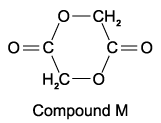
Compound M is used in leather processing.

Compound M is synthesised in the presence of concentrated sulfuric acid and heat.
Which other starting materials are required to synthesise compound M?
Choose your answer
CH3COOCH2COOH only
CH3COOH mixed with HOCH2COOH
CH3COOH only
HOCH2COOH only
Mixture F is produced upon refluxing compound G with aqueous sodium hydroxide.
Upon distillation of mixture F with acidified potassium dichromate (VI), propanone is produced. Mixing compound G with aqueous silver nitrate and dilute nitric acid gives a cream precipitate.
Which of the following could be compound G?
Choose your answer
CH3CH2CH2Br
CH3CH2CH2I
CH3CHBrCH3
CH3CHICH3
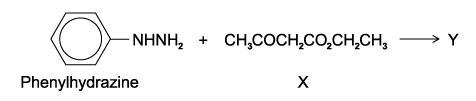
Antipyrine is a drug used to reduce fever. The initial step of its synthesis is the reaction of phenylhydrazine with compound X.

Which of the following is product Y?
Choose your answer
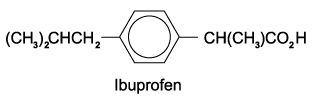
Ibuprofen is an anti-inflammatory drug, the structure of which is shown below.

Which reaction leads to the formation of ibuprofen?
Choose your answer