Propylamine can be produced from 1-bromopropane.
Construct an equation for this reaction.
State the reagents and conditions required to produce propylamine from 1-bromopropane.
Name the mechanism for the reaction of 1-bromopropane with ammonia.
5 questions · 40 marks · ≈ 40 min
Propylamine can be produced from 1-bromopropane.
Construct an equation for this reaction.
State the reagents and conditions required to produce propylamine from 1-bromopropane.
Name the mechanism for the reaction of 1-bromopropane with ammonia.
Propylamine can be produced by the reaction of 1-chloropropane with ammonia.
CH3CH2CH2Cl CH3CH2CH2NH2
i) State the role of ammonia in this reaction.
(1 mark)
ii) Name the mechanism of this reaction.
(1 mark)
Use a chemical equation to explain why propylamine acts as a Brønsted-Lowry base when it dissolves in water.
Extract:
Propylamine can be produced by the reaction of 1-chloropropane with ammonia.
CH3CH2CH2Cl → CH3CH2CH2NH2
The reaction between 1-chloropropane and ammonia proceeds in two steps. Step 1 involves the formation of an intermediate. Step 2 forms the final propylamine product.
As the reaction proceeds, the bond angles around the nitrogen atom change. Explain these changes in the bond angles around the nitrogen atom.
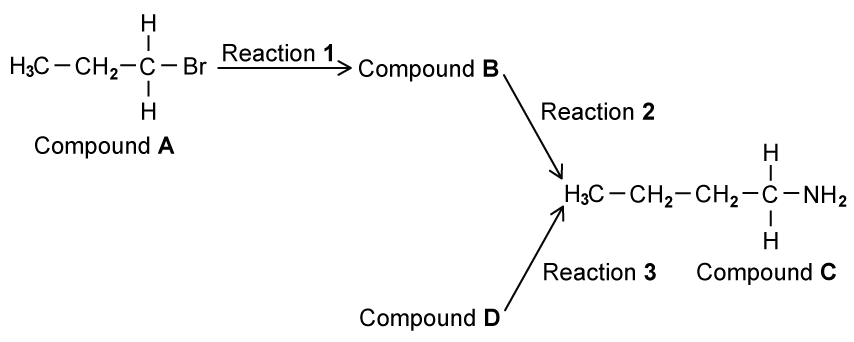
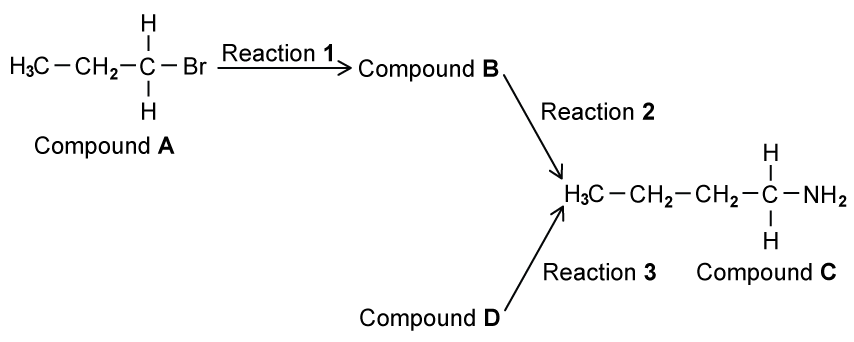
Fig. 2.1 shows a reaction sequence to form an amine.

Fig. 2.1
i) State the systematic name of compound A.
(1 mark)
ii) Reaction 1 heats compound A under reflux with an ethanolic solution of potassium cyanide.
Draw the mechanism for the reaction of compound A with the cyanide ion (CN-). Include charges, dipoles, lone pairs of electrons and curly arrows, as appropriate. Draw the structure of compound B in your answer.
(4 marks)
Extract:
Fig. 2.1 shows a reaction sequence to form an amine.

{align=center} Fig. 2.1
In Fig. 2.1, compound B reacts with hydrogen gas over a nickel catalyst to form compound C.
State the type of reaction that occurs.
Extract:
Fig. 2.1 shows a reaction sequence to form an amine.
Fig. 2.1 shows compound A reacting with KCN in ethanol under reflux to form compound B, then compound B reacting with hydrogen gas over a nickel catalyst to form compound C.
Compound B is a nitrile (R–C≡N), which gains hydrogen atoms in the presence of H2 and a Ni catalyst to form compound C (a primary amine, R–CH2–NH2).
Compound C can also be produced in a single step from compound D.
i) Draw the displayed formula of compound D.
(1 mark)
ii) State suitable reagents and conditions for reaction 3.
(2 marks)
Extract:
Fig. 2.1 shows a reaction sequence to form an amine.
Fig. 2.1 shows compound A reacting with KCN in ethanol under reflux to form compound B, then compound B reacting with hydrogen gas over a nickel catalyst to form compound C.
The systematic name of compound A is 1-bromopropane.
Compound B is butanenitrile (CH3CH2CH2CN).
Draw the skeletal formulae of two isomers of compound C that are also primary amines.
One possible method of making butylamine from 1-chlorobutane is shown in Fig. 3.1.

Fig. 3.1
i) Name the mechanism of reaction 1.
(1 mark)
ii) State suitable reagents and conditions for reaction 1.
(2 marks)
Extract:
One possible method of making butylamine from 1-chlorobutane is shown in Fig. 3.1.
{align=center} Fig. 3.1
i) Name the mechanism of reaction 1.
ii) State suitable reagents and conditions for reaction 1.
Draw the mechanism for reaction 1 and label compound X in your answer. Include charges, dipoles, lone pairs of electrons and curly arrows, as appropriate.
Extract:
One possible method of making butylamine from 1-chlorobutane is shown in Fig. 3.1.

Fig. 3.1
Compound X undergoes another reaction in reaction 2 before butylamine is formed.
i) State the role of ammonia in reaction 2.
(1 mark)
ii) State the formula of compound Y.
(1 mark)
iii) The by-products Cl- and compound Y can combine together to form compound Z. State the name of compound Z.
(1 mark)
Compound X is produced from cyclohexene by reaction with a hydrogen halide.
An amine which is a relatively weak base containing one nitrogen atom can be produced from compound X in one step.
Draw the mechanism for the formation of compound X from cyclohexene. Include charges, dipoles, lone pairs of electrons and curly arrows, as appropriate. State the hydrogen halide used in your answer.
Extract:
Compound X is produced from cyclohexene by reaction with a hydrogen halide.
An amine which is a relatively weak base containing one nitrogen atom can be produced from compound X in one step.
Allow HBr, HCl, or HI as the hydrogen halide; compound X is then the corresponding halocyclohexane
Compound X reacts with ammonia to form cyclohexylamine.
i) State the reagents and conditions required for this reaction.
(2 marks)
ii) Suggest why an excess of ammonia is used.
(1 mark)
Propylamine acts as a Brønsted-Lowry base when it dissolves in water.
Construct an equation to show this behaviour.

