11 markeasy
What is formed when butanone is warmed with a solution of NaBH4?
Choose your answer
Butan-1-ol
Butan-2-ol
Butanal
Butane
21 questions · 21 marks · ≈ 21 min
What is formed when butanone is warmed with a solution of NaBH4?
Choose your answer
Butan-1-ol
Butan-2-ol
Butanal
Butane
In 1903, Arthur Lapworth investigated the reaction of hydrogen cyanide with propanone.
What is the name of this type of mechanism?
Choose your answer
Electrophilic addition
Electrophilic substitution
Nucleophilic addition
Nucleophilic substitution
Which carbonyl compound(s) react with both LiAlH4 and Tollens’ reagent?
Choose your answer
Aldehydes only
Both aldehydes and ketones
Ketones only
Neither aldehydes nor ketones
An aqueous methanolic solution of NaBH4 acts as a reducing agent when added to propanal, CH3CH2CHO.
What is the first step of this mechanism?
Choose your answer
Attack of an H– ion at the carbon atom of the carbonyl group.
Attack of an H– ion at the oxygen atom of the carbonyl group.
Attack of an H+ ion at the carbon atom of the carbonyl group.
Attack of an H+ ion at the oxygen atom of the carbonyl group.
The characteristic smell of burnt sugar is partly caused by the following compound.
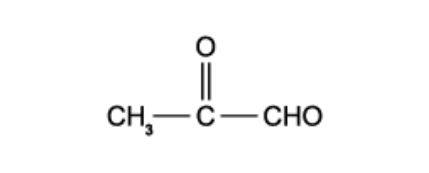
Which reagent will react with both functional groups?
Choose your answer
Acidified potassium dichromate (VI)
Fehling’s solution
Hydrogen cyanide
Sodium hydroxide
In which reaction is the organic compound oxidised?
Choose your answer
CH3CH2CH2OH + concentrated H3PO4
CH3CH2CHO + Tollens’ reagent
CH3CH2CN + dilute H2SO4
CH3COCH2CH3 + 2,4-dinitrophenylhydrazine reagent
Ethanal, CH3CHO, is reduced using NaBH4 in aqueous ethanol.
What is the first step of this mechanism?
Choose your answer
The carbon atom of the carbonyl group is attacked by an H– ion
The carbon atom of the carbonyl group is attacked by an H+ ion
The oxygen atom of the carbonyl group is attacked by an H– ion
The oxygen atom of the carbonyl group is attacked by an H+ ion
The orange colour of carrots is due to the presence of β-carotene, the structure of which is shown in the diagram below.
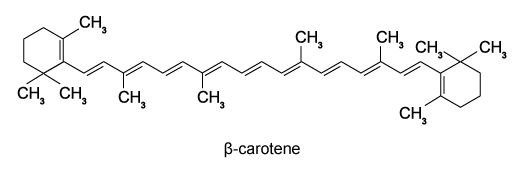
Excess hot concentrated acidified potassium manganate(VII) will oxidise β-carotene.
When an individual molecule of β-carotene is oxidised in this way there are multiple possible products.
How many of these product molecules contain a ketone functional group?
Choose your answer
3
6
9
12
Hex-3-enal is used as a flavouring agent.
CH3CH2CH=CHCH2CHO
Which row correctly shows the product formed when hex-3-enal is treated with the given reducing agent?
| Product | Reducing agent | |
|---|---|---|
| A | CH3(CH2)4CH3 | H2 + Ni |
| B | CH3(CH2)4CH2OH | NaBH4 |
| C | CH3(CH2)4CHO | H2 + Ni |
| D | CH3(CH2)4CHO | NaBH4 |
Choose your answer
When alkaline I2 solution is added to butanone, a yellow precipitate is formed.
Which of the following compounds is responsible for the precipitate?
Choose your answer
CH3CH2CO2-
CH3CH2COCH2I
CH3CHICOCH3
CHI3
The colour of warm acidified potassium dichromate(VI) changes from orange to green when added to compound Y. 1 mol of Y reacts with 2 mol of hydrogen cyanide in the presence of potassium cyanide.
What could Y be?
Choose your answer
CH3CH2CH2CHO
CH3COCH2COCH3
H2C=CHCH2CHO
OHCCH2CH2CHO
Hydroxyethanal has the structural formula HOCH2CHO.
In an experiment hydroxyethanal is heated under reflux with an excess of acidified potassium dichromate (VI) until no further oxidation takes place.
What is the skeletal formula of the organic product formed in the experiment?
Choose your answer
Which reagent will give similar results with both propanone and propanal?
Choose your answer
2,4-dinitrophenylhydrazine reagent
Acidified aqueous potassium dichromate (VI)
Fehling’s solution
Tollens’ reagent
Carvone is used as a flavouring for spearmint chewing gum.
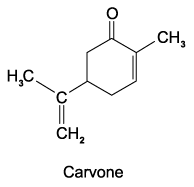
When carvone is heated under reflux with excess hot concentrated acidified potassium manganate(VII) the products carbon dioxide and compound X are formed.
X contains nine carbon atoms and reacts with 2,4-dinitrophenylhydrazine reagent.
What is the maximum number of molecules of 2,4-dinitrophenylhydrazine that will react with one molecule of X?
Choose your answer
1
2
3
4
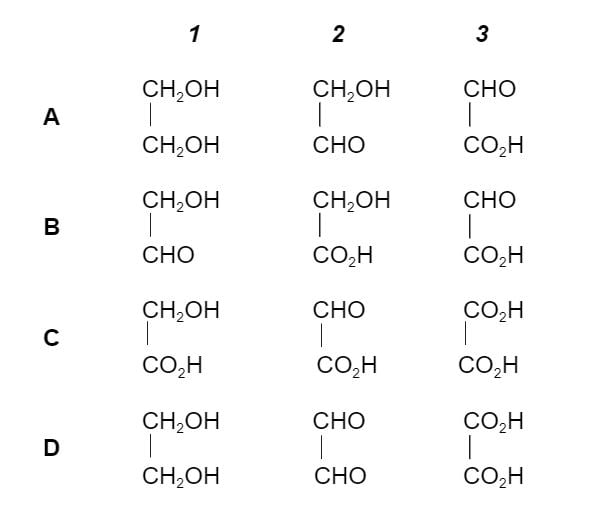
When compounds 1, 2 and 3 react with PCl5, hydrogen chloride is evolved. However, only one of the three reacts with 2,4-dinitrophenylhydrazine reagent.
Which one of the following combinations could be 1, 2 and 3?
Choose your answer
An organic liquid X gives the following results:
What is the identity of X?
Choose your answer
Butan-2-ol
Butanone
Pentan-3-one
Propanal
An organic compound X has a molecular ion peak at m/z = 58 in its mass spectrum.
Experimental data for compound X is shown in the table below:
| Test | Observation |
|---|---|
| Addition of 2,4-dinitrophenylhydrazine (2,4-DNPH) | Orange precipitate formed |
| Warming with Tollens' reagent | No visible change |
What is the identity of compound X?
Choose your answer
CH3CH2CH2CH3
CH3CH2CHO
CH3CH2COOH
CH3COCH3
When HCN reacts with butanal, CH3CH2CH2CHO, product X is formed. If X is then hydrolysed by aqueous acid, product Y is produced.
When pentanal, CH3CH2CH2CH2CHO, is heated under reflux with acidified potassium dichromate(VI), product Z is formed.
What is the difference in relative molecular mass of products Y and Z?
Choose your answer
12
14
16
18
Hydroxynitriles can be made from carbonyl compounds by generating CN– ions from HCN in the presence of a weak base.
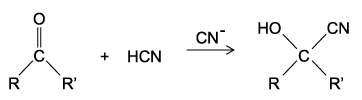
In a similar reaction, –CH2CO2CH3 ions are generated from CH3CO2CH3 by strong bases.
Which compound can be made from an aldehyde and CH3CO2CH3 in the presence of a strong base?
Choose your answer
(CH3)2C(OH)CH2CO2CH3
CH3CH(OH)CO2CH3
CH3CH2CH(OH)CH2CO2CH3
CH3CO2CH2CH(OH)CH3
When compound T reacts with its own oxidation product, a sweet-smelling liquid is produced.
What is the identity of compound T?
Choose your answer
Butan–1–ol
Butanal
Butanoic acid
Butanone
1 mol of CH3COCH2CH2CHO is placed into each of three separate test-tubes.
An excess of NaBH4 is added to test-tube 1 and an excess of acidified potassium manganate(VII) is added to test-tube 2. No reagent is added to test-tube 3.
An excess of HCN is then added to each test-tube.
Which row correctly shows the number of moles of HCN that react with the organic compound in each test-tube?
| test-tube 1 | test-tube 2 | test-tube 3 | |
|---|---|---|---|
| A | 0 | 1 | 2 |
| B | 0 | 2 | 2 |
| C | 1 | 1 | 2 |
| D | 2 | 1 | 0 |
Choose your answer