11 markeasy
Which pair of homologous series does not have the same C:H ratio in their general formulae?
Choose your answer
Aldehydes and ketones
Alkanes and alkenes
Aldehydes and alkenes
Carboxylic acids and esters
10 questions · 10 marks · ≈ 10 min
Which pair of homologous series does not have the same C:H ratio in their general formulae?
Choose your answer
Aldehydes and ketones
Alkanes and alkenes
Aldehydes and alkenes
Carboxylic acids and esters
The following mechanism shows hydrogen cyanide reacting with propanone.
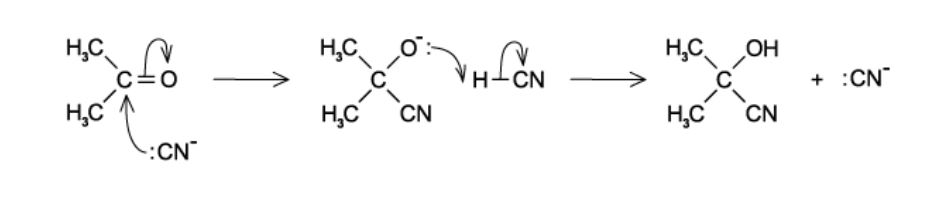
Which statement is not correct?
Choose your answer
CN- is an electrophile.
Heterolytic bond breaking is involved.
Propanone is a ketone.
This is an addition reaction.
Which statement describes an electrophilic addition reaction?
Choose your answer
The organic molecule acts as an electrophile and becomes less saturated.
The organic molecule acts as an electrophile and becomes more saturated.
The organic molecule acts as a nucleophile and becomes less saturated.
The organic molecule acts as a nucleophile and becomes more saturated.
Which species acts as a nucleophile?
Choose your answer
C2H6
Cl•
H+
OH-
What type of reaction occurs when 1-chloroethane reacts with aqueous sodium hydroxide?
Choose your answer
Electrophilic addition
Electrophilic substitution
Nucleophilic addition
Nucleophilic substitution
Which row gives correct statements about a homologous series?
| same general formula | similar chemical properties | gradual change in physical properties | |
|---|---|---|---|
| A | ✓ | ✓ | ✓ |
| B | ✓ | ⨯ | ✓ |
| C | ⨯ | ✓ | ✓ |
| D | ✓ | ✓ | ⨯ |
Choose your answer
Which diagram correctly shows the heterolytic fission of the C–Cl bond in 1-chloropropane?
Choose your answer
The reaction sequence below shows a pair of reaction types.
CH3CH=CHCH3 CH3CH2CHICH3 CH3CH2CH(OH)CH3
Which row in the table identifies reaction 1 and reaction 2?
| Reaction 1 | Reaction 2 | |
|---|---|---|
| A | Nucleophilic addition | Nucleophilic substitution |
| B | Electrophilic addition | Electrophilic substitution |
| C | Nucleophilic addition | Electrophilic substitution |
| D | Electrophilic addition | Nucleophilic substitution |
Choose your answer
The methyl group, CH3, can exist as an anion, a cation or a free radical. The CH3 species can act as a nucleophile, an electrophile or a free radical depending on the number of outer shell electrons on the methyl carbon atom.
How many outer shell electrons must be present for CH3 to act in these different ways?
| nucleophile | electrophile | free radical | |
|---|---|---|---|
| A | 6 | 8 | 7 |
| B | 8 | 6 | 7 |
| C | 6 | 7 | 8 |
| D | 8 | 7 | 6 |
Choose your answer
Which row correctly describes a nucleophile and an electrophile?
| nucleophile | electrophile | |
|---|---|---|
| A | Has a lone pair of electrons | Accepts a pair of electrons |
| B | Is a negative ion | Is a positive ion |
| C | Attacks double bonds | Is only involved in substitution reactions |
| D | Accepts a pair of electrons | Has a lone pair of electrons |
Choose your answer