Methods of Operation (Production) (Cambridge International AS Business)
Capital intensive operations
-
Capital-intensive production predominately uses machinery and technology in the production of goods and services
-
Large-scale production of standardised products is likely to be capital-intensive
-
Manufacturing in developed countries where labour costs are relatively high is likely to be capital-intensive
- E.g. Vehicle manufacturers such as Ford use robots and other production technology to manufacture cars, with supervisors overseeing the quality of output
-
Evaluating capital intensive production
| Advantages | Disadvantages |
|---|---|
| - Low-cost production where output is high - Machines are usually consistent and precise - Machines can run without breaks | - Significant set-up and maintenance costs - Breakdowns can severely delay production - May not provide flexibility in production |
Labour intensive operations
Spec point —
4.1.3
-
Labour-intensive production predominantly uses physical labour in the production of goods and services
- The delivery of services is usually more labour-intensive than manufacturing
- In countries where labour costs are low, such as Bangladesh and Vietnam, labour-intensive production is common
- Small-scale production is likely to be labour-intensive
- E.g. UK schools are labour-intensive operations as teachers plan and deliver lessons and provide pastoral support
Evaluating labour intensive production
| Advantages | Disadvantages |
|---|---|
| - Low-cost production where labour costs are low - Provides opportunities for workers to be creative - Workers are flexible (e.g. they can be retrained) | - Workers may be unreliable and need regular breaks - Incentives may be needed to motivate staff - Training costs can be significant |
An introduction to production methods
-
Production is the transformation of resources (e.g. raw materials components and processes) into finished goods or services
- Goods are physical products, such as bicycles and T-shirts
- Services are non-physical items such as hairdressing, tourism and manicures
The four main production methods
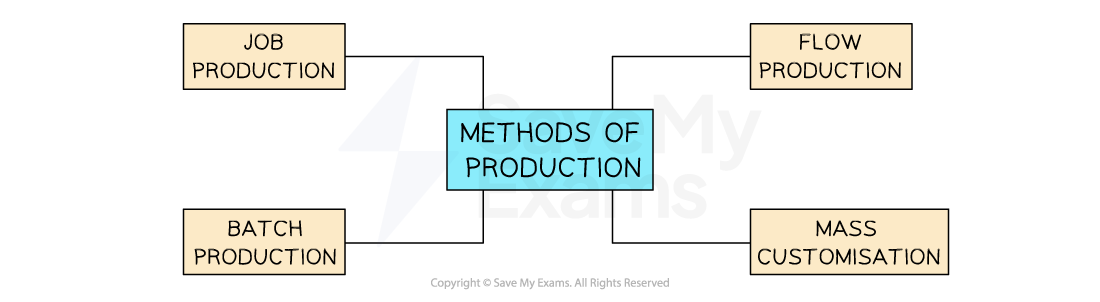
*The type of production method used often depends on the nature of the product being made *
-
The method of production used by a business depends upon a number of factors
- The level of output required to be produced
- The nature of the product
- Whether the product is standardised or customised
- The level of automation *used in production
Job production
-
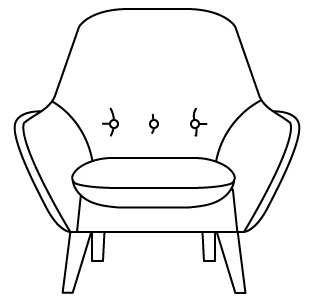
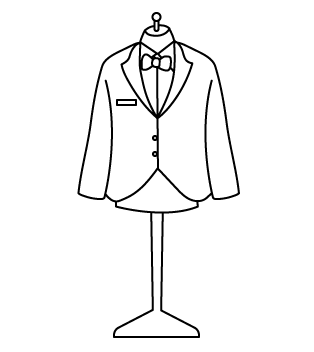
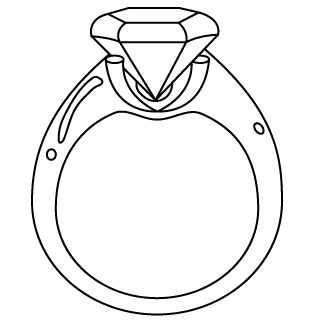
Job production is where products are made to meet the specific requirements of individual customers
- Each item is produced separately and the production process is tailored to the unique specifications of the customer's order
-
It is typically used for unique or specialised products that are not produced in large quantities
-
Job production often requires skilled labour, such as craftsmen or technicians, as the manufacturing process may involve intricate tasks or specialised techniques
Examples of job production
| Furniture made to order Where customers can choose the design, dimensions, materials and finishes | Tailored clothing Such as wedding suits, where each garment is made to fit the specific preferences of the individual customer | High-end jewellery Especially those with unique designs or personalised engravings |
|---|---|---|
 |  |  |
-
Job production has the potential to add significant levels of added value and can therefore be very profitable
- Specialised products made by skilled craftspeople can command high prices because they are unique and can be made to meet customer needs very precisely
- This would arguably be lost if other methods of production were to be adopted
Advantages and disadvantages of job production
| Advantages | Disadvantages |
|---|---|
| - High customisation – meets unique customer needs | - More expensive due to customisation |
| - Flexible – can adapt to changes in demand or trends | - Longer lead times – not ideal for urgent orders |
| - High quality – greater attention to detail and control | - Complex to manage – requires close coordination with customers |
| - Personalised experience – customers involved in design, increasing loyalty | - Low volume – limits ability to achieve economies of scale |
Batch production
-
Batch production occurs when products are produced in groups or batches
- A certain quantity of products is produced together before moving on to the next batch
- Each batch goes through the entire production process, from raw materials to the finished product, before the next batch begins
- Batches are usually of a standardised size and composition and follow a certain sequence of operations
Goods made using batch production

*Commonly used in industries such as pharmaceuticals, beauty products and food processing *
- Batch production strikes a balance between customisation and cost-effectiveness, making it a suitable production method for industries that deal with diverse product ranges and varying customer needs
Advantages and disadvantages of batch production
| Advantages | Disadvantages |
|---|---|
| - Batch production allows manufacturers to switch between batches and cater for varying customer demand - It can be more cost-effective compared to flow production, especially when producing items in smaller quantities - It allows a business to benefit to some extent from purchasing economies as larger quantities of stock may be purchased than with job production - Quality issues can be identified and defects can be rectified within a specific batch before moving on to the next, minimising the impact on the entire production line | - Setting up the equipment and configuring the production line for each batch can be time-consuming and may result in idle time between batches - Often leads to the accumulation of inventory, which requires storage and careful management to avoid wastage - It is not as adaptable as other production methods, such as flow production - Rapid changes in product demand or frequent product variations may be difficult to manage - Frequent start-up and shutdown of machinery can put additional stress on equipment, requiring regular maintenance and repair to ensure smooth operations |
Mass (flow) production
-
Flow production occurs when a product is produced in a continuous sequence of operations on a production line
- It involves the movement of materials or components through a series of workstations or machines with each workstation performing a specific task or operation
- As a product moves along the production line it undergoes a series of operations, such as assembly, testing, packaging or quality control until it is completed
-
This method is commonly used in industries that produce high volumes of standardised products such as automobiles and consumer electronics
Characteristics of flow production
-
Division of labour
- Different tasks are allocated to different workstations or machines, allowing workers to specialise in a specific task
-
Standardisation
- The manufacture of identical products helps to ensure consistency and the smooth flow of production
-
Continuous movement
- The product moves continuously from one workstation to another, minimising idle time and maximising productivity
-
High volume
- Flow production is suitable for high-volume manufacturing as it enables the efficient production of large quantities of identical or similar products
-
Automation
- Flow production often involves the use of machinery and automated equipment to perform repetitive tasks quickly and accurately
Advantages and disadvantages of flow production
| Advantages | Disadvantages |
|---|---|
| - The continuous flow of production eliminates the need for frequent equipment start-ups and shutdowns, reducing energy consumption and minimising material waste - Labour costs may be lower due to automation and processes that require less skilled workers - It allows for greater control over product quality because it is easy to identify and address any defects early on - It enables fast production, resulting in short lead times, which help companies respond more quickly to market demands | - Implementing flow production systems often requires significant capital investment to purchase expensive manufacturing equipment and automation technologies - It relies on the reliability and efficiency of equipment and machinery - If any part of the production line breaks down, it can disrupt the entire process, leading to costly down time - If a defect is detected, it may require the stoppage of the entire production line, resulting in substantial losses - Relies on a steady supply of components and raw materials - Any disruption in the supply chain can have a severe impact on production |
Exam Hint When recommending a suitable method of production, carefully consider the needs of the customers. Where the selling price is a key driver of consumer demand, flow production (where unit costs are minimised) is likely to be very suitable. Where demand is driven by quality or where customisation is required, job or batch production are likely to be better choices.
Mass customisation
Spec point —
4.1.4
-
Mass production is usually achieved through flow production and involves the manufacture of large quantities of standardised products
- This results in low costs per unit compared to other methods of production
-
Customisation is usually associated with job production or small-scale batch production
- This allows customers to design products from scratch
-
Mass customisation seeks to bridge this gap by offering flexibility with a range of customisable options within a standardised production process alongside the low unit costs typically associated with flow production
- It uses technology, such as computer-aided design (CAD), flexible manufacturing systems and data analytics to efficiently accommodate customer preferences
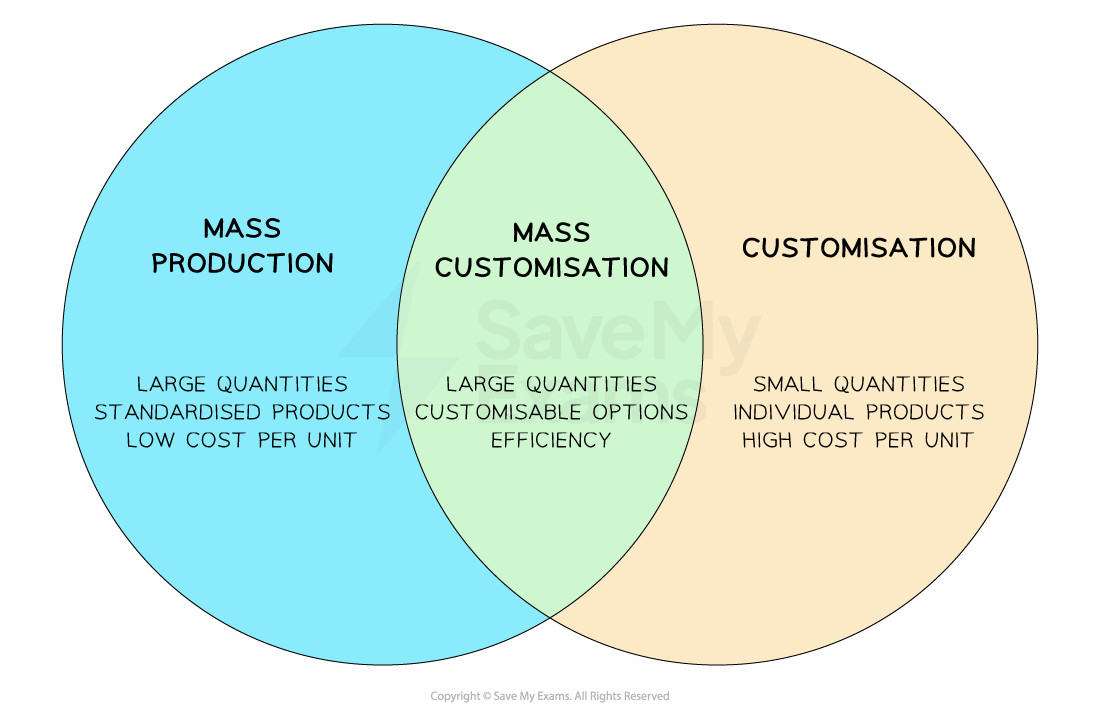
A comparison of mass production, customisation and mass customisation
Stages of mass customisation
1. Choice
-
Customers are presented with a range of pre-designed product options, features or configurations from which they can choose
- E.g. Audi customers can select a specific model, such as the Avant, Saloon, Coupé or Sportback and decide the trim level from Premium, Premium Plus and Prestige
2. Customisation
-
Customers have the opportunity to personalise their chosen product by selecting specific features, colours, sizes or other configurable elements
- E.g. Audi customers can choose extra features such as driver assistance tools, a towbar or a dashcam
3. Production
-
Once the customer's preferences are received, the manufacturing process can begin
-
The production system is designed to efficiently produce the customised product, often using flexible manufacturing techniques such as cell production
- E.g. At Audi each new vehicle takes between six and twelve weeks to manufacture on the highly automated production plant in Germany, with steps involving the use of 3D printing and artificial intelligence
Evaluating mass customisation
-
Mass customisation offers several advantages for both businesses and customers
- Customers can obtain products that match their unique preferences and requirements and are likely to be highly satisfied, which leads to positive feedback and loyalty
- Businesses can adapt to changing market demands effectively by offering a wide range of product variations without the expense of full customisation
- Using standardised components and processes allows businesses to achieve economies of scale, reduce stock costs and improve overall production efficiency
- Mass customisation can differentiate a business from competitors, attract new customers and create a perception of high value and innovation
-
However, mass customisation
- Usually r equires heavy capital investment in technology
- Tends to lead to higher variable costs than for standardised, mass produced items
Problems of changing from one method to another
-
A business may want to change its method of production for several reasons
- It wants to achieve higher levels of output
- It wants to increase quality
- Labour costs have increased
- Costs of running machinery, such as power, have increased
-
However, it could face a range of challenges in making changes to its method of production
-
Increasing the scale of production is likely to require extensive capital investment in machinery, facilities for the storage of inventory and training of workers in new processes
- Using loans to finance this investment will increase fixed costs and would likely increase the business's level of gearing, making it more difficult to borrow more finance in the future
-
Changing the method of production places different demands on workers
- Some workers' skills may no longer be required, leading to the need for redundancies
- Others may be resistant to change, concerned about the impact on their day-to-day working life and experiences
- Adjusting to roles that require lower levels of skill or creativity could demotivate workers, lowering their productivity
-
A business needs to ensure that increased demand can be sustained before making significant changes
- Detailed market research and sales forecasting that firmly established future demand should be carried out
- Outsourcing may be a more suitable solution in the short-term before capital is invested in non-current assets and staff development
-
Was this revision note helpful?
Build on this topic