Gene Mutations (Cambridge International AS Biology)
Gene Mutations & Their Effect on Polypeptides
Spec point —
6.2.6· state that a gene mutation is a change in the sequence of base pairs in a DNA molecule that may result in an altered polypeptide
-
A gene mutation is a change in the sequence of base pairs in a DNA molecule that may result in an altered polypeptide
-
As the DNA base sequence determines the sequence of amino acids that make up a protein, mutations in a gene can sometimes lead to a change in the polypeptide that the gene codes for
-
Most mutations do not alter the polypeptide or only alter it slightly so that its structure or function is not changed
- This is because the genetic code is degenerate
-
There are different ways that a mutation in the DNA base sequence can occur:
Insertion of nucleotides
-
A mutation that occurs when a nucleotide (with a new base) is randomly inserted into the DNA sequence is known as an insertion mutation
-
An insertion mutation changes the amino acid that would have been coded for by the original base triplet, as it creates a new, different triplet of bases
-
An insertion mutation also has a knock-on effect by changing the triplets (groups of three bases) further on in the DNA sequence
- This is sometimes known as a frameshift mutation
-
This may dramatically change the amino acid sequence produced from this gene and therefore the ability of the polypeptide to function
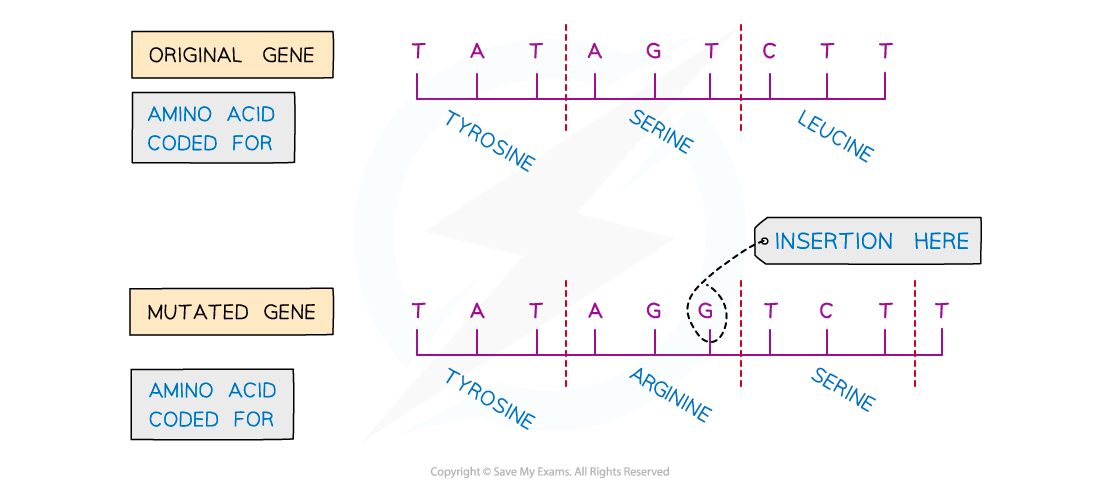
An example of an insertion mutation
Deletion of nucleotides
-
A mutation that occurs when a nucleotide (and therefore its base) is randomly deleted from the DNA sequence
-
Like an insertion mutation, a deletion mutation:
-
Changes the amino acid that would have been coded for
-
Has a knock-on effect by changing the groups of three bases further on in the DNA sequence
- This is another type of frameshift mutation
-
-
This may dramatically change the amino acid sequence produced from this gene and therefore the ability of the polypeptide to function
Substitution of nucleotides
-
A mutation that occurs when a base in the DNA sequence is randomly swapped for a different base
-
Unlike an insertion or deletion mutation, a substitution mutation will only change the amino acid for the triplet (a group of three bases) in which the mutation occurs
- It will not have a knock-on effect (it is not a frameshift mutation)
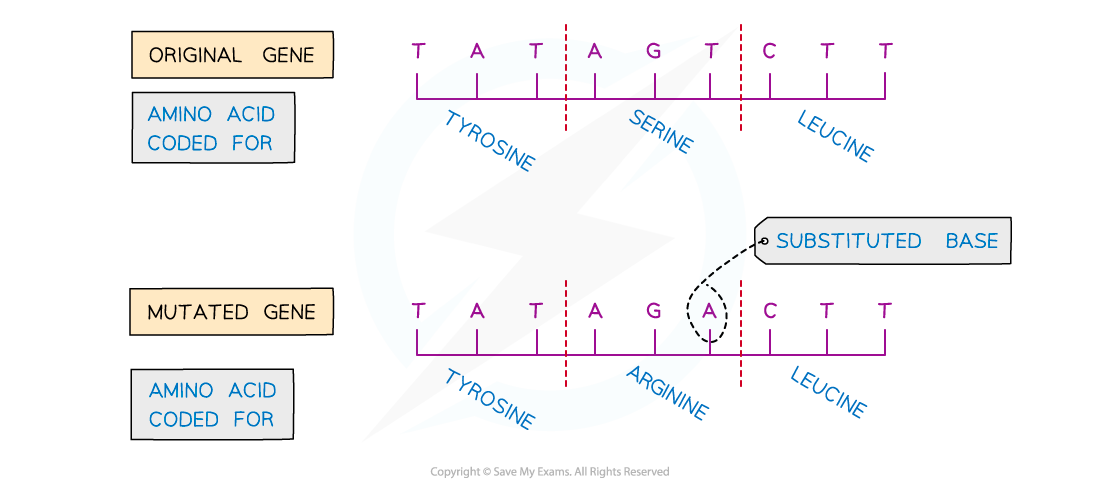
An example of a substitution mutation
The effect of gene mutations on polypeptides
-
Most mutations do not alter the polypeptide or only alter it slightly so that its appearance or function is not changed
-
However, a small number of mutations code for a significantly altered polypeptide with a different shape
-
This may affect the ability of the protein to perform its function
-
For example:
- If the shape of the active site on an enzyme changes, the substrate may no longer be able to bind to the active site
- A structural protein (like collagen) may lose its strength if its shape changes
-
Was this revision note helpful?
Build on this topic