x = g(x) Iteration (Cambridge International A-Level Mathematics)
Exam board Cambridge International · A-LevelUpdated 2026-10-01
x = g(x) iteration
What is iteration?
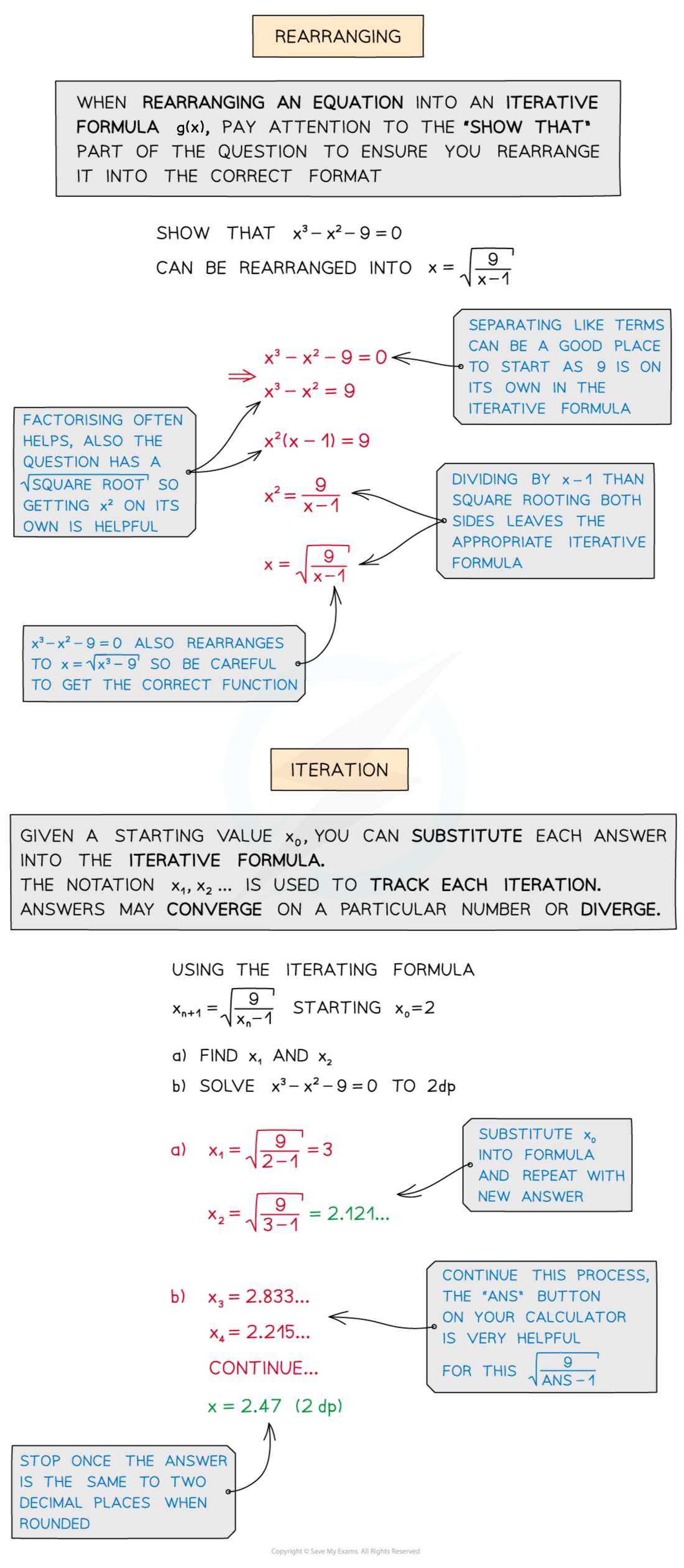
- When an equation cannot be solved using the usual analytical methods, we can still find approximate solutions to a certain degree of accuracy
- Iteration is one way to do this, by repeatedly using each answer as the new starting value for a function, we can achieve an ever more accurate answer
What does xn + 1 = g(xn) mean?
- Iterations are shown using the notation xn + 1 = g(xn)
- This is a recurrence relation where, starting with a number (xn), we will get an answer xn + 1 which we can then reuse in the original function
- Equations need to be rearranged into an iterative formula – ie. the form x = g(x)
What are staircase diagrams and cobweb diagrams?
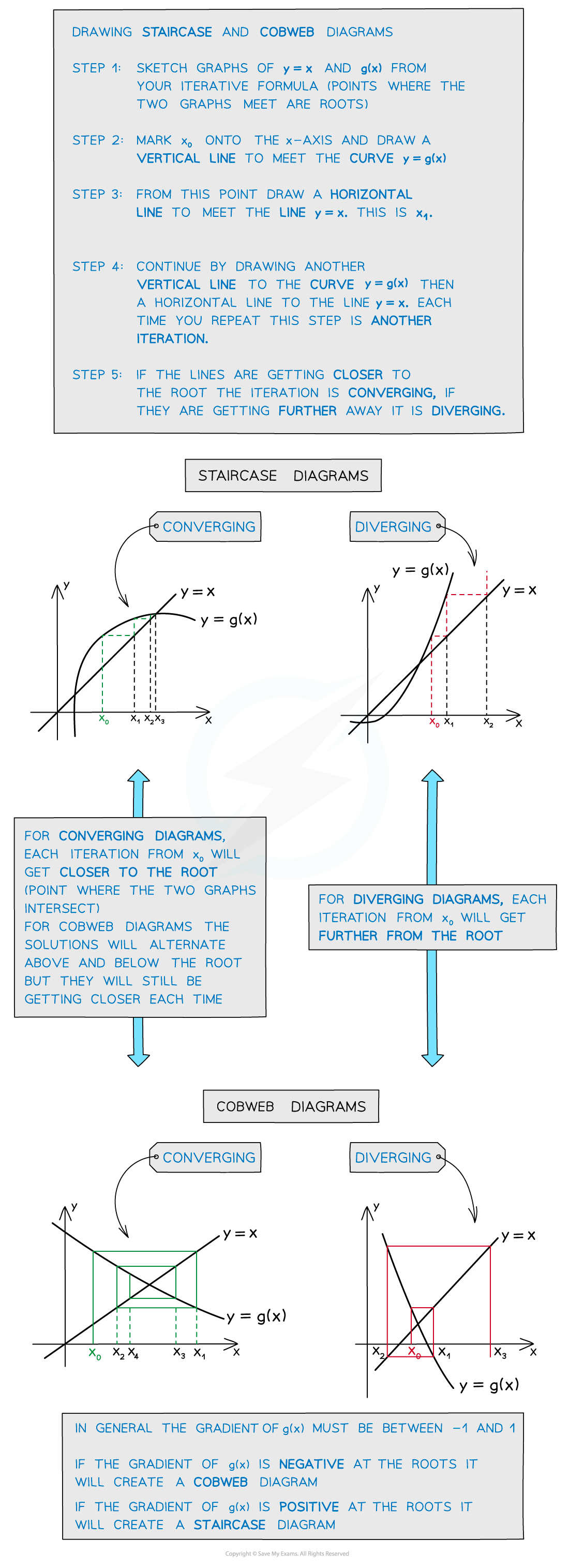
- Iterations can be shown on diagrams called staircase or cobweb diagrams
- These can be drawn by plotting the graphs of y = x against y = g(x) from your iterative formula
Exam Hint
- You must show all your steps when rearranging an equation into an iterative formula
- Working backwards can often be helpful to figure out how an equation has been rearranged but you must write your answer as if you worked forwards
- Use ANS button on your calculator to calculate repeated iterations
- Keep track of your iterations using x2, x3… notation
- Iteration may be part of bigger numerical methods questions
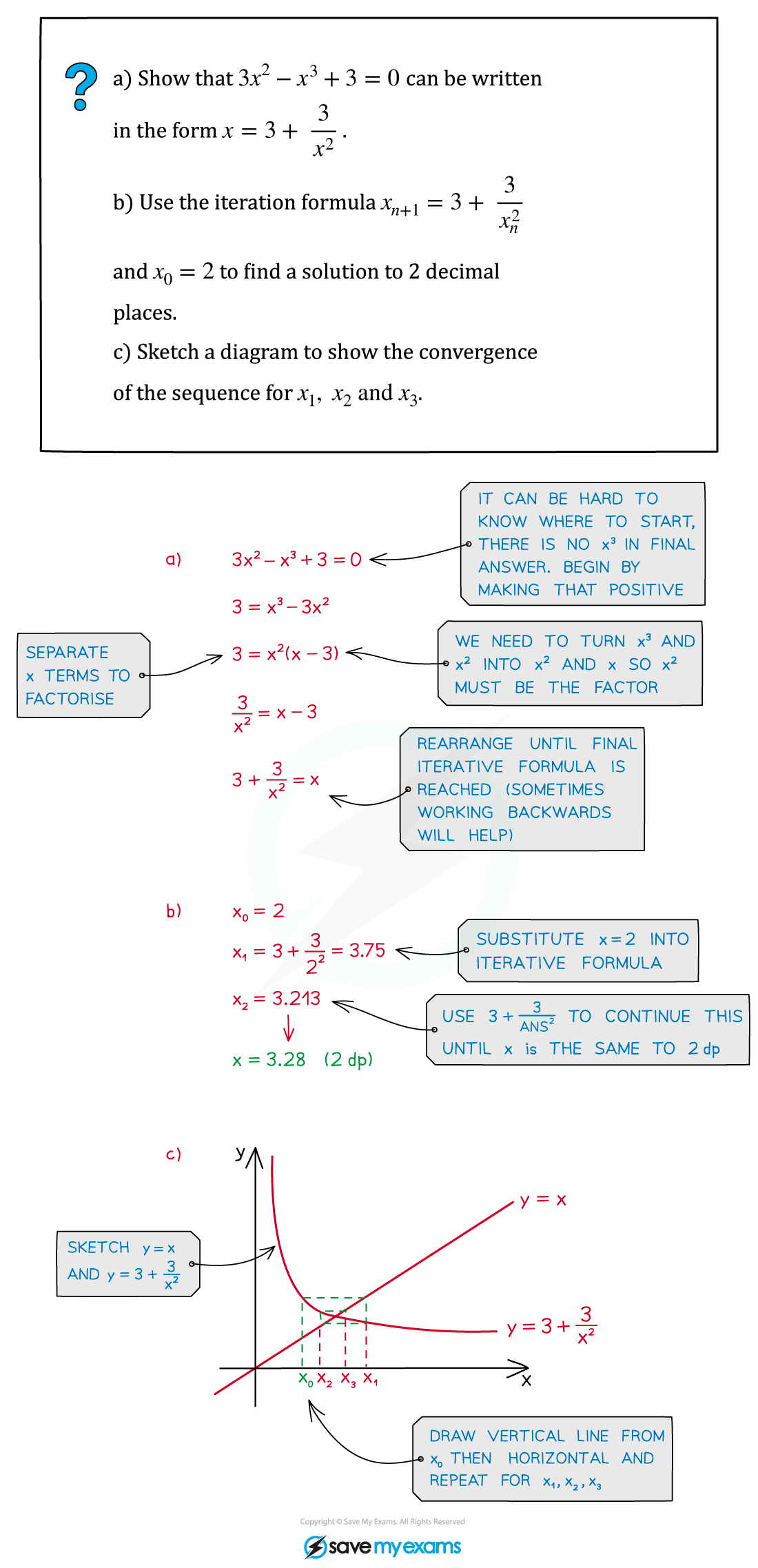
Worked Example
Was this revision note helpful?