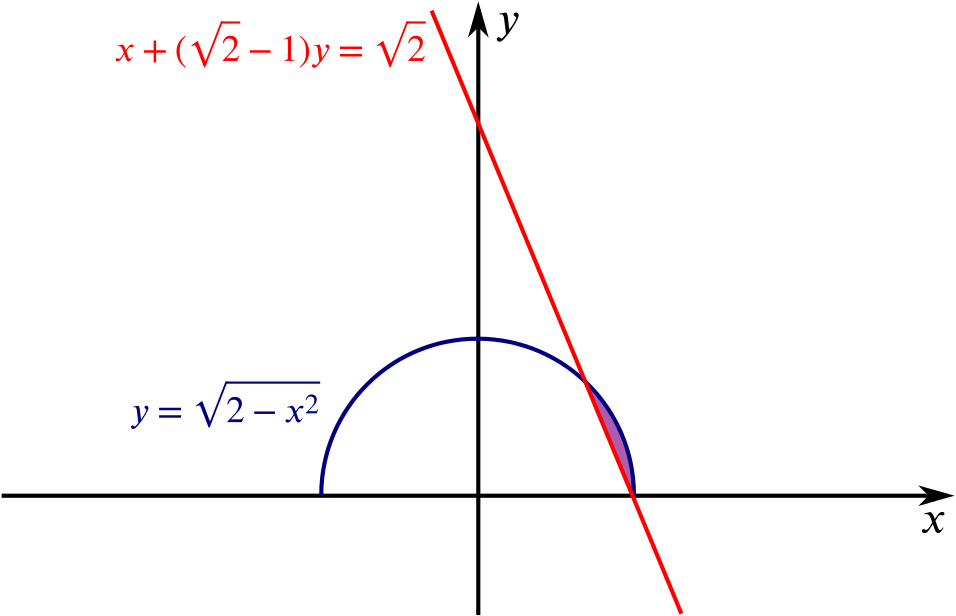
The area bounded by the graphs y=2−x2andx+(2−1)y=2 equals
2sin2;
4π−21;
22π;
6π2.
Suggestion
Could we start by sketching the graphs of our two functions?
How do we calculate the area of the required shape? Could we write it as the difference of two other areas?
What would we expect our answer to look like? Do some of the options in the list seem more likely than others?
Solution
The equation y=2−x2 can be squared to get y2=2−x2, or x2+y2=2. This is a circle centred at the origin with radius 2.
The original equation, though, is y=x2⋯, which is never negative, so we actually only have the semicircle with y≥0.
The graph of x+(2−1)y=2 is a straight line which intersects the y-axis at (0,2+2), and the x-axis at (2,0), which is on the circumference of the circle.
We can now sketch these two graphs.
To find the other point of intersection, we substitute x=2−(2−1)y into the equation of the circle, to get (2−(2−1)y)2+y2=2⟹2−22(2−1)y+(2−1)2y2+y2=2⟹2−(4−22)y+(3−22)y2+y2=2⟹−(4−22)y+(4−22)y2=0⟹(4−22)y(−1+y)=0. So y=0 (the intersection we already know about) or y=1.
Alternatively, substituting y=2−x2 into the equation of the line gives a shorter solution if we notice that 2−x2=(2−x)(2+x).
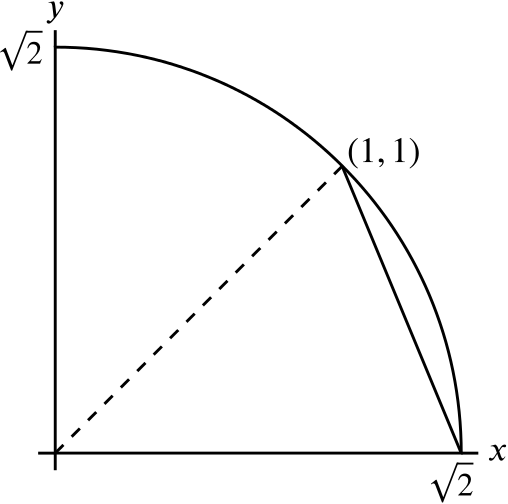
So the line intersects this semicircle at (2,0) and (1,1).
The sector has an angle of 45∘=4π. The simplest way to calculate the area of this segment is to work out the area of 81 of the circle, and then subtract the triangle which has base 2 and height 1.
So the area is 81×2π−21×2×1=4π−21
and the answer is (b).
Once we know that the area we seek is the difference between the area of a sector of a circle and the area of a triangle, does one of the answers pick itself?