What can we say if is tangent to ?
Question
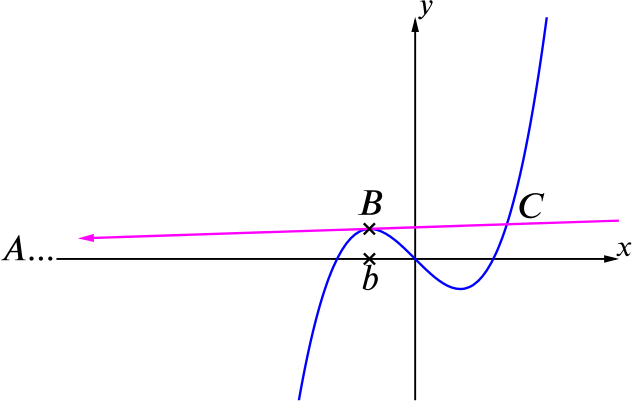
The graphs of and are drawn on the axes below. Here and .
The line meets the -axis at , touches the cubic at and intersects again with the cubic at . The -coordinates of and are respectively and .
- Use the fact that the line and cubic touch when , to show that .
- Show further that
- If , what is the approximate value of ?
- Using the fact that (which you need not prove), show that .
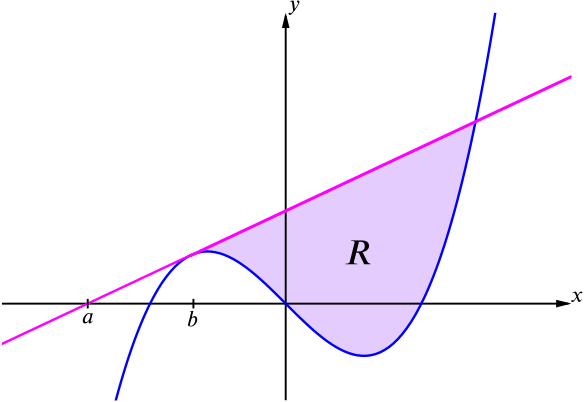
- is the finite region bounded above by the line and bounded below by the cubic . For what value of is the area of largest? Show that the largest possible area of is .

Suggestion
What do we know about curves and lines which touch at some point? How can that help us to answer this question?
Can we find simply in terms of and ? Could we drop a vertical from ?
Can you sketch a graph to show this situation?
Why is this true? For which values of x is this true? So this tells us that …
How does the area of change as changes?
Or… can we find a formula for the area? When we’ve done so, how can we maximise this?
Solution
For the line and the cubic to touch at , the gradients must be equal at this point.
The gradient of the cubic is given by and the gradient of the line is .
Therefore, equating these expressions at gives
The value of must be the same for each graph at . Hence we have
Now from part (i) we know that , so substituting this into the above expression gives
We can rearrange this to get
by dividing by
to give
and then finding
If is large and negative, the line (which is still a tangent to the curve somewhere between and ) will be almost horizontal.
So the point will lie almost at the maximum point of the curve, which is where , so .
Another way of thinking about this is that the fraction in (ii) must be very large and negative.
For this, either must be very large and negative, or the denominator must be very close to zero.
But lies between and , so it must be the latter, and , giving (taking the negative square root).
We can put both sides in a polynomial form, so that we can see the coefficients of , etc. on each side. Doing this gives
Since the statement is true for all , it must be true that the coefficient of any power of must be the same on both sides.
In particular the coefficient of on the left side, , must be equal to the coefficient on the right side, . Therefore , and hence .
If increases (getting closer to ), then decreases and the line rises, making the area of larger.
Therefore we want to choose the largest possible value of in order to make the area the largest. So as , the area of is largest when .
And when , the line must be tangent to the curve at the point since this is a point on both the line and the curve for this value of .
So coincides with and .
We can also deduce this algebraically using the earlier results, as follows. By part (ii), we see that
Rearranging this gives , which can be factorised as . Since can’t be positive, we conclude that .
Then using part (iv), we obtain , and from part (i), we see that .
So we can now calculate