A cubic has one real root—can we find an approximation to it?
Question
Show that the equation has one positive root. Find to three decimal places an approximation to this root.
Suggestion
‘Every cubic has at least one real root.’ True or false?
Can we show we have a positive root here?
Can we show we have only one?
There is more than one way of doing this…
In 1952, when this question was first set, students did not have calculators, so more efficient methods were preferable!
Solution
Consider the equation
Approach 1
When , , and when , , so since the curve is continuous (we can draw it without taking our pen off the paper), it must cut the -axis somewhere betwwen and .
Could it cut the positive -axis more than once? Well, we can see that and are increasing functions for positive .
If there were to be a second positive root, the curve would have to decrease somewhere for , which is not possible.
So the curve has a single positive root.
Approach 2
Here we find the turning points of the curve.
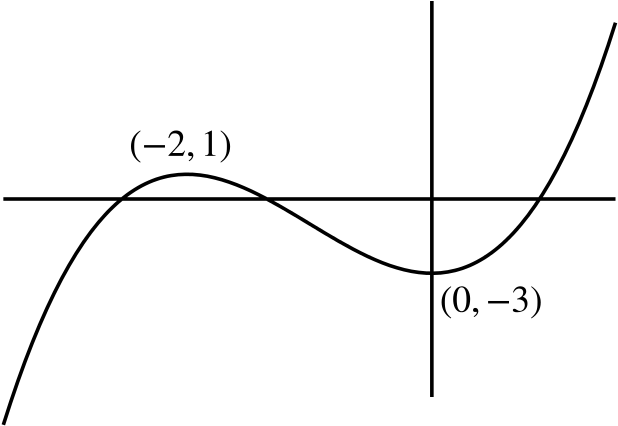
Differentiating gives and so setting and solving gives or . Therefore, the turning points lie at and .
It is now clear that is a maximum and is a minimum, as .
We can now sketch the graph:
We can see that the equation has exactly one positive root.
Method 1: Trial and improvement
We first find two integers that the root lies between, then use the same technique to find the root to one decimal place, and so on.
| - | - | - | - | - | - | - | - | - | - | - |
So lies between and , so to three decimal places, .
Method 2: Linear interpolation
We first find two integers that the root lies between, as in Method 1. Writing , we find that and .
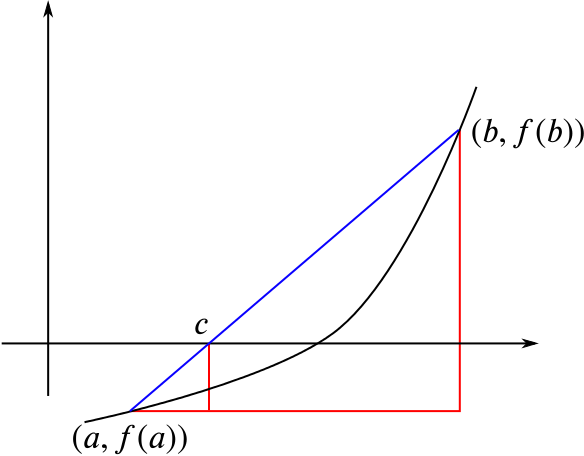
This suggests that the root is much closer to than to , and we can use linear interpolation to improve our estimates, as shown in this diagram:
If our estimates are and , giving and , then our new estimate is given by similar triangles (as explored in the resource In-betweens). We have so rearranging gives
If turns out to be negative (as in the example shown), then the root lies between and , so we use and for the next iteration. If turns out to be positive, then the root lies between and , so we use and for the next iteration.
It looks as though we are almost there: to confirm this, we calculate , so the root lies between and , so is to three decimal places.
Method 3: Newton-Raphson iteration
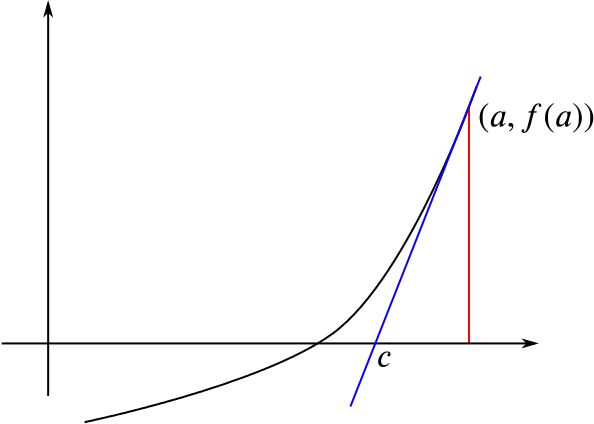
Here we start with an estimate for the root, say , and draw a tangent to the curve from here. Our next estimate is the intersection of the tangent with the -axis.
The tangent has gradient , so we see that Rearranging this to find gives Once we have found our , we use that as our next value of .
Since we therefore have an iteration here, we could write for our initial value of , then for the next, and so on, and our formula can be written as
In our case, , so the formula is
We cannot start with , as then the denominator would be (what does this correspond to in terms of the graph?)
So we start with :
(We can use the ANS button on our calculator to help us here). The last two values agree to three decimal places. So checking and (or using which we’ve already had to calculate) shows that the root is to three decimal places.
Which of these methods is the simplest, do you think?
Which requires the fewest calculations? (Especially remembering that there were no electronic pocket calculators in the 1950s!)
Are there other methods which might have been even better?