When are the roots for real and positive?
Question
Consider the equation where and are real numbers.
- Show that the roots of the equation are real and positive if and only if and , and sketch the region of the - plane in which these conditions hold.
- Sketch the region of the - plane in which the roots of the equation are real and less than in magnitude.
Suggestion
How can we show the roots of a quadratic equation are real? What more do we need to do to show that the roots are also positive?
What do we need to do to show an “if and only if” statement is true?
Solution
We need to show an ‘if and only if’ statement, so let’s consider the two directions separately to make sure that we get the logic straight.
Approach 1
First suppose that the roots of the equation
are real and positive. From the quadratic formula, we see that the roots of are of the form For the root or roots to be real, we require that , that is, . In order for them to be positive, we require that This immediately tells us that , but we can go further. We can rearrange this to get which (assuming that ) is true if and only if since both sides of the inequality are positive so we may square. But then That is, if the roots are real and positive then and .
Now suppose that and .
Then the roots of are real since , and guarantees that the root is positive.
So it remains to show that . We have that so that then square rooting shows that so the roots of are real and positive, as required.
Approach 2
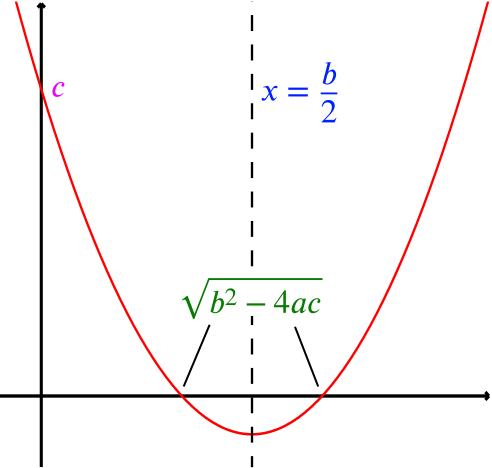
This is intended to be a proof without words! We have from the diagram that:
- If , and are all positive, there are two real positive roots for (if , we have two real positive equal roots).
- If there are two real positive roots for , then and are positive and is non-negative.
(Why is the distance between the roots ?)
Approach 3
When solving problems about the roots of polynomials, it is often useful to find expressions those roots must satisfy and see if this tells us anything new. If and denote the roots of the equation, then
and so and .
We also know that the roots of a quadratic equation are real if and only if the discriminant is non-negative, that is, if and only if .
Using these facts, if and are both real and positive, then , and , as above.
Conversely, if
and
, then we know the discriminant is positive and hence both roots are real. We also have that
and
As and are both real, by , we know that and are either both positive or both negative. However, if and were both negative, then could not possibly hold. Hence and are both positive, as required.
We now sketch on a graph the region where , and :
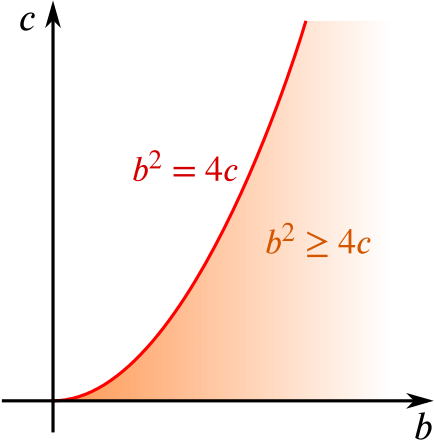
The region of the - plane for which , and
We know that in order for the roots to be real we need
as in the first part. We now need to find the region where
We have so we only need to consider the values for which both
Firstly, we will consider the values for which Rearranging gives So , as the square root is non-negative, and we can square both sides to get which we may rearrange to find .
We will now consider the values for which Similarly, we can rearrange to get So , and we can, as before, square to get and hence .
To sketch the graph, we start by considering the boundary curves , and , and the points at which they intersect. We can see that the two lines only intersect when and , and the lines intersect the curve when
which rearrange to
This tells us that each line intersects with the curve in only one place and so these lines must be tangent.
Is there a way we could have deduced this directly from ?
What do the lines being tangent signify in terms of our equation ?
Is this a representation of a well-known property of these equations?
Sketching the graph then yields the following picture:
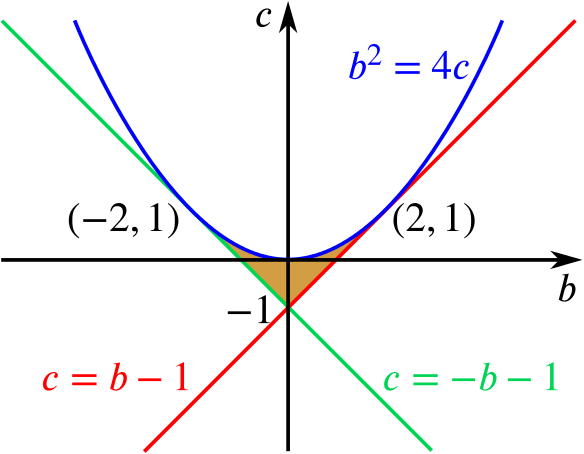
The shaded region is where , , and
We might notice that when we derived the inequalities and , a lot of the work we did was very similar.
We might also notice that the graph above is symmetric about the axis. Why is this?
Does the graph give us any ideas about how we might deduce one inequality from the other?