Discriminating
Excerpt: Discriminating can be used to consolidate understanding of the discriminant and make connections between graphs and algebra. Students are given statements about the number of solutions of a quadratic equation and asked to decide whether MUST, MAY or CAN’T is the correct choice of word within the statement. For detailed notes on this resource, please see Discriminating - teacher support.
Problem
Below are several statements about the quadratic equation where , and are allowed to be any real numbers except that is not .
For each statement, decide whether MUST, MAY or CAN’T is the correct word to use in the statement.
To say that something MUST be the case, we need it to be true in all cases; we will need to give a convincing explanation (a proof) of why this must be always true.
To show that something CAN’T be the case, we likewise need to give a convincing explanation (a proof) of why.
To show that something MAY be the case, we need to give an example when it is true and an example when it is false. If you want a harder challenge, can you determine exactly when it is and when it is not true?
You might want to download cards with the statements on them, so that you can sort them into piles.
If , then MUST / MAY / CAN’T have real roots.
If , then MUST / MAY / CAN’T have one repeated real root.
If has no real roots, then MUST / MAY / CAN’T have two distinct real roots.
If , then MUST / MAY / CAN’T have two distinct real roots.
If , then MUST / MAY / CAN’T have one repeated real root.
The equation MUST / MAY / CAN’T have three real roots.
If , then MUST / MAY / CAN’T have real roots.
The equation MUST / MAY / CAN’T have the same number of real roots as .
If has two distinct real roots, then we MUST / MAY / CAN’T have .
If , then MUST / MAY / CAN’T have two distinct real roots.
The equation MUST / MAY / CAN’T have the same number of real roots as .
If has no real roots, then MUST / MAY / CAN’T have two distinct real roots.
Suggestion
Do you have any favourite examples of quadratics with different numbers of real roots? Having some examples to test is a good way to begin on a problem like this.
How can we use the coefficients to determine the number of real roots?
How can thinking about the graph of the quadratic help us to think about some of these statements?
As well as trying to visualise this, it may be helpful to use the interactive graph.
Solution
To say that something MUST be the case, we need it to be true in all cases; we will need to give a convincing explanation (a proof) of why this must be always true.
To show that something CAN’T be the case, we likewise need to give a convincing explanation (a proof) of why.
To show that something MAY be the case, we need to give an example when it is true and an example when it is false. If you want a harder challenge, can you determine exactly when it is and when it is not true?
You may like to explore some of the scenarios on the cards using graphing software or the interactive graph in this resource.
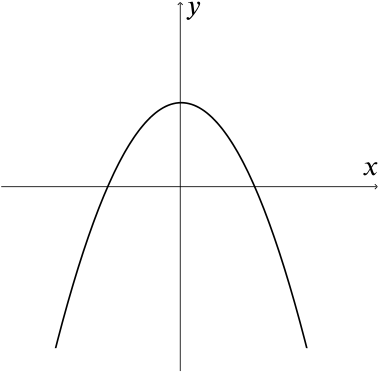
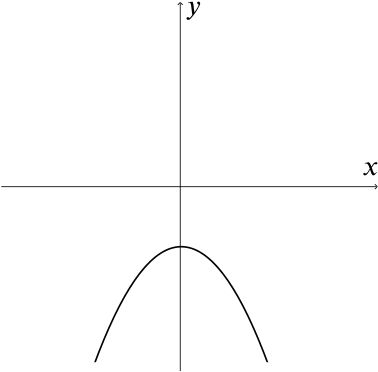
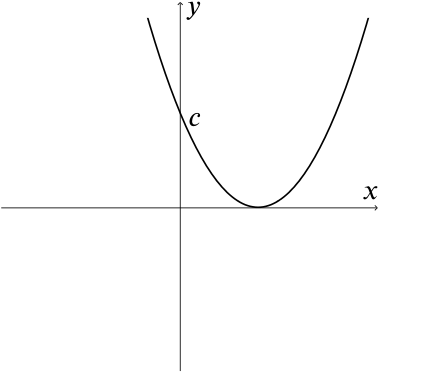
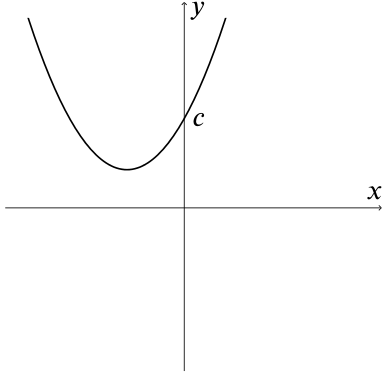
Knowing that tells us that this is a “vertex up” parabola. For example, it could look like one of these two graphs:
 |  |
|---|
The graph of the left is a sketch of , while the one on the right is .
This shows that if , then MAY have real roots.
From the quadratic formula, we know that the equation (with ) has roots In this case, we are told that the discriminant is , so the only real root of the equation is .
Therefore, if , then MUST have one repeated real root.
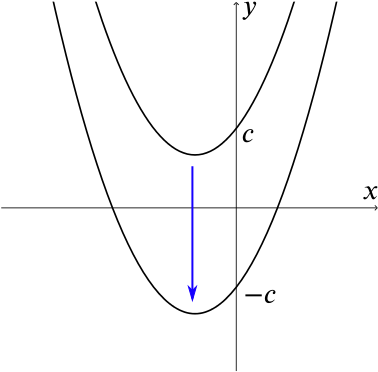
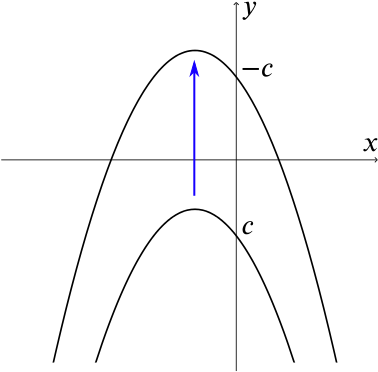
If the equation has no real roots, then the graph of (which intersects the -axis at ) does not cut the -axis, and its vertex is on the same side of the -axis as , as in the following sketches, the left one showing the case of and the right one showing :
 |  |
|---|
The graph of is obtained by translating the first graph in the -direction until it intersects the -axis at . Since the direction of the parabola does not change (it remains “vertex up” or “vertex down”), it must now intersect the -axis in two distinct points.
Therefore, if has no real roots, then MUST have two distinct real roots.
Alternatively, we can argue algebraically. Since the equation has no real roots, we can say something about the discriminant: we know that .
Since is the square of a real number, it is always non-negative (that is, ), so tells us that is positive.
The equation has discriminant , and now this must be positive.
So has two distinct real roots.
The tempting thing to do is to multiply both sides of the inequality by , to obtain . This would give , so that the equation couldn’t have two distinct real roots – it would have no real roots.
Unfortunately, we don’t know whether is positive or negative, so when we multiply both sides of the inequality by , we may be changing the direction of the inequality.
If is positive, then and the equation has no real roots.
However, if is negative, then multiplying the given inequality by will yield , so and the equation has two distinct real roots.
So if , then MAY have two distinct real roots, depending upon the sign of .
If we start by taking , then we have the family of quadratics , which look like this:
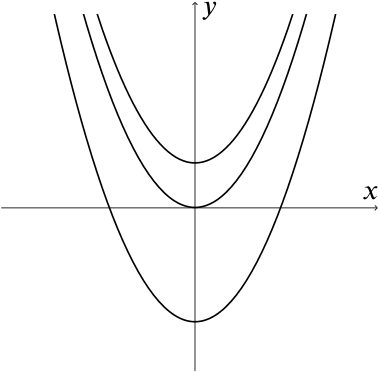
We can clearly see that we may have two real roots, one repeated real root (when ) or no real roots.
So if , then MAY have one repeated real root.
Alternatively, we could consider this from an algebraic perspective.
The discriminant is , since . For the equation to have one repeated real root, we require the discriminant to be zero. This will be true if and only if (as ), so MAY have one repeated real root.
The equation CAN’T have three real roots, as a quadratic equation can have at most two roots. (We can see this from the quadratic formula or from thinking about the shape of the graph.)
If , then the equation is of the form , and so is a real root.
In fact is also a real root, so if then the equation has two distinct real roots, while if , it has one repeated real root.
Alternatively, we could calculate the discriminant, (since ). Since is a square, it is never negative, so the equation always has either two distinct or one repeated real root.
So if , then MUST have real roots.
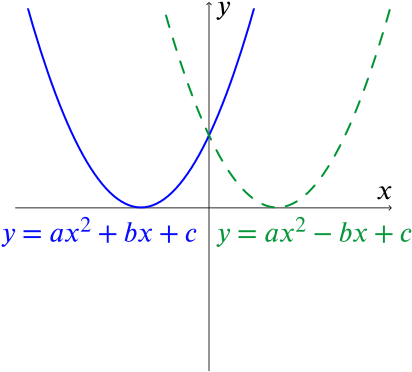
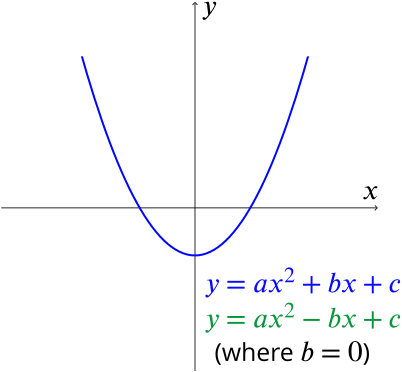
Changing the term to in the equation has the same effect as replacing by (since ).
So the effect on the graph of is to reflect it in the -axis, as in the following sketches:
 |  |  |
|---|
So we see that and MUST have the same number of real roots. We can even see more than this: the roots of are the negatives of the roots of .
Alternatively, we could think in terms of the discriminant.
The equations and both have discriminant , so they must have the same number of real roots (whatever that number is).
If the equation has two distinct real roots, then its discriminant must be positive, that is, .
Now we can rearrange that to obtain . We can now divide this inequality by (which is positive) to obtain .
So if has two distinct real roots, then we MUST have .
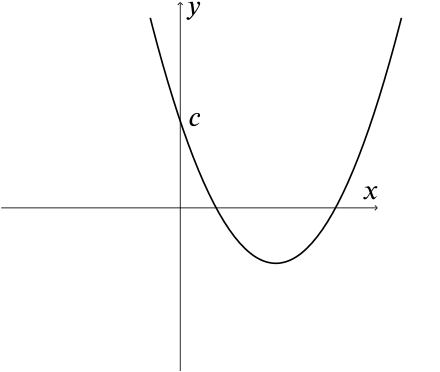
The value of tells us where the quadratic crosses the -axis. Here are some sketches of graphs with a positive -intercept.
 |  |  |
|---|
So we can see from this that if , then MAY have two distinct real roots.
Explicit examples of quadratic equations would include , which has two distinct real roots, and , which has no real roots.
Alternatively, if we consider the discriminant , if we take , then is positive. So if we choose with , we will have (giving two distinct real roots), while if we choose with , then and there are no real roots.
There is no obvious way of relating the graph of to that of , though it would be fine to draw them both and compare them.
We consider instead the discriminants of the two equations. The discriminant of is , while that of is . So the discriminants are equal, and so the equations have the same number of roots.
However, we made an assumption here which may not be valid. The equation is certainly a quadratic, as is non-zero. However, is only a quadratic if is non-zero. But what if ? In this case, is just the linear equation (assuming is non-zero). So if , the equation has one real root, which will not be the same number of real roots as .
As explicit examples, the equation has two distinct real roots. The equation obtained by reversing the coefficients is , and this factorises as so has roots and —it too has two distinct real roots.
On the other hand, the equation has two distinct real roots (since , which has roots and ). The equation obtained by reversing the coefficients is , that is, , and this has just one real root ().
Therefore, the equation MAY have the same number of real roots as .
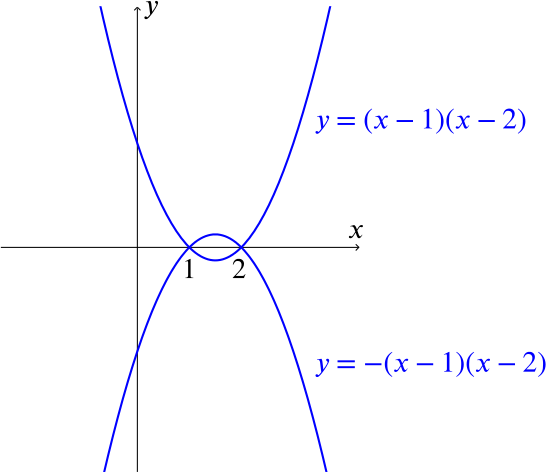
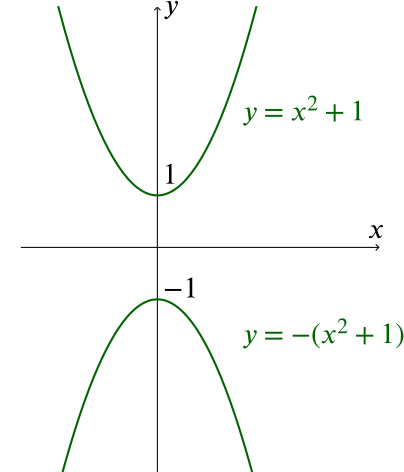
One way to think about this is that the graph of is the reflection of the graph in the -axis. They therefore have the same number of roots as each other.
These two graphs show examples of this. On the left, has two real roots; on the right, has none. It is clear that their reflections have the same number of real roots.
 |  |
|---|
Algebraically, if we multiply by , we obtain , which must therefore have the same roots as the original equation. In some sense, they are essentially the same equation.
Therefore, if has no real roots, then CAN’T have two distinct real roots.
Interactive graph
Here is an interactive graph which you might find useful for exploring some of the scenarios on the cards.
[interactive embed (geogebra-iframe): //www.geogebratube.org/material/iframe/id/bhSGAxMC/width/627/height/427/border/888888/rc/false/ai/false/sdz/true/smb/false/stb/false/stbh/false/ld/false/sri/true/asb/false/at/html5] — not part of the text import; see the source page.
Download GeoGebra file