When is negative?
Question
- Find the range of values of for which the expression is negative.
- Find the range of values of for which the expression is always positive.
Suggestion
If a quadratic is always positive, what can be said about its roots?
Solution
This is the same as asking: when is the curve below the -axis?
Let’s start by finding when . We can use the quadratic formula here, giving the roots as
(We could factorise here, but the factorisation could take us a while to spot.)
The coefficient of is positive here, so the curve is ‘vertex-down’. We have enough information now to sketch the curve.
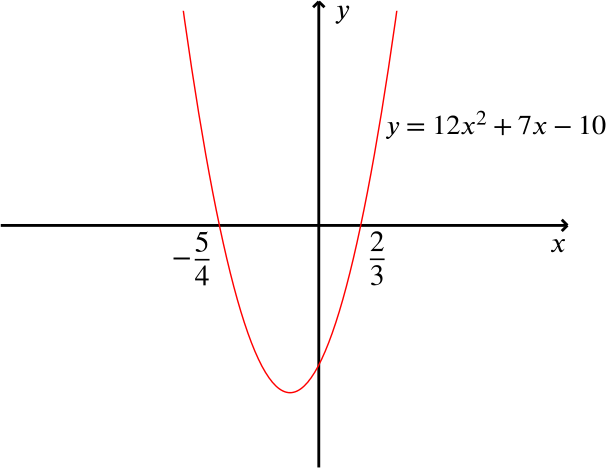
So the expression is negative for .
We note that since the coefficient of is positive, will always be positive for some values of , and the curve is ‘vertex-down’.
So the question is the same as asking: which values of mean that the curve is always above the -axis?
This means there are no roots for , and so the discriminant must be negative.
So we have , or .
Hence the expression is always positive if and only if .
Alternatively we could complete the square here. The expression can be written , which is always positive if and only if .