The Business (Trade) Cycle (Cambridge International A-Level Economics)
The link to output gaps
Phases of the cycle
-
The business (trade) cycle describes the fluctuations of actual real GDP around the long-term trend rate of growth
- Four recognisable phases repeat over time: boom, slowdown, recession and recovery.
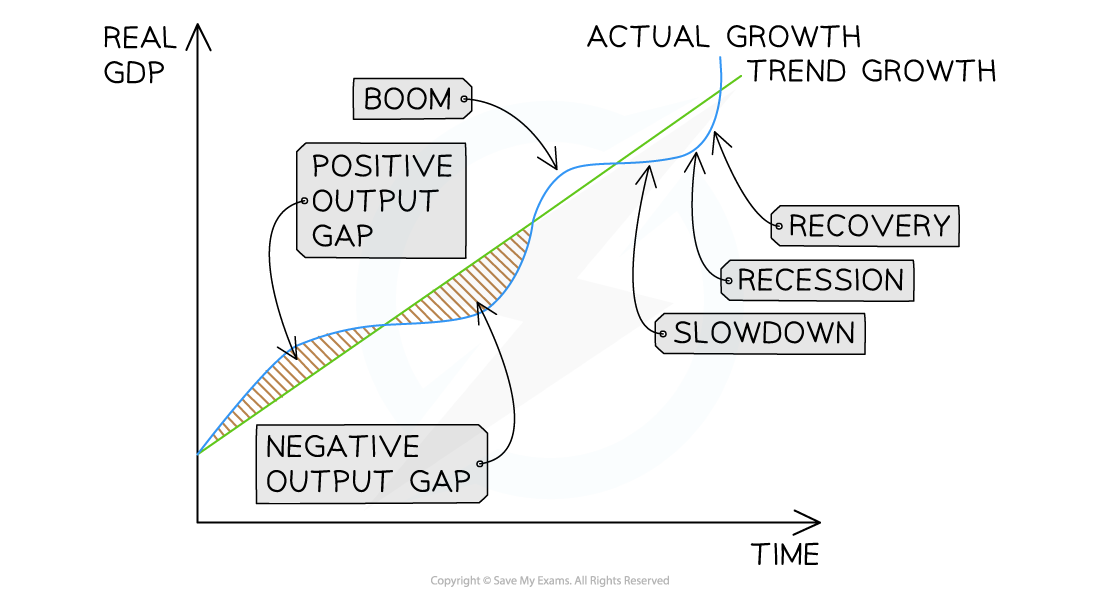
The business cycle
Diagram analysis
-
The straight rising line shows the long-term actual growth trend - the path real GDP follows on average over time as potential output expands
-
The wavy curve shows actual real GDP fluctuating above and below this trend
- The positive output gap zone is shaded above the trend line during the boom phase - actual real GDP is higher than the trend suggests it should be
- The negative output gap zone is shaded below the trend line during the recession phase - actual real GDP is lower than the trend suggests
-
The four phases follow a natural sequence: boom → slowdown → recession → recovery, then back to boom
- The transition from boom to slowdown happens as the economy approaches capacity
- The transition from recession to recovery is often moderated by government intervention
-
The cycle is rarely symmetric in practice - recessions may be short and sharp or long and gradual, and booms may be of very different lengths
Characteristics of booms and recessions
- Each phase has distinctive qualitative features worth recognising in context:
| Recession | Boom |
|---|---|
| - Sustained period of negative economic growth, usually two consecutive quarters (6 months) | - Sustained period of above-trend growth |
| - Low confidence among firms and households | - High confidence and rising willingness to take on risk |
| - Businesses defer investment; households defer large purchases | - Strong investment and consumer durables spending |
| - Government budget deficit rises as spending rises and tax revenue falls | - Government budget deficit falls as tax revenue rises and benefit spending falls |
| - Political pressure for intervention and stimulus | - Political pressure for restraint and cooling measures |
Causes of the cycle
-
The business cycle has multiple interacting causes
-
No single factor explains it alone — most recessions/booms reflect a combination of the following
-
Useful distinction:
- Endogenous causes — generated from within the economy itself
- Exogenous causes — external shocks hitting the economy from outside
1. Multiplier–accelerator interaction (endogenous)
- Most important endogenous cause (links to 9.1)
- Upswing: rise in autonomous investment → raises Y via multiplier → induces further investment via accelerator → raises Y again via multiplier
- Downswing: slowdown in growth → induced investment falls sharply → Y falls via multiplier → induced investment falls further
- Can generate cyclical behaviour even in an otherwise stable economy
2. Changes in confidence (can be endogenous or exogenous)
- Consumer and business confidence — Keynes's "animal spirits" (instinctive optimism/pessimism driving economic decisions) — is volatile and self-reinforcing
- Optimism → raises autonomous C and I → boom
- Confidence shock (financial stress, political uncertainty, public health crisis) → collapse in AD → recession
3. Supply-side shocks (exogenous)
- Sudden changes in cost/availability of key inputs (esp. energy) shift SRAS leftward
- Can trigger recession even without a fall in AD
- Key examples: 1970s oil price shocks; 2022 energy price spikes following Russia–Ukraine conflict
4. Monetary policy changes (can be endogenous or exogenous)
- Tightening interest rates to control inflation → deliberately slows economy, potentially into recession
- Loosening rates → helps economy recover from recession but may cause the next boom
- Policy-induced cycles common in economies with independent inflation-targeting central banks
5. External shocks and international transmission (exogenous)
- In open economies, recessions often imported through trade and financial linkages
- Recession in major trading partner → reduces exports
- Global financial crisis → disrupts credit and investment across borders
- Globalisation has tended to synchronise cycles across countries
How Phases Transition
- Phases do not end abruptly - they transition as cyclical drivers weaken, reverse, or are moderated by policy
Main transition mechanisms:
-
Exhaustion of cyclical drivers
- Factors starting a boom (rising confidence, easy credit, rising asset prices) weaken as the cycle matures; prolonged booms face capacity constraints, rising costs and diminishing investment opportunities
-
Reversal of the multiplier–accelerator
- Same mechanism that amplified the upswing reverses during the downswing; slowdown in Y growth → induced I falls sharply (accelerator) → Y falls (multiplier) → induced I falls further; self-reinforcing reversal explains why recessions can be severe and fast
-
Automatic stabilisers
- Tax and benefit system automatically reduces the severity of downturns and restrains upswings without any policy decision (see next section)
-
Discretionary policy response
- Central banks tighten monetary policy as inflation rises in a boom, loosen as recession deepens; governments may use expansionary fiscal policy in recession, contractionary in boom
-
Lags and timing
- Transitions rarely sudden because responses take time to take effect; monetary policy may take 12–18 months to affect AD; fiscal measures face implementation delays
Exam Hint See the Keynesian vs Classical debate on whether gaps close automatically or require intervention
Automatic stabilisers
- Automatic stabilisers are features of the tax and benefit system that dampen fluctuations in AD as the economy moves through the cycle - without any discretionary government action being required
- The main stabilisers are progressive taxation and unemployment benefits and other transfer payments
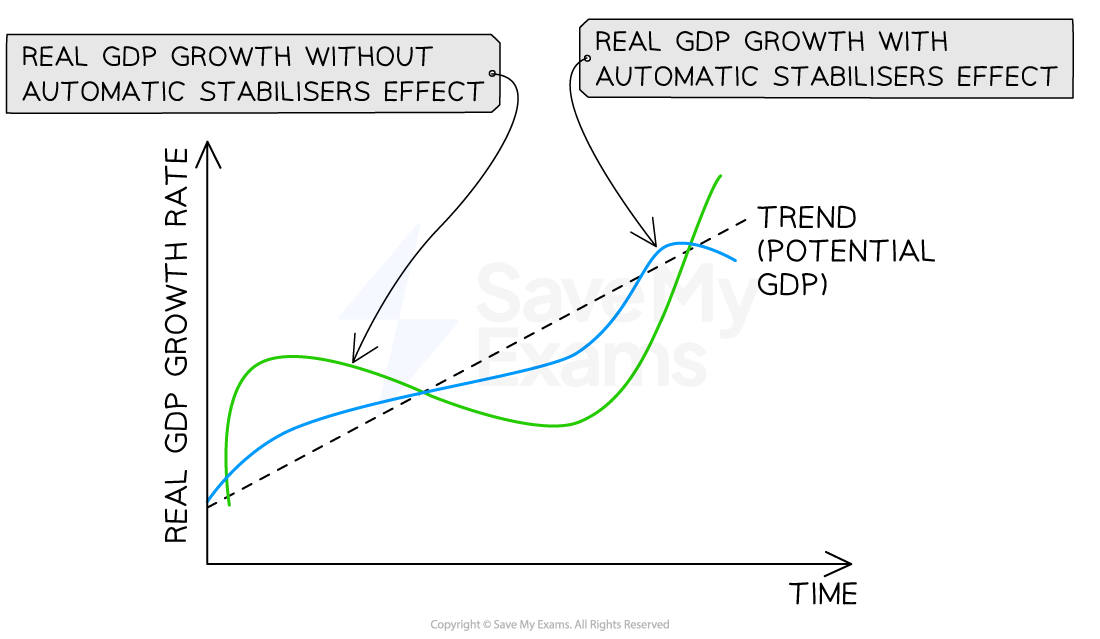
Automatic stabilisers
Diagram analysis
- The trend line represents potential GDP - the path the economy would follow at its sustainable growth rate
- The curve labelled "without automatic stabilisers" fluctuates widely above and below trend - recessions are deep and booms are pronounced
- The curve labelled "with automatic stabilisers" follows the same broad pattern but with a smaller amplitude - deviations from trend are reduced in both directions
- The two curves share the same trend line - stabilisers change the amplitude of the cycle, not the long-run potential growth rate
- The dampening is symmetric: stabilisers reduce the depth of recessions and the height of booms by the same mechanism operating in reverse
How stabilisers work in a recession
- Tax revenue falls automatically as incomes fall under progressive taxation
- Households retain more of their income, partially offsetting the fall in AD
- Unemployment benefits and transfer payments rise automatically as unemployment rises
- The recipients of these payments tend to have high MPCs, so the spending loss to the economy is smaller than it would otherwise be
- The combined effect is that real GDP falls by less than it would without stabilisers
How stabilisers work in a boom
- Tax revenue rises automatically as incomes rise and households move into higher tax brackets
- Households retain less of each additional £1 of income, restraining consumption growth
- Unemployment benefits and transfer payments fall automatically as unemployment falls
- The combined effect is a disinflationary restraint on AD, moderating demand-pull inflation
- Real GDP rises by less than it would without stabilisers
Limitations of automatic stabilisers
-
Stabilisers dampen but cannot eliminate the cycle - severe shocks still produce recessions and booms
-
Their strength depends on the progressivity of the tax system and the generosity of unemployment benefits
- Economies with smaller public sectors (e.g. Singapore, Hong Kong) have weaker stabilisers than those with larger ones (e.g. France, Nordic countries)
-
Stabilisers worsen government budget positions during recessions (automatic deficit rise) - politically difficult if public debt is already high
-
They address demand-side fluctuations but do little for supply-side shocks
Exam Hint The strongest answers on the cycle link causes to consequences through specific transmission mechanisms rather than listing factors generically. "A fall in confidence causes a recession" is a weak explanation; "a fall in business confidence reduces autonomous investment, which triggers a multiplier-accelerator downward spiral as induced investment also falls" shows the analytical depth examiners reward at Level 4.
Be precise about what automatic stabilisers do and do not do. They dampen the cycle, they do not eliminate it. They operate automatically without discretionary intervention, unlike active fiscal policy. And they are only as strong as the underlying tax and benefit system - a point worth making explicitly when comparing cycle volatility across different economies.
For evaluation, acknowledge that the business cycle is one of the most contested areas of macroeconomics. Keynesians emphasise demand-side causes and argue for active counter-cyclical policy; monetarists and new classical economists emphasise supply-side and policy-induced causes and are sceptical of discretionary intervention. Candidates who can frame their answer around this debate consistently reach the top band.
Was this revision note helpful?
Build on this topic