Sustainable Economic Growth (Cambridge International A-Level Economics)
What is sustainable economic growth?
-
Sustainable economic growth is growth that meets the needs of the present generation without compromising the ability of future generations to meet their own needs (Brundtland definition)
- It requires balancing current output with environmental protection and intergenerational equity
Using and conserving resources
| Resource type | Characteristic | Condition for sustainable use |
|---|---|---|
| Non-renewable (oil, coal, minerals) | - Finite stock | - Develop substitutes - Reinvest revenues in alternatives |
| Renewable (forests, fish, solar) | - Regenerate naturally | - Use at rate ≤ regeneration rate |
| Common access (atmosphere, oceans) | - No ownership — prone to overuse | - Collective action to prevent tragedy of the commons |
Impact of economic growth on environment and climate
- Growth typically uses more inputs and emits more waste
- These are negative externalities where producers and consumers do not bear the full social cost
| Impact | Mechanism |
|---|---|
| Climate change | - CO₂ from fossil fuels traps heat - Global temperatures rising |
| Air and water pollution | - Industrial emissions and agricultural runoff damage health and ecosystems |
| Deforestation and biodiversity loss | - Land cleared for farming, logging, urbanisation |
| Resource depletion | - Non-renewables consumed faster than substitutes developed |
Policies to mitigate the environmental impact
-
The polluter pays principle sits at the core of most policies
- Those who generate pollution should bear the cost of damage caused; underpins most environmental policy
The externality problem
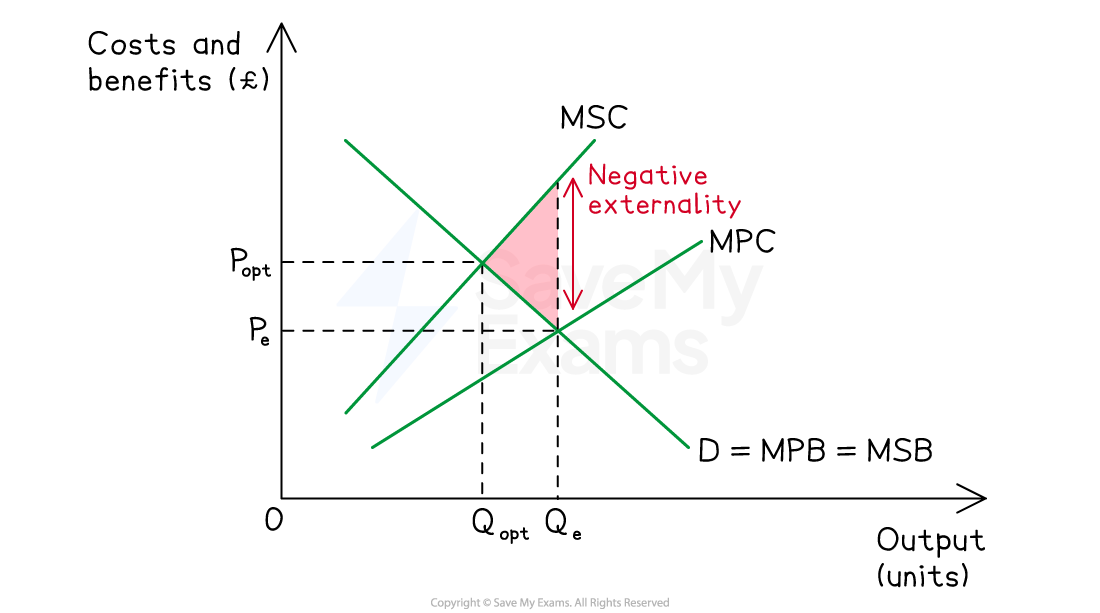
A negative externality of production
- Without intervention, the market produces at Qe where private cost = private benefit
- Socially optimal output is Qopt where marginal social cost = marginal social benefit
- The gap between Qe and Qopt is the welfare loss — policy aims to close it
Market-based policies
| Policy | Mechanism | Real-world example | Limitation |
|---|---|---|---|
| Carbon/pollution tax | - Tax per unit of emissions raises private cost toward social cost → firms reduce output or switch to cleaner inputs | - Sweden's carbon tax (US$130/tonne, 1991) | - Politically unpopular - Regressive on low-income households - Hurts competitiveness if unilateral |
| Tradable pollution permits (cap-and-trade) | - Government caps total emissions and issues permits; firms that cut emissions cheaply sell permits to firms that cannot → market price emerges on pollution | - EU Emissions Trading System (EU ETS) — world's largest carbon market, covers ~40% of EU emissions | - Requires accurate cap - Price volatility - Risk of over-allocation (EU ETS prices collapsed 2008–2017) |
| Subsidies for clean technology | - Lowers cost of renewables, EVs, energy efficiency → shifts production and consumption toward cleaner alternatives | - US Inflation Reduction Act (2022) - EU renewable subsidies | - Expensive - Opportunity cost on government budgets - Risk of picking wrong winners |
Command-and-control policies
| Policy | Mechanism | Real-world example | Limitation |
|---|---|---|---|
| Regulation and emissions standards | - Legal limits on pollution per unit of output - Bans on specific pollutants (e.g. CFCs) | - EU vehicle emissions standards - Montreal Protocol CFC ban | - Enforcement costs - No incentive to exceed standard - Can be inflexible |
| Direct provision | - Government supplies green infrastructure (public transport, renewable grid) | - China's high-speed rail - UK offshore wind expansion | - High capital cost - Long payback period |
International agreements
- Paris Accord (2015) — 196 parties committed to limit global warming to well below 2°C; each country set its own Nationally Determined Contributions
- Kyoto Protocol (1997) — earlier binding commitments for developed countries
- Key challenge — free-rider problem: countries benefit from others' emissions cuts without bearing their own costs; weak enforcement mechanisms
Comparing market-based vs command-and-control
| Market-based (taxes, permits) | Command-and-control (regulation) | |
|---|---|---|
| Strength | - Economically efficient — firms cut emissions where it is cheapest to do so - Ongoing incentive to innovate | - Certain outcomes — pollution cannot exceed the set limit |
| Weakness | - Uncertain quantity of emission cuts (taxes) or uncertain price (permits) | - Economically inefficient — same standard applied regardless of cost; no innovation incentive once standard is met |
| Best used when | - Marginal damage of pollution is gradual - Many small polluters | - Marginal damage is catastrophic at thresholds (e.g. ozone-depleting substances) - Few large polluters |
Case Study Costa Rica's green growth model
Costa Rica has maintained economic growth while reversing severe environmental damage
The policies
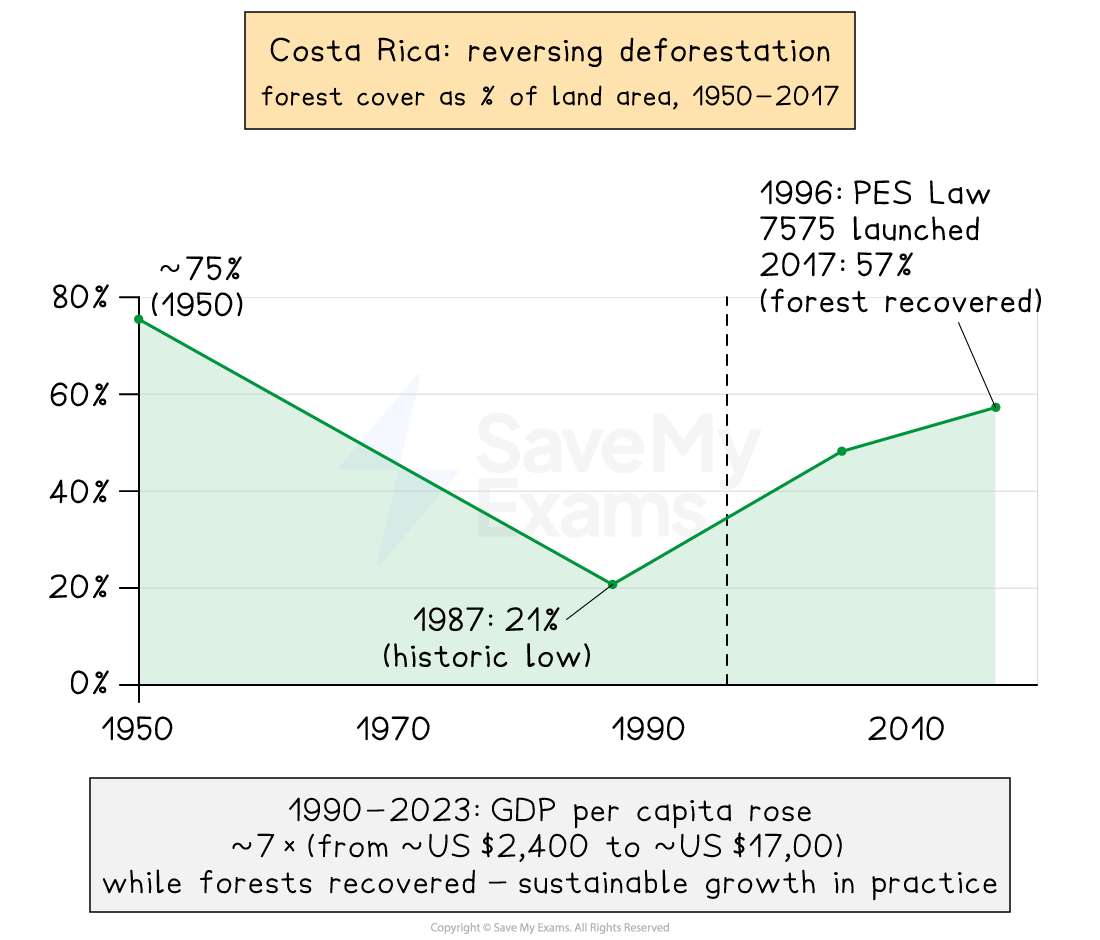
- Payment for Ecosystem Services (Forestry Law 1996) — landowners paid to conserve forests, funded by a fossil fuel tax
- Renewable electricity — over 90% from hydro, geothermal and wind
- Protected areas cover ~26% of national territory
Outcomes
- Forest cover rose from 21% (1987) to 57% (2017) — reversing decades of deforestation
- GDP per capita rose from ~US$2,400 (1990) to ~US$17,000 (2023)
- GDP growth averaged ~4% annually 1990-2020
Limitations
- Transport emissions are rising as car ownership grows
- Agriculture remains a deforestation pressure
- The model relies on favourable geography (hydro potential) and small population
Key lesson
Sustainable growth is achievable with a policy mix combining pricing (carbon tax), incentives (PES) and protection (reserves) — but requires decades of political commitment.
Exam Hint Always frame sustainable growth around intergenerational equity - meeting present needs without compromising future generations.
For 12-mark evaluation questions, the core trade-off is between short-run growth (often relying on cheap fossil fuels) and long-run sustainability (requiring costly clean alternatives).
For policy questions, distinguish market-based tools (taxes, permits) from command-and-control (regulation, bans) and evaluate which works best given the specific context.
Was this revision note helpful?
Build on this topic