Types of Market Structures (Cambridge International A-Level Economics)
Perfect competition
Market structures
- Market structures are the characteristics of the market in which a firm or industry operates
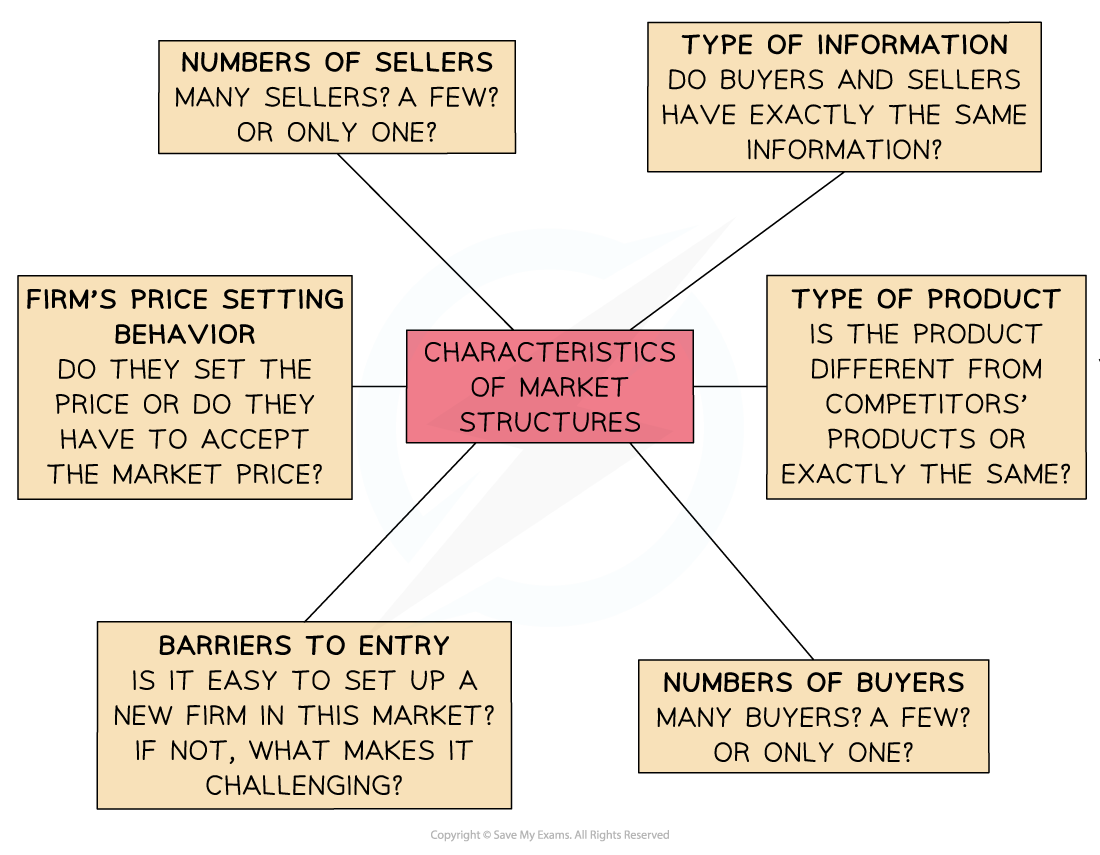
- Market structures can be separated into perfect competition and imperfect competition
Perfect competition
-
Perfect competition describes a market structure where no individual firm has control over price
- Typical examples include fruit sellers on a street market
Characteristics of perfectly competitive markets
-
Large number of buyers and sellers
- Each firm produces a very small share of total market output
- No firm can influence the market price
-
Homogeneous products
- Goods produced by different firms are identical
-
Free entry and exit
- Firms can easily enter or leave the market
-
Perfect information
- Consumers and firms have full knowledge of prices and products
-
Price takers
- Individual firms must accept the market-determined price
Imperfect competition
- Imperfect competition occurs when firms have some control over price and competition is not perfect
- Several imperfect market structures exist
1. Monopoly
-
A monopoly is a market structure where a single firm dominates the market
- A pure monopoly market structure is when there is a single supplier of a particular product and has the power to influence the market supply and price
- A natural monopoly is when the optimum number of firms in the market is one as the LRAC minimum efficient scale is unobtainable

Two firms domintae the smart phone market and each is a technical monopoly i the USA - Samsung and Apple
Characteristics of monopoly
-
Number of firms
- One dominant firm
-
Product differentiation
- The product has no close substitutes
-
Barriers to entry
- Very high barriers prevent new firms entering the market
-
Information
- Information may be imperfect
-
Because there is only one firm, the monopolist is a price maker.
2. Monopolistic competition
- Monopolistic competition is a market structure where many firms compete but sell differentiated products
- Typical examples include hair or nail salons, tattoo artists, pizza takeaways, etc.
Characteristics of monopolistic competition
-
Number of firms
- Many firms
-
Product differentiation
- Products are similar but not identical
-
Freedom of entry
- Firms can enter and exit the market relatively easily
-
Information
- Information is not perfect
-
Firms have some price-setting power due to product differentiation.
3. Oligopoly
-
An oligopoly is a market structure dominated by a small number of large firms
- Many industries are oligopolies, e.g., banking, retail, supermarkets, insurance, petrol

Budget supermarkets in the UK act in an oligopoly industry
Characteristics of oligopoly
-
Number of firms
- Few large firms dominate the market
-
Product differentiation
- Products may be differentiated or homogeneous
-
Barriers to entry
- High barriers to entry protect existing firms
-
Information
- Information is usually imperfect
-
Firms in an oligopoly are interdependent, meaning their decisions affect competitors
Comparison of market structures
| Characteristic | Perfect competition | Monopolistic competition | Oligopoly | Monopoly |
|---|---|---|---|---|
| Number of firms | Very many | Many | Few | One |
| Product differentiation | None (homogeneous) | Differentiated | May be differentiated or homogeneous | Unique product |
| Barriers to entry | None | Low | High | Very high |
| Availability of information | Perfect | Imperfect | Imperfect | Imperfect |
| Price control | Price takers | Some price control | Considerable market power | Price maker |
| Type of profit in long run | Normal profit | Normal profit | Supernormal possible | Supernormal possible |
| Shape of demand curve | Perfectly elastic | Downward sloping | Downward sloping | Downward sloping |
Was this revision note helpful?