Long-Run Production (Cambridge International A-Level Economics)
Long-run production
-
In the long run, firms can vary all factors of production, including labour, capital, land and enterprise
-
This allows firms to change the scale of production, for example by expanding factories, investing in new machinery or adopting new technologies
-
The long-run production function shows the relationship between inputs and output when all factors of production are variable
- Firms can adjust the quantity of every input
- This allows them to choose the most efficient scale of production
- The long run therefore focuses on how output changes when all inputs increase
Choosing the best factor combination
-
Firms aim to produce a given level of output using the most cost-effective combination of inputs The choice of inputs depends on:
- The price of each factor of production (e.g. wages, rent, cost of machinery)
- The productivity of each factor (how much output each input produces)
-
To compare inputs, firms consider the marginal product generated per unit of cost
-
Efficiency is achieved when the marginal product per unit of cost is equal across inputs
-
For example, a technology firm deciding whether to hire more engineers or invest in cloud infrastructure will compare:
- The additional output generated by each option
- The cost of each input
-
The firm will allocate resources toward the input that generates the highest output relative to its cost
Returns to scale
- Returns to scale describe how output changes when all inputs increase proportionally
- Three outcomes are possible
1. Increasing returns to scale
- Output increases more than proportionally compared to the increase in inputs
- This occurs because firms experience economies of scale
- Production becomes more efficient as the firm expands
2. Constant returns to scale
- Output increases in the same proportion as inputs
- Production efficiency remains unchanged
3. Decreasing returns to scale
- Output increases less than proportionally compared to the increase in inputs
- This occurs due to diseconomies of scale
- Production becomes less efficient as the firm becomes very large
Increasing and decreasing returns to scale
-
The diagram below illustrates how the long-run average cost (LRAC) curve reflects different returns to scale
- At low levels of output, firms experience economies of scale, so average costs fall
- At moderate levels of output, firms may experience constant returns to scale
- At very high levels of output, diseconomies of scale cause average costs to rise
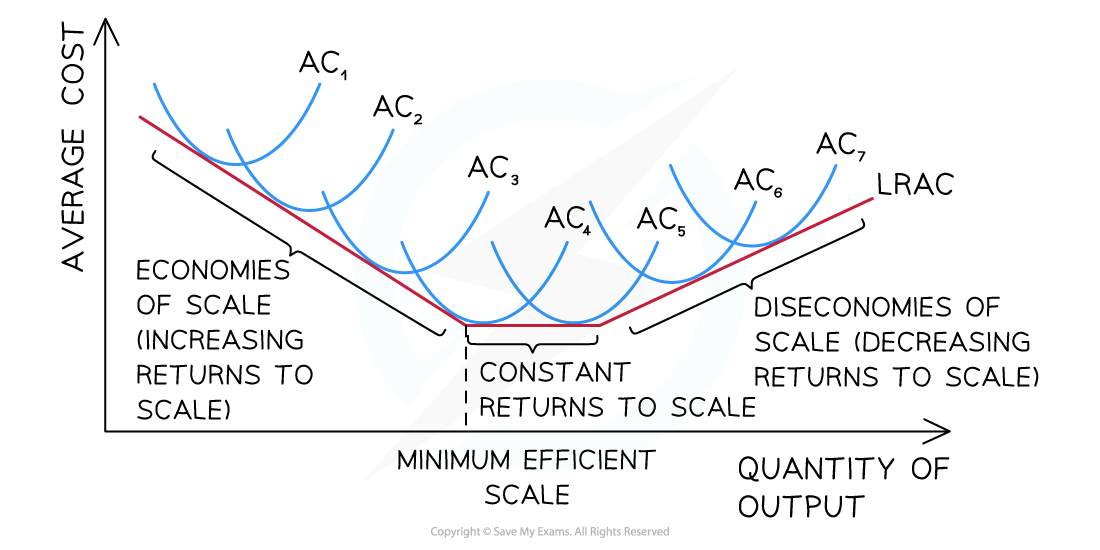
As a firm grows, economies of scale help it reach its minimum efficient scale, before diseconomies raise the cost/unit again
Diagram analysis
-
In the short-run, the firm operates on its short-run average cost curve
-
In the long-run, the firm will increase its capacity (e.g. build a new factory), and then operate for a period of time on a new short-run cost curve
-
Each subsequent short-run average cost (SRAC) curve represents growth and an increase in size
-
Output increases with each period of growth
-
Initially, firms experience increasing returns to scale as a result of the economies of scale
-
At a certain level of output, the firm will reach the minimum efficient scale where it experiences constant returns to scale
-
If it continues to grow beyond that level of output, the firm will experience decreasing returns to scale as diseconomies of scale occur
Was this revision note helpful?