Positive Externalities (Cambridge International A-Level Economics)
Positive externalities
-
Positive externalities/external benefits occur when the social benefits of an economic transaction are greater than the private benefits
- A private benefit for the consumer is what they actually gain from consuming a good/service
- An external benefit (positive externality) is the benefit not factored in to the economic activity (for example, someone who studies law enjoys private benefits but society benefits from having strong legal institutions)
-
Private benefit + external benefit = social benefits
Positive externalities of consumption
-
Positive externalities of consumption are created during the consumption of a good or service
- The externalities are caused by consumer demand and result in a positive external impact on a third party
-
As only the private costs are considered by consumers and not the external costs, individuals will under-consume these goods/services, causing a market failure
- If the external benefits were considered, the demand would increase, and the goods would be sold at a higher price
- An example of a positive externality of consumption is vaccinations. These protect those that receive them but also prevent the spread of disease to others around them. Other examples include education, healthcare and healthy eating
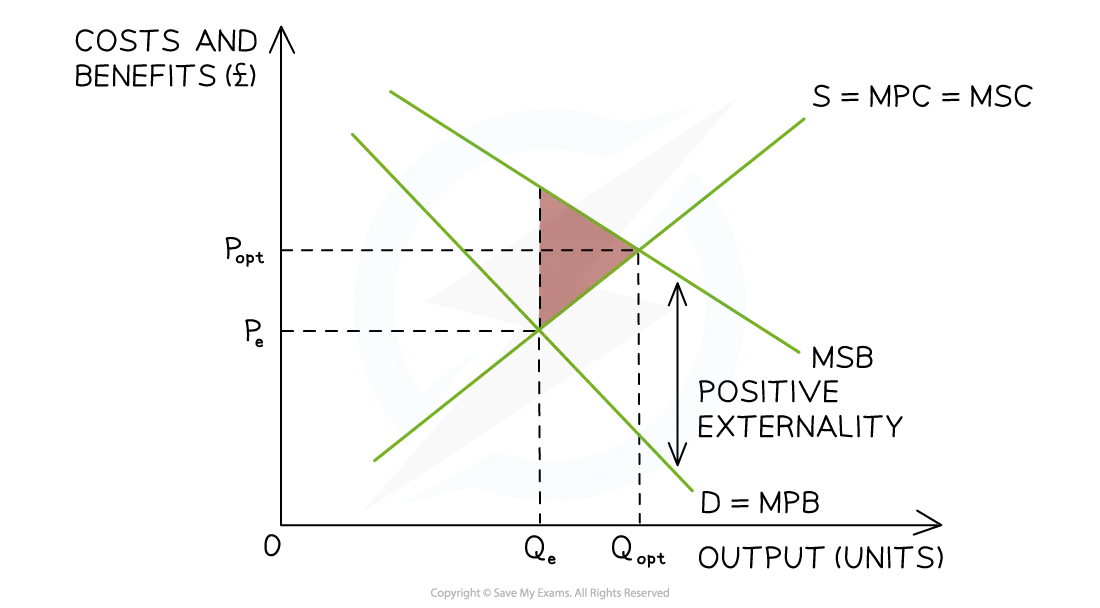
External benefits of consumption (positive externality) result in an under-consumption equal to Qopt - Qe
Diagram analysis
-
The MSC is assumed to equal the MPC, as the externality arises from consumption rather than production
-
The socially optimal level of output occurs where MSB = MSC, at Pₒₚₜ Qₒₚₜ, which is allocatively efficient
-
The free-market equilibrium occurs at PₑQₑ where MPB = MSC, representing the private optimum
-
Because MPB < MSB, consumers ignore the external benefits of consumption
- As a result, the market produces too little output, creating under-consumption equal to Qₒₚₜ − Qₑ
- This leads to a welfare loss (deadweight loss) shown by the pink triangle
- To achieve allocative efficiency, output must increase so that MSB = MSC
-
This creates a role for government intervention (e.g. subsidies or public provision) to reduce the welfare loss
Positive externalities of production
- Positive externalities of production occur when producing a good or service creates benefits for third parties who are not directly involved in the transaction
- These external benefits arise from the production process itself
- Producers only consider the private benefits of production, not the external benefits to society
- As a result, the market under-provides these goods and services, creating market failure
- For example, beekeeping increases pollination, which can improve crop yields for nearby farmers
Diagram: Positive externality of production
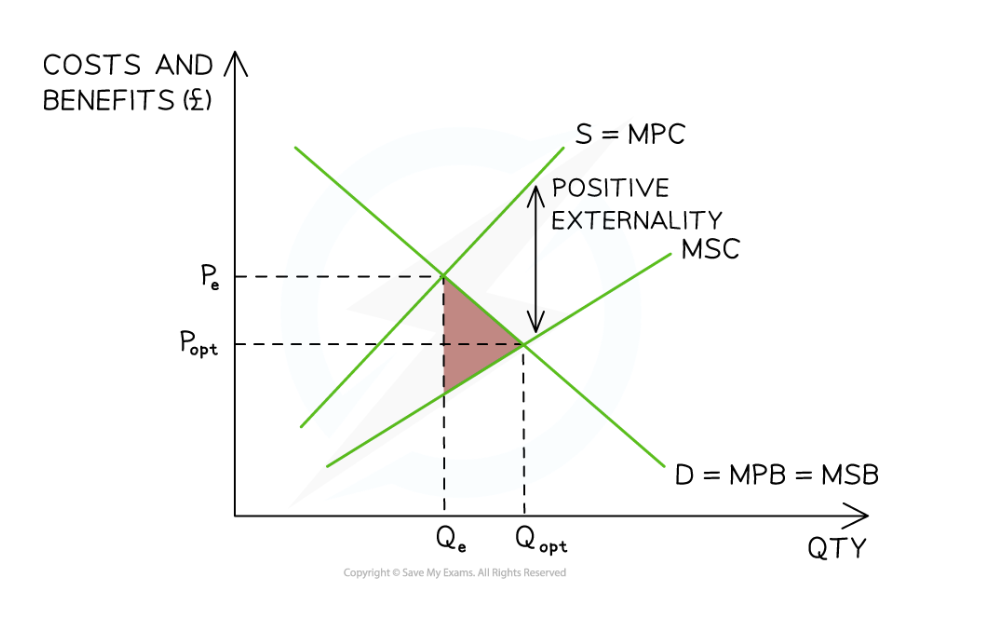
External benefits of production (positive externality) resulting in an under-production equal to Qopt - Qe
Diagram analysis
- The MSB is assumed to equal the MPB, as the externality arises from the production (supply) side of the market
- The free-market equilibrium occurs at PeQe, where MPC = MSB, representing the private optimum
- Producers do not consider the external benefits of production, so the MSC is lower than the MPC
- The socially optimal level of output occurs where MSC = MSB, at PoptQopt, which is allocatively efficient
- Because the market produces only Qe, there is under-provision equal to Qopt − Qe
- This results in a welfare loss (deadweight loss) shown by the pink triangle
- To achieve social efficiency, output must increase so that MSC = MSB
- This creates a role for government intervention, such as subsidies or regulation, to encourage greater production
Was this revision note helpful?
Build on this topic